

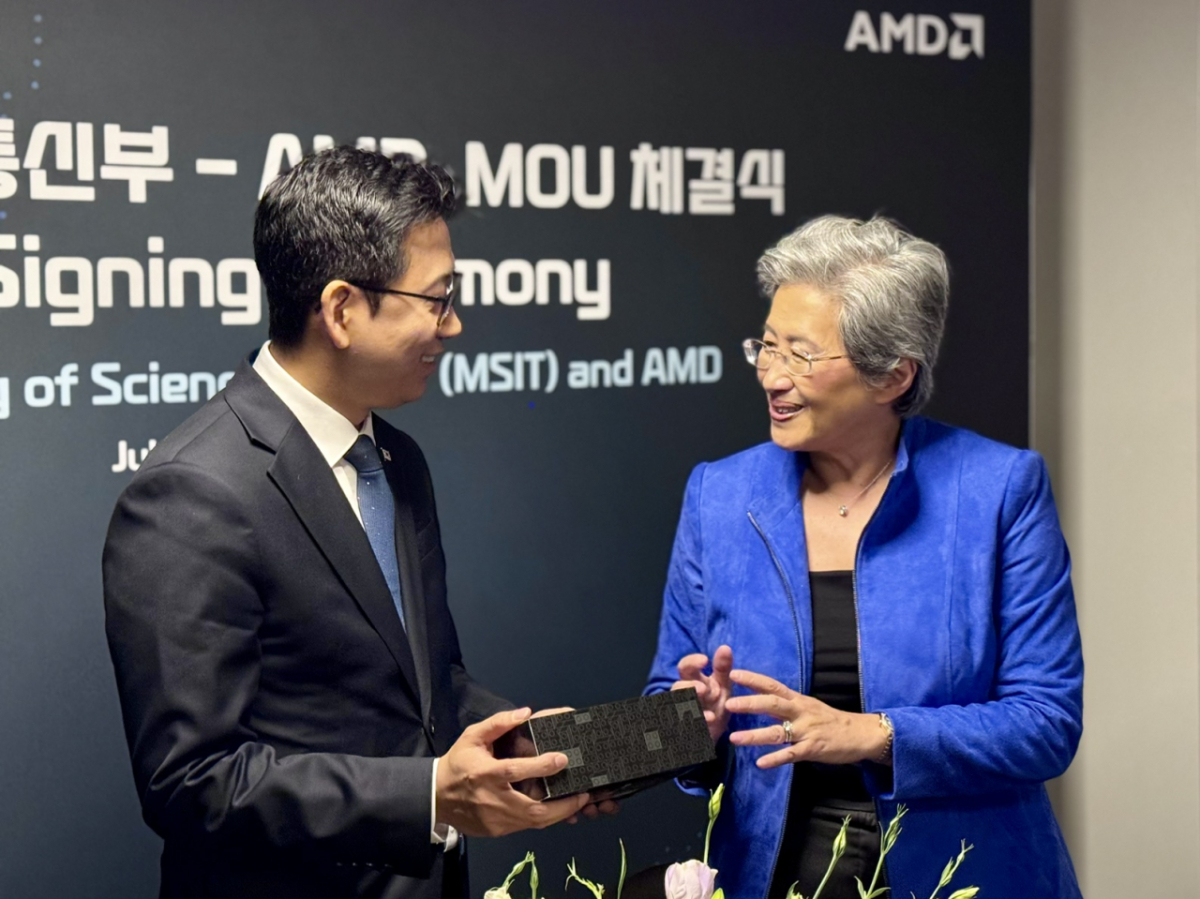
The government has launched follow-up discussions based on the MOU (Memorandum of Understanding) with AMD to expand South Korea's participation in the global ecosystem for domestic AI (artificial intelligence) semiconductors. It sought concrete cooperation directions with the domestic AI semiconductor industry to build an open AI computing environment that flexibly integrates CPUs (central processing units), GPUs (graphics processing units), NPUs (neural processing units), and other components.
On the 20th, the Ministry of Science and ICT held a symposium titled "Building an Open AI Computing Infrastructure Ecosystem" at Seoul Gwanghwamun HJ Business Center, attended by Deputy Prime Minister Bae Keong-hun and officials from the domestic AI semiconductor industry.
This symposium was a follow-up to the MOU signed between the Ministry of Science and ICT and AMD last month. Discussions covered industry response directions for expanding the market penetration of domestic NPUs and participating in the global ecosystem, government support measures, and public-private cooperation plans.
Furiosa AI presented global trends in open AI computing infrastructure and the domestic industry's response directions. AMD Korea shared its MOU implementation plan, while MangoBoost and More introduced their current status of AI computing optimization and software collaboration with AMD.
Participating companies diagnosed that as the generative AI market shifts from training to inference, AI computing competition is expanding from individual chips to system- and platform-level competition. They emphasized that an open structure flexibly combining CPUs, GPUs, NPUs, memory, networks, and software is more important than relying on specific semiconductors. This move is interpreted as an effort to reduce dependence on a single company in the market dominated by NVIDIA GPUs and their proprietary GPU computing software platform "CUDA" while broadening options.
Specifically, participants called for securing open computing structures using CXL (Compute Express Link), DPUs (data processing units), and other technologies, as well as strengthening investments in future AI semiconductor core technologies such as PIM (processing-in-memory) and neuromorphic computing. They also agreed on the need to disseminate open interfaces, international standards, and open-source-based technologies, along with establishing a national-level demonstration environment to verify them.
Participating companies urged the government to identify concrete cooperation tasks and pursue follow-up execution to ensure that the MOU with AMD leads to tangible results.
Meanwhile, on this day, AMD Korea delivered an AI computer "AMD Ryzen AI Halo," donated by AMD, to the Korea Advanced Institute of Science and Technology (KAIST) to commemorate the signing of the MOU. This was done after Lisa Su, Chairman of AMD, expressed her intention to donate, and Deputy Prime Minister Bae proposed that it be utilized by outstanding domestic talents.
Deputy Prime Minister Bae stated, "As the global AI market shifts from training to inference, the stage for AI competition is expanding beyond individual chip performance to open AI computing ecosystems that offer advantages in power and cost efficiency." He added, "This will create new opportunities for domestic AI semiconductor companies with strengths in inference efficiency." He further announced, "We will strengthen full-stack demonstration support to quickly secure successful cases where domestic NPUs are utilized in actual data centers and AI service sites."

 in TECH
