

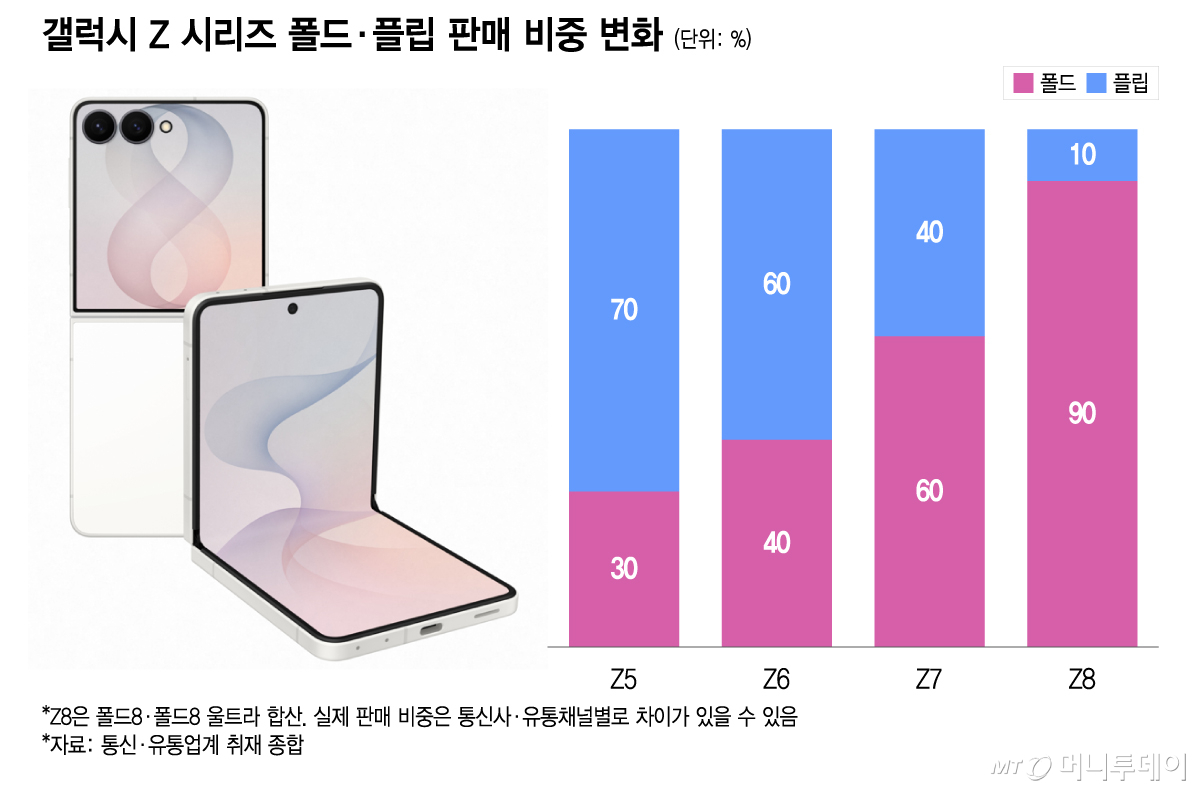
Consumer preference is shifting toward the Fold8 within Samsung Electronics' foldable phone 'Galaxy Z8' series, while the clamshell-type Flip8 is struggling. Some mobile phone retailers report that the Flip8 accounts for less than 10% of total Z8 series sales. The telecommunications industry also recognizes the Flip8 as the weakest-selling model in the series, reigniting earlier 'discontinuation rumors.'
According to the telecommunications and retail sectors on the 25th, consumer preference has concentrated on the Fold8 since the launch of the Galaxy Z8 series. While the Fold8 Ultra follows closely behind, the Flip8 is said to have lost its presence at sales sites. A mobile phone retailer official stated, "During pre-orders, for every 100 units of the Z8 series sold, only three or four were Flip8s," adding, "After the official launch, even fewer customers are seeking the Flip8 compared to that time." Multiple telecommunications officials also confirmed that the Flip8 is the weakest-selling among the three Z8 series models in actual sales.
The decline of the Flip8 was already evident during pre-orders. LG Uplus's pre-order results showed the Fold8 accounted for 67.4%, with the Fold8 Ultra and Flip8 at 17.1% and 15.5%, respectively. During the Z5 series, the sales ratio between Flip and Fold was approximately 7-to-3, with the Flip dominating. Even in the Z6, the Flip held a 6-to-4 advantage, but in the Z7, it was reversed for the first time at 4-to-6 in favor of the Fold. For this year's Z8 series, the sales ratio between the Fold product line and the Flip has widened to approximately 9-to-1 at retail outlets.
Amid these developments, rumors have emerged that the Flip8 could be the final model, particularly within the overseas IT industry. Although Samsung Electronics has not officially confirmed any discontinuation plans, the continued poor sales performance has raised concerns about potential lineup restructuring in the future.
Deteriorating profitability in the smartphone business is another variable. According to Samsung Electronics, the MX (Mobile Experience) and Network business unit recorded revenue of 33.2 trillion won and an operating loss of 700 billion won in the second quarter. This marks the first quarterly deficit for the MX business unit since its inception.
Cost burdens have also increased. In Samsung Electronics' semiannual report, the purchase amount of mobile memory for the DX division reached 5.426 trillion won, the largest among individual raw materials. Mobile memory prices surged by approximately 211% compared to last year's annual average. This creates an environment where profitability for underperforming products must be evaluated more strictly than before.
However, it is not easy to simply dismiss the Flip based solely on sales figures. The Flip8 is equipped with Samsung Electronics' proprietary AP (Application Processor), 'Exynos 2600.' Folding the device reduces the number of premium product lines that utilize Exynos processors.
If the poor performance of the Flip8 continues, Samsung Electronics' dilemma is expected to deepen. While maintaining an underperforming lineup in a deteriorating profitability environment is burdensome, the company must also consider its proprietary AP ecosystem. Whether Samsung Electronics will maintain the Flip, which once led the mass adoption of foldable phones, or refocus its foldable strategy on the Fold line remains a key point of attention.

 in TECH
