

#SF survival game 'The Alters' developer 11 Bit Studios did not disclose on its Steam page that it had utilized generative AI for text (scripts) and translation last year. The company explained that this was an oversight, such as forgetting to remove temporary elements applied to the game, but ultimately posted an apology on its official SNS. 11 Bit Studios clarified, "We are not trying to downplay the situation, but the impact on the actual gaming experience was very limited."
There is a field where rapidly advancing AI surprisingly struggles: 'game development.' This is because users who view games as 'works' crafted with artisanal spirit show resentment toward game production that utilizes AI. Conversely, developers and outsourcing firms are lured by the sweet nectar of 'cost and time savings.' The problem lies in publishers being forced to bear new risks in the middle.
The global PC game distribution platform 'Steam' is mandating that publishers (suppliers) or developers disclose whether sound, images, or scripts generated by AI are included in games provided to users. This is to make the fact of 'AI usage' public to users. While AI can be used in internal idea meetings and discarded drafts, it must be excluded from the final product.
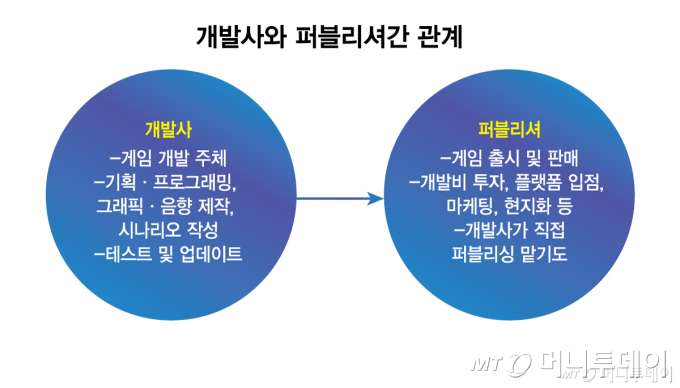
Games are sold through a model where developers produce them and publishers handle distribution, marketing, and operations. When a developer handles publishing directly, the developer and publisher are the same entity; however, for small and medium-sized developers, large game companies often handle publishing. The problem is that publishers find it difficult to fully understand the production processes of developers or outsourcing firms. Even if AI is used during production, it is hard to verify unless the developer discloses it.
Consequently, publishers have taken on a new obligation: 'verifying whether AI was used.' Game AI companies like NC AI explain that they are safe from copyright issues because their AI is developed by learning their own images, sounds, and scripts. They argue that since this is based on data accumulated within game companies for decades, there is no need to worry. However, the reason platforms impose such obligations is not only 'copyright protection' but also 'providing clear information.' This ensures users' 'right to know' whether AI was utilized in game production. Many users harbor resentment toward AI-generated games and use it as a criterion for deciding whether to purchase.
If publishers fail to accurately determine whether AI was used, they may become entangled in future disputes. Replacing music or images, re-inspection, etc., could cause delays in the launch schedule or incur additional costs. In the worst-case scenario, registered games might have to be delisted. This means paying a much larger cost for launch delays than the few won saved on production unit prices.
Industry experts advised that companies should clearly verify AI usage by checking a checklist including: △tools and stages used, △rights of input materials, △human creative portions, △retention of generation records, △subject responsible for re-production in case of issues, and △liability limits.
An industry official stated, "AI is used only for drafting designs, images, or sound within games. In genres that deeply immerse users, such as subcultures, many users feel betrayed if it is revealed that the content was produced by AI." The official added, "From a publisher's perspective, it is a reality that it is difficult to verify all AI usage details of developers and outsourcing firms."

 in TECH
