

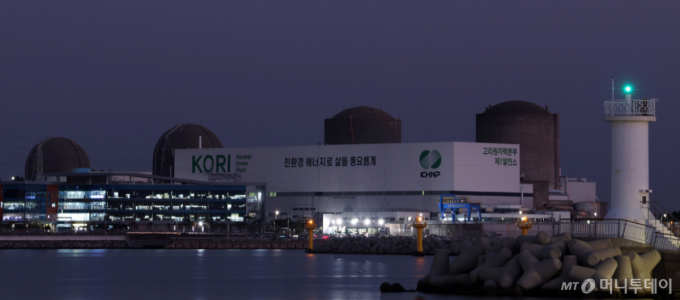
The Nuclear Safety and Security Commission will deliberate on the approval of accident management plans and operating change permits for the halted Gori Units 3 and 4 in Gijang County, Busan, and Hanbit Units 1 and 2 in Yeonggwang, South Jeolla Province, at its 2026-16th session on the 15th.
This is the third time that accident management plans for Gori Units 3 and 4, and Hanbit Units 1 and 2 have been placed on the agenda of a commission meeting. The plans were postponed at the first meeting where they were submitted on the 11th of last month, and were again deferred without a conclusion at the 15th session held on the 30th of last month.
An accident management plan is a document containing response strategies, related equipment, and implementation systems to minimize damage in the event of a major accident at a nuclear power plant. It is also an essential gateway for the continued operation of aging nuclear plants. The accident management plan serves as the criterion for determining whether a nuclear plant that has applied for continued operation can be operated safely even after exceeding its design life. Gori Unit 2, which was granted permission for continued operation in November last year, had first received approval for its accident management plan in October of that same year.
Korea Hydro & Nuclear Power submitted the accident management plans for Gori Units 3 and 4, and Hanbit Units 1 and 2 to the Nuclear Safety and Security Commission in 2019. The Korea Institute of Nuclear Safety (KINS) began its main review in 2020, completed the review last July, and is currently in a state where it has requested approval from the Nuclear Safety and Security Commission.
Given that no conclusion was reached in the previous two meetings, attention is focused on this third session. Gori Units 3 and 4 halted operations due to the expiration of their design lives in September 2024 and August 2025, respectively, without completing the continued operation review. Hanbit Unit 1 ceased power generation in December last year, while Hanbit Unit 2 stopped production last month.
Excluding Gori Units 3 and 4 and Hanbit Units 1 and 2, five domestic nuclear plants are currently 'awaiting review.' Hanul Units 1 and 2, and Wolsong Units 2, 3, and 4 applied for operating change permits for continued operation in 2023 and 2024, respectively. The total generation capacity of these nine nuclear units reaches approximately 7.8 gigawatts (GW). This is about one-third of the total domestic nuclear power generation capacity of approximately 26.1 GW.
Although four nuclear plants are currently 'on hiatus,' the country's maximum electricity demand is projected to increase by another 70% by 2040, driven by factors such as the 'Three Major Mega Projects.' Experts believe that electricity demand will surge even further when additional demands from AI data centers and the Honam semiconductor industrial complex are added.
Pointers have also continued in the National Assembly. At a state audit targeting the Nuclear Safety and Security Commission held on the 13th, Democratic Party of Korea lawmaker Hwang Jung-a stated, "The opportunity cost of electricity sales due to the shutdown of Gori Units 3 and 4 and Hanbit Units 1 and 2 is 2 trillion won, and this opportunity cost is increasing by 5.1 billion won per day," adding, "The continued operation review must be conducted more quickly."
The Nuclear Safety and Security Commission maintains its position that it will ensure the continued operation review does not suffer unnecessary delays.
On a separate note, the quorum for resolutions by the Nuclear Safety and Security Commission requires a majority attendance of the total seven members and a majority vote of the total members. At the previous second meeting, six commissioners attended, excluding Nuclear Safety and Security Commission Chairman Choi Won-ho and the Secretary-General of the Nuclear Safety and Security Commission Office.

 in TECH
