

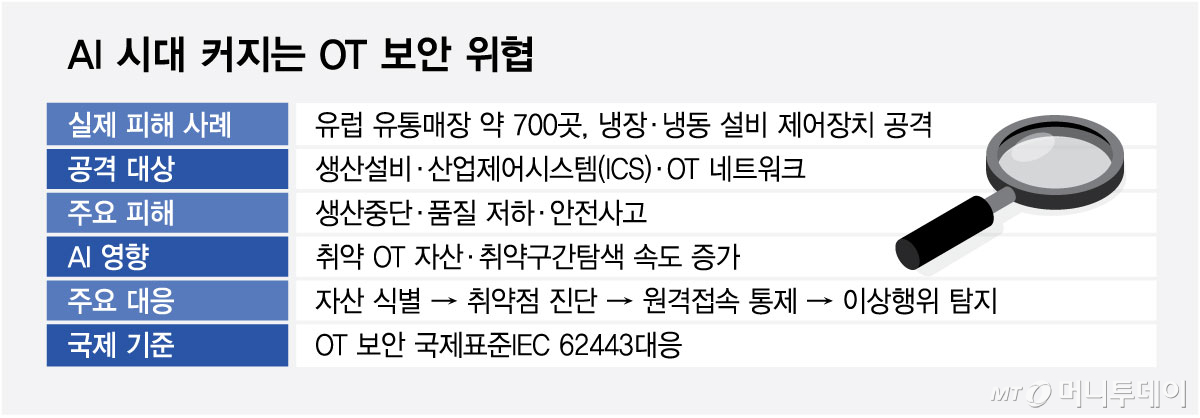
Recently, approximately 700 retail stores in Europe were simultaneously affected by a cyberattack. The hackers targeted not customer information or payment systems, but the control devices of outdated refrigeration and freezing equipment that had not been patched. This case demonstrated that cyberattacks can impact actual equipment operations beyond information systems.
The domain controlling machinery and equipment in factories and industrial sites is known as OT (Operational Technology). When OT is attacked, the damage differs from typical IT hacking. It does not end with data breaches or computer system failures but can lead to production stoppages, quality degradation, and safety accidents.
The risk grows as smart factories spread. This is because production equipment, Industrial Control Systems (ICS), and various operational systems are connected to networks, increasing the points of contact with external entities. In industries such as semiconductors, batteries, and automobiles, where the production processes of multiple companies are linked through supply chains, a shutdown at one factory could potentially spread to cause production disruptions at other companies.
The proliferation of AI is another variable. Companies use AI for productivity improvement and equipment management. However, attackers also utilize AI. They can identify unmanaged OT assets or vulnerable segments faster than before. The barrier to entry for attacks has actually lowered.
Moon Byung-gi, Head of the OT Business Group at SK Shielders, stated, "With the advancement of AI technology, the barrier to entry for cyberattacks is lowering and the speed of vulnerability scanning is increasing, further expanding OT security risks in manufacturing sites."
Equipment and processes vary from one manufacturing site to another. The equipment and operational methods used in semiconductor factories, automobile factories, and battery factories differ. In some cases, older equipment and the latest systems operate together. It is difficult to apply general IT security methods as-is.
OT security begins with identifying what equipment is connected within a factory. SK Shielders identifies assets of production equipment, ICS, and OT networks to analyze connection structures and potential risk factors. Subsequently, it builds systems for vulnerability diagnosis, remote access control, OT network protection, and abnormal behavior detection. Considering the characteristics of manufacturing processes, it also analyzes how much production could be halted in the event of an incident and what impact it would have on quality and safety.
OT security is also linked to supply chain and export competitiveness issues. Domestic companies are in a situation where they must not only establish security systems but also objectively prove them. This is because global customers and regulatory institutional investors require a certain level of security at partner companies' production facilities.
SK Shielders provides consulting that diagnoses a company's security level based on IEC 62443, the international standard for OT security in manufacturing enterprises, and analyzes gaps with international standards and regulatory requirements. It is also strengthening integrated security services that manage IT and OT together, in line with the spread of AI and smart factories.
As AI moves beyond offices into production sites, the scope of AI infrastructure inevitably expands. It is no longer enough to merely build GPUs, data centers, and networks; a security system capable of safely operating production equipment connected to AI is also required.
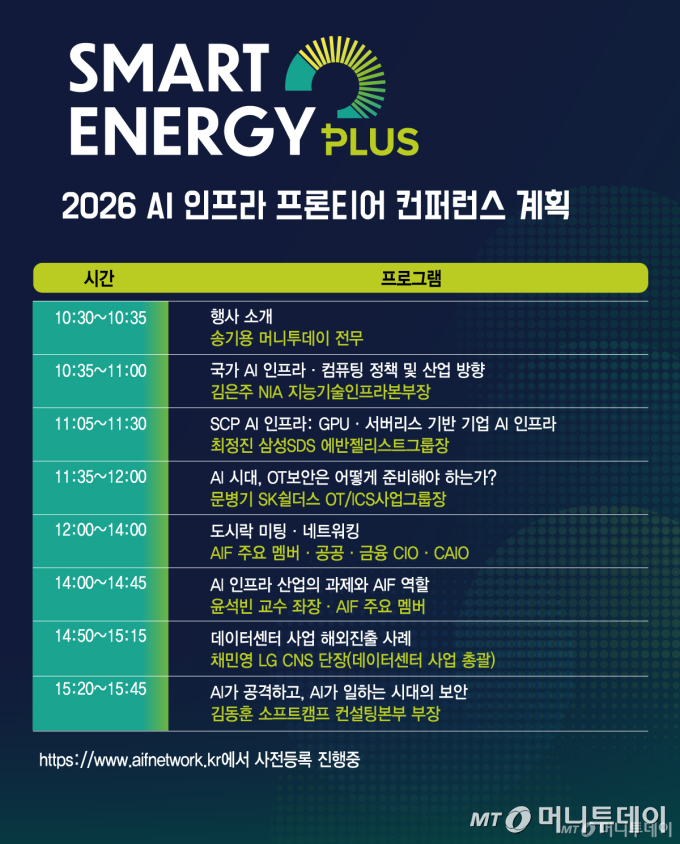
Group Head Moon is scheduled to present on the topic "In the AI era, how should OT security be prepared? - From business AI already in use to AI adoption in production sites" at the "AI Infrastructure Frontier Conference" to be held at Seoul COEX on the 29th.

 in TECH

