

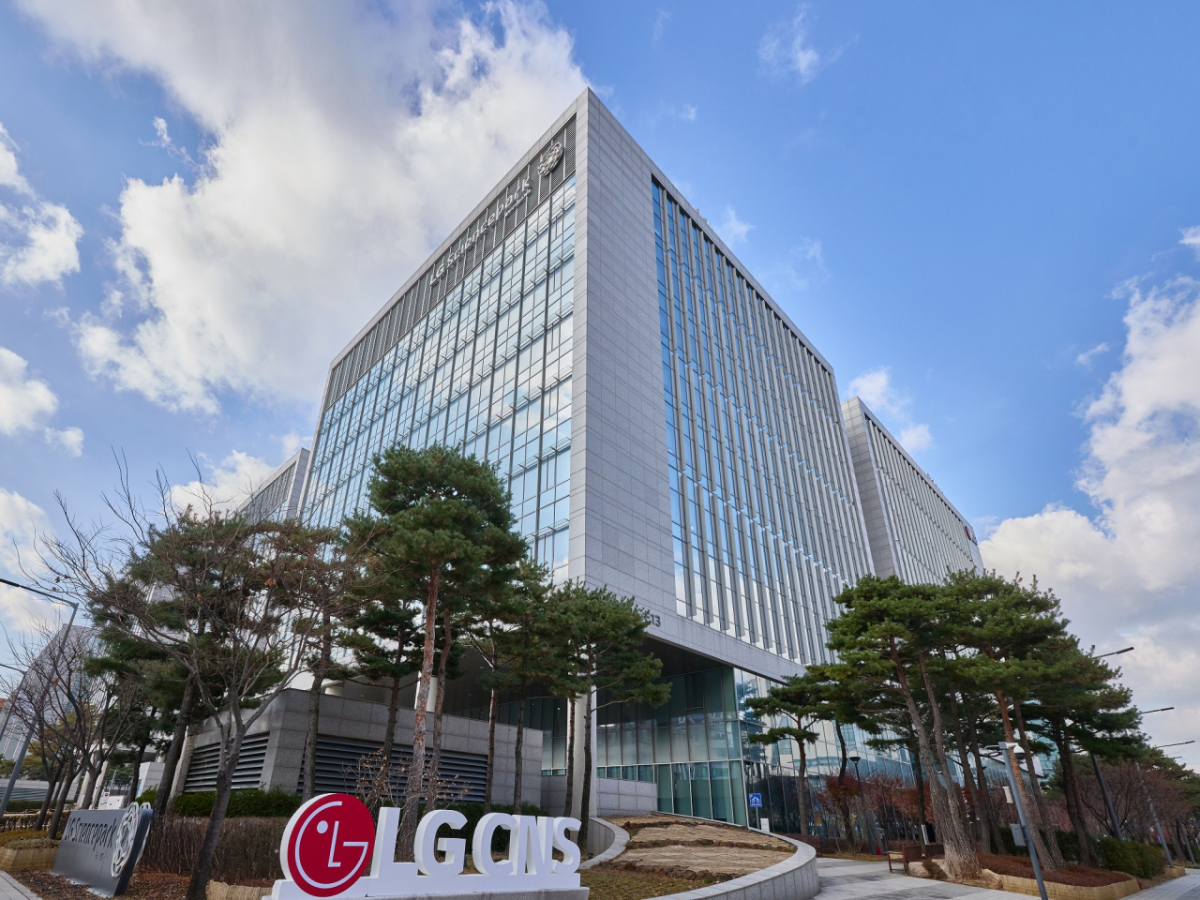
LG CNS said Friday that it achieved revenue of 1,664.3 billion won and an operating profit of 138.2 billion won in the third quarter of this year. Revenue increased by 9.3% and operating profit rose by 15% compared to the same period last year.
Steady growth in core AI and cloud businesses, along with expanded revenue from financial next-generation projects, drove the third-quarter results.
Revenue in the AI (artificial intelligence) and cloud sector reached 961.5 billion won in the third quarter, a 9.3% increase from the same period last year.
Results continued in the AI infrastructure business. In addition to the construction and operation of the Samseong AI data center, colocation revenue from AI data centers operated under LG CNS’s contract increased.
Recently, at a global data center event held in Singapore, LG CNS showcased its pre-fabricated modular data center “AI HAUS,” GPUaaS based on NVIDIA’s “Vera Rubin,” and other offerings, highlighting its AI factory full-stack service capabilities and solidifying its business foundation spanning infrastructure, cloud, and data.
Revenue in the digital business services sector reached 408.2 billion won in the third quarter, a 21.3% increase from the same period last year, as revenue recognition from financial next-generation projects accelerated.
This growth was driven by the entry into full-scale development phases of next-generation system construction projects previously secured with NH NongHyup Bank, Mirae Asset Life Insurance, and KB Kookmin Bank.
Revenue in the smart engineering sector totaled 294.5 billion won in the third quarter, a slight decrease from the same period last year due to the slowdown in manufacturing industry conditions. Despite this environment, LG CNS achieved results by expanding external projects and broadening its customer base.
The smart factory business secured customer references across diverse industries such as defense, pharmaceuticals, electronics, and batteries, while the smart logistics business expanded logistics automation projects targeting domestic companies that have entered overseas markets.
In line with surging AI demand, LG CNS is strengthening its AI business competitiveness by focusing on two main pillars: agentic AI services that autonomously perform overall business tasks, and AI infrastructure that stably supports them.
Based on this strategy and business capabilities, the company was recently introduced as a key player in core areas of the AI era, such as “digital workplace services” and “data center management software,” in IDC’s MarketScape Worldwide Report by the global IT market research firm IDC.
LG CNS is also expanding AI investments for future growth. To secure GPUs needed for building and operating AI factories, LG CNS acquired tangible assets worth approximately 380 billion won. The company has also actively begun joint investments in enterprise software and AI businesses with leading global investment firm General Atlantic. It plans to further diversify its AI business portfolio based on these efforts.
The Robotics Transformation (RX) business is conducting proof-of-concept based on the robot learning and operation platform PhysicalWorks, centered on logistics and manufacturing sites, and converting this into full-scale projects to expand orders.
Discussions are also underway with internal and external customers to commercialize services in areas such as patrol, hospitality, and safety. Additionally, LG CNS plans to continue strengthening partnerships with global big tech companies including NVIDIA, MS, and AWS, as well as physical AI firms and robot manufacturers.

 in TECH
