

The National Artificial Intelligence Strategy Committee (hereinafter referred to as the Committee) will unify the legislative direction on artificial intelligence (AI) across government ministries, activate task forces (TFs) for seven key initiatives to strengthen national AI competitiveness, and expand a government-wide data sharing system so that AI can utilize public data scattered among institutional investors. This is an effort to strengthen government-wide cooperation in implementing AI-related legislation and policies, as well as in data utilization.
The Committee held its third plenary meeting at Seoul Square on the 6th, deliberating and approving three agenda items: △ The Framework for Artificial Intelligence Legislation in the Republic of Korea, △ The Plan for Forming and Operating Committee TFs to Advance National AI Key Initiatives, and △ The Status of Building a Government-Wide Data Pipeline and Utilization Strategies.
The meeting was chaired by Ha Jeong-woo, Senior Vice Chairman, with approximately 60 government and private sector committee members and heads of related agencies attending, including Lee Hyoung-il, Deputy Prime Minister for Economy and Minister of the Ministry of Economy and Finance, and Bae Kyung-hoon, Deputy Prime Minister of the Ministry of Science and ICT.
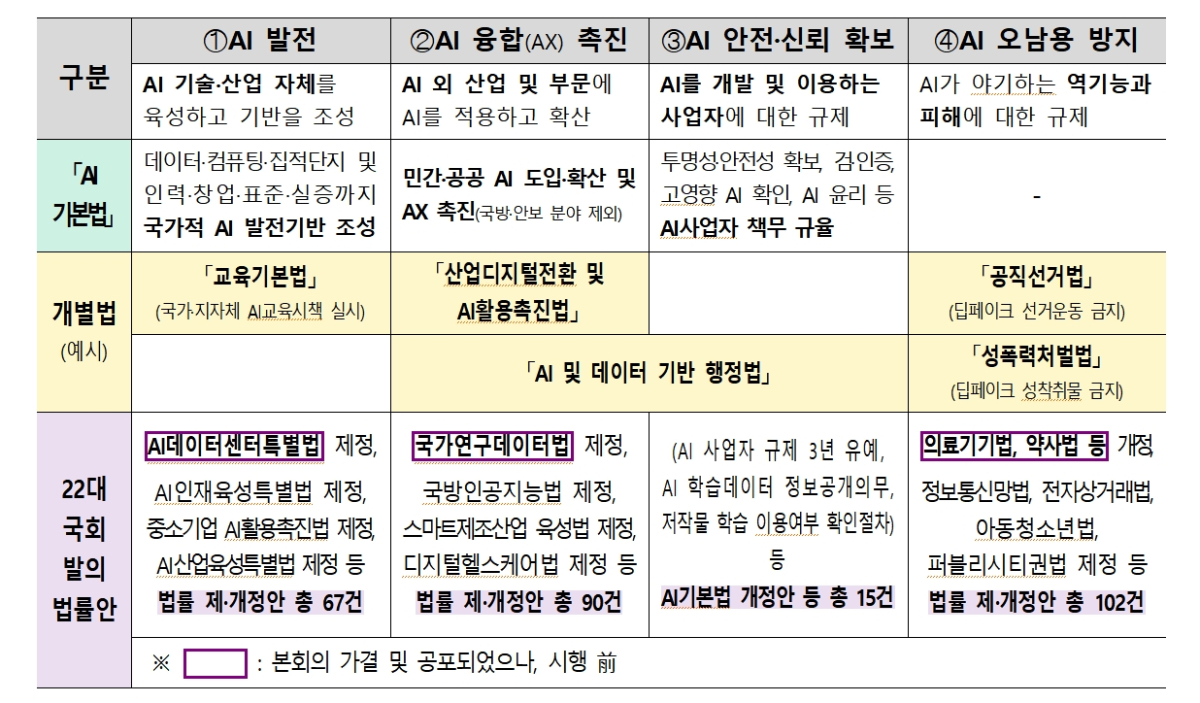
The first agenda item, the AI legislative framework, aims to organize the system of rapidly increasing AI-related bills. Since the opening of the 22nd National Assembly until October 19, a total of 477 bills proposing new laws or amendments mentioning "artificial intelligence" have been recorded. This is approximately 4.7 times higher on a monthly average compared to the 170th bills proposed over the four years of the 21st National Assembly. As individual bills increase, the potential for conflicts between laws and overlapping regulations has also grown.
The Committee categorized AI-related laws into four areas—AI development, promotion of AI convergence (AX), ensuring AI safety and trust, and preventing AI misuse—and presented four legislative directions. It will prioritize reviewing amendments to the AI Basic Act or existing individual laws over enacting new independent laws, and will pursue separate legislation for defense and national security fields, which fall outside the scope of application of the AI Basic Act. To enhance predictability for businesses, the policy is to clarify standards rather than strengthen regulations, while responding swiftly if risks to life, physical safety, or fundamental rights are identified.
The plan to form seven TFs to advance national AI key initiatives, the second agenda item, was also finalized. Three TFs—△ Youth Leap, △ Response to National Superintelligence, and △ Strategic Global AI Cooperation—will be operated directly under the Senior Vice Chairman. Four TFs—△ Strengthening National Cyber Resilience, △ Cultural and Content AI Innovation, △ Building a Data Flywheel, and △ Building a K-AI Full-Stack Ecosystem—will be pursued in coordination with subcommittees. The Response to National Superintelligence TF will identify 10 tasks to reinforce the AI action plan for preparing for the superintelligence era by June 2027. The Cyber Resilience Strengthening TF plans to prepare scenarios for complex failures and recovery of AI data centers by March 2027.
The third agenda item concerns expanding the sharing and utilization of public data among institutional investors. The government-wide data pipeline, which connects data from government ministries, local governments, and public institutions, began pilot operation in September this year and is currently used by 848 institutional investors. As of October, there are 54,768 shared data items and 2.442269 million metadata items. The government plans to utilize AI-based search functions to find necessary data and build composite datasets combining welfare, employment, regional decline, and disaster safety data that multiple institutional investors repeatedly require, thereby supporting joint utilization among institutional investors.
Deputy Prime Minister Bae stated, "In a situation where changes in the global market environment are expected following the U.S. midterm elections, we will link and execute each ministry's AI policy capabilities and large-scale public-private investment projects centered on the Committee to create results, and respond appropriately to changes in the external policy environment."
Senior Vice Chairman Ha Jeong-woo said, "The challenge is to produce results that citizens and businesses can feel, going beyond the plans established by the Committee," adding, "Through the key initiative TFs, we will demonstrate execution as a team of government and private sector, showing tangible results."

 in TECH
