

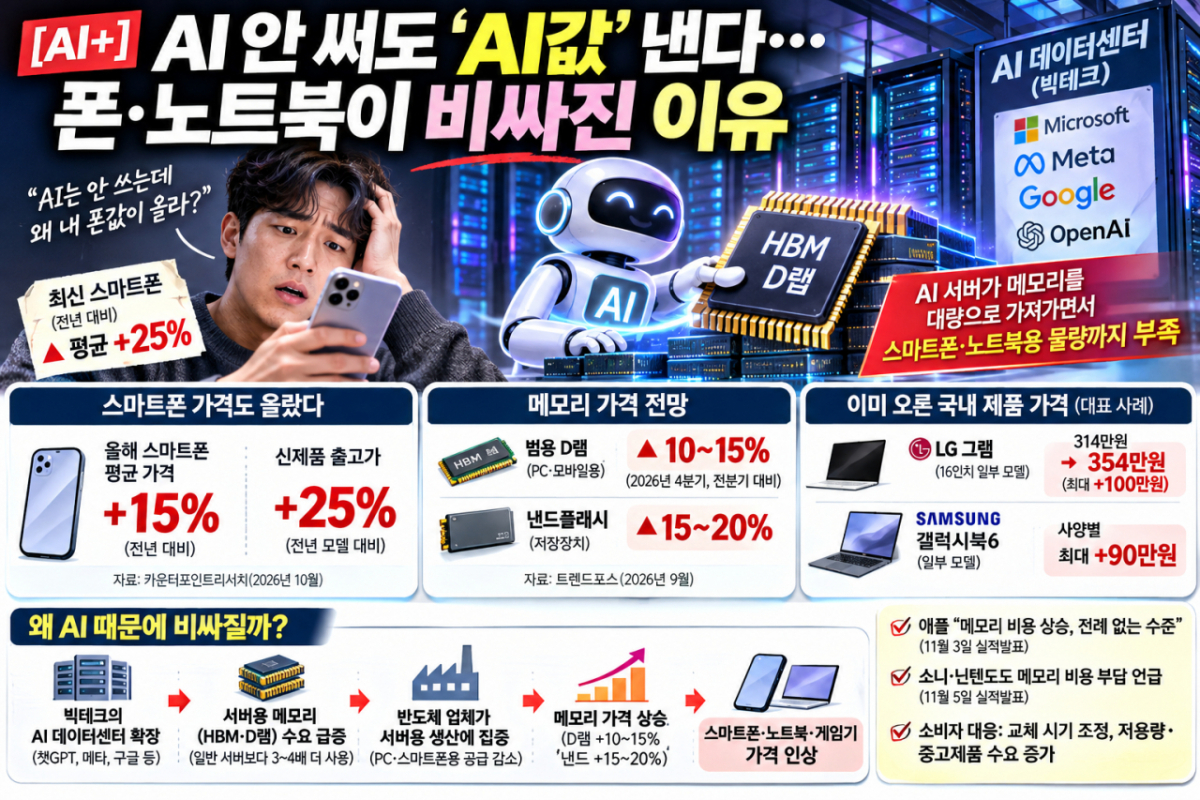
"Why has it gone up so much?" Recently, the prices of new smartphones and laptops have risen significantly. The influence of AI lies behind this.
Even people who have never used ChatGPT or Claude pay "AI costs" in the same way. This is because global big tech companies are competitively expanding their AI data centers and procuring large quantities of memory semiconductors. When supply is limited but demand increases sharply, prices rise. The ripple effects are spreading to smartphone and laptop prices as well.
According to Counterpoint Research, a global market research firm, the average price of smartphones worldwide rose by 15% this year. Newly released products were on average 25% more expensive than models from one year ago. More than four out of the 10th smartphones surveyed raised their prices.
This is already being felt domestically as well. LG Electronics raised the price of its flagship laptop, the Gram, by up to 1 million won in April last month. One model of the 16th-inch Gram, which cost 3.14 million won, jumped to the 3.54 million won range. Samsung Electronics also raised the price of the Galaxy Book6 by up to 900,000 won depending on specifications. The prices of some tablets and smartphones have also increased.
Why do laptop prices rise because of AI? AI servers require far more memory than general servers. This is to process calculations quickly. From the perspective of semiconductor companies, it is better to produce more high-profitability HBM and server DRAM. However, factories cannot be expanded suddenly. If more server-oriented products are made, the production capacity for memory going into PCs and smartphones decreases accordingly.
TrendForce, a Taiwan-based market research firm, forecast that contract prices for general-purpose DRAM in the fourth quarter of this year will rise by 10% to 15% from the previous quarter, while NAND flash used for storage will increase by 15% to 20%, respectively. It analyzed that as Samsung Electronics and SK hynix produce more memory for AI servers, the supply of DRAM for PCs is becoming insufficient.
The price burden is passed on to manufacturers. Apple unusually mentioned rising memory prices directly in its earnings announcement on the 3rd. John Ternus, Apple's Chief Executive Officer, described the rise in memory costs as "unprecedented levels." It was explained that demand from AI data centers is driving up memory prices, putting pressure on Apple's profitability.
Game consoles are no exception. Sony stated in its earnings announcement on the 5th that it had secured the necessary amount of memory for PlayStation 5 sales, but cited rising memory prices as a cost burden factor. Nintendo is also in the process of securing memory for the Switch 2.
When memory becomes expensive, manufacturers have few options. They must either raise prices, lower specifications such as storage capacity and cameras, or reduce profits.
In fact, Counterpoint analyzed that some smartphone companies are responding by reducing storage capacity and lowering camera specifications. Consumers have also begun to postpone replacing their mobile phones or seek low-capacity and used products.
The bill for the AI boom is not staying only within data centers. People who use a lot of AI pay usage fees. Those who do not use AI are sharing the costs of the AI era by bearing the prices of more expensive mobile phones and laptops.

 in TECH
