

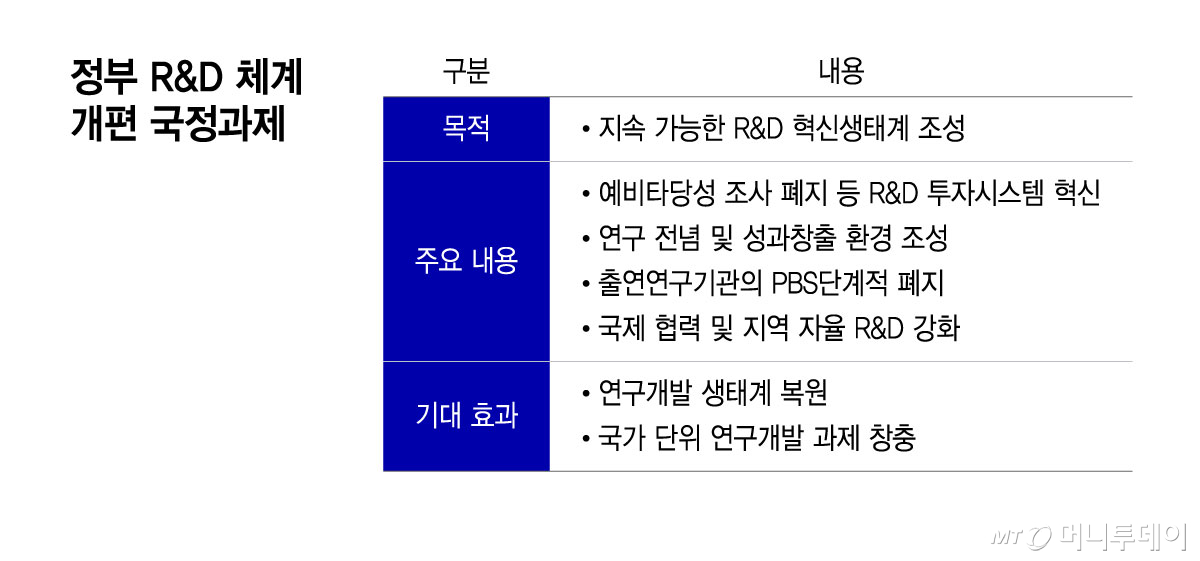
The National Science and Technology Advisory Council, directly under the President, has begun a study on reforming the national R&D (research and development) investment system. This is part of the government's national task to "create a sustainable R&D ecosystem." As the government moves toward the phased abolition of the Project-Based System (PBS) and the elimination of pre-feasibility studies for R&D, it is expected that future criteria for carrying out national-level R&D projects will be reviewed.
According to government sources on the 9th, the Advisory Council recently commissioned a study titled "Improvement Plans for National R&D Investment" through the Ministry of Science and ICT. This is one of the steps in the government's effort to innovate the R&D investment system, which it has designated as a national task.
The Lee Jae-myung administration included systemic innovation to realize the goal of becoming a top-five science and technology power among its 123 national tasks announced shortly after taking office. The plan was to improve the R&D sector's system, which had been controversial due to significant budget cuts under the Yoon Suk-yeol administration, in order to drive substantive expansion of the R&D budget.
To this end, pre-feasibility studies for large-scale national-level R&D projects exceeding 50 billion won were abolished in January of this year. The PBS, through which government-funded research institutes (GFRIs) have covered research costs and personnel expenses with commissioned projects beyond their grant funding, is to be phased out by 2030. The plan is to provide researchers with stable personnel costs and encourage participation in essential R&D even if profitability is low, thereby allocating the R&D budget centered on national and institutional investor missions.
The Advisory Council explained the background of this study, stating, "To enhance the effectiveness of national R&D investment, it is necessary to expand the scale of investment while also reviewing and institutionally supplementing the entire investment decision-making process, including planning, coordination, and budget allocation for the national R&D budget."
The study will proceed until September 2027. The plan is to analyze the current state and key issues of the national R&D investment system, review domestic and international institutional and policy cases, and then develop improvement directions and policy alternatives to fulfill the task of building a sustainable R&D ecosystem. An official from the Advisory Council explained, "As we are pushing for the reform of the R&D investment system as a national task, this study is intended to identify the issues that need to be considered in that process," adding, "We will review alternatives and other measures centered on the issues derived from the study."
Meanwhile, the Ministry of Science and ICT plans to prepare an implementation plan for R&D reform following the abolition of PBS at GFRIs by the first half of 2027. Kim Young-sik, Chairman of the National Research Foundation of Korea (NRF), stated during last month's national audit that, in response to a question about improving researcher treatment after the abolition of PBS, "We are currently advancing policy research, and once results come out, we will proceed while communicating accordingly." He added, "I think we can finalize an implementation plan by the first half of next year (2027)." He further stated, "The core issue is how to allocate resources to research outcomes," noting, "I understand that there is a goal to generally move in an upward direction."

 in TECH
