

"Our goal is not to grow and transplant a single good tree, but to learn how to build a forest and share that knowledge with the world."
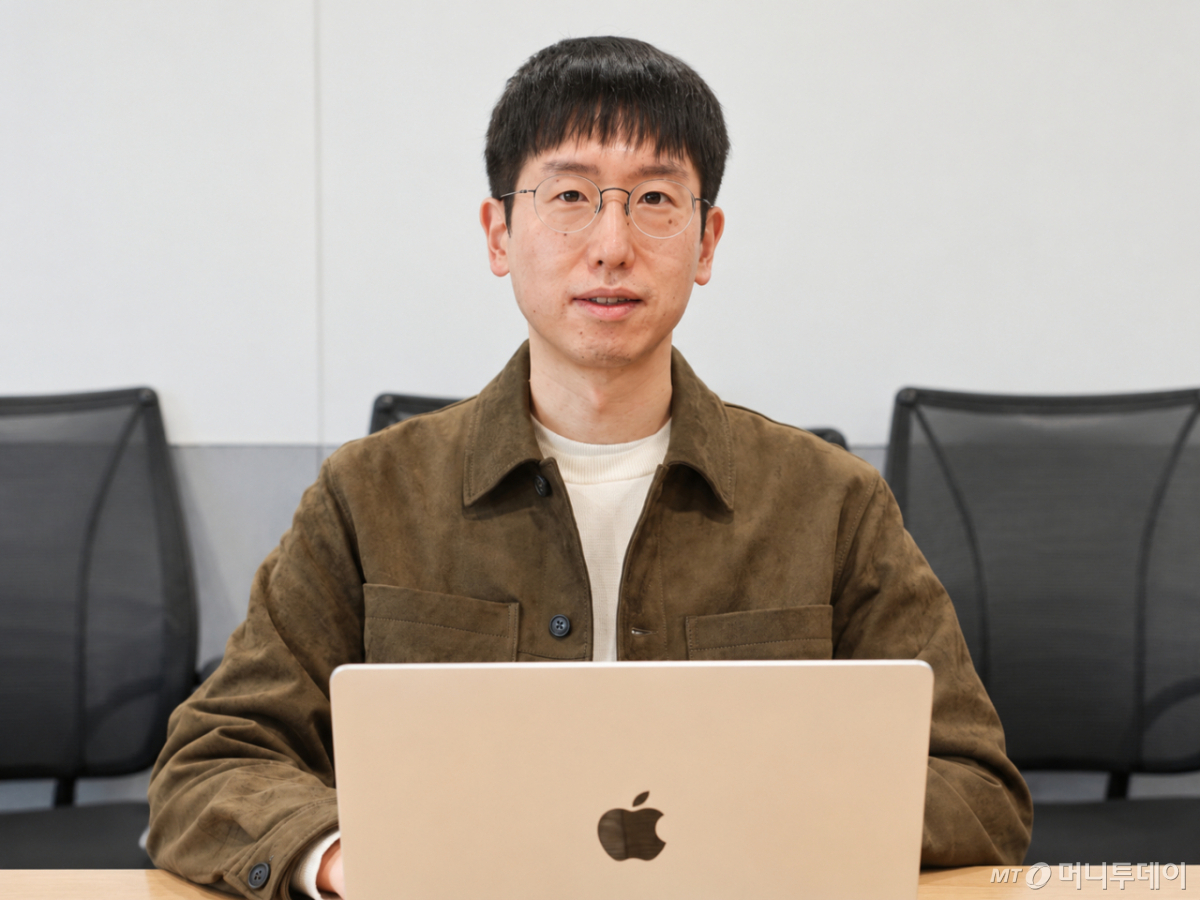
Kim Hyun-woo, head of the joint AI research center established by Nvidia and the Korea Advanced Institute of Science and Technology (KAIST), made the remarks in an interview at Nvidia Korea's office in Gangnam-gu, Seoul, on Nov. 10.
Kim, who is also an assistant professor at KAIST's Kim Jaechul Graduate School of AI, outlined plans to release data and training methods that companies can use, rather than developing a specific AI model.
Nvidia and KAIST announced the establishment of the joint research center in July, pledging to invest $300 million (about 403.2 billion won) over the first five years.
Kim, born in 1991, said, "We have some exciting projects in the works, and I think we will be able to unveil them all sometime in the second half of next year."
The research will focus on two areas: synthetic data technology, which enables AI to generate its own training data, and learning techniques that help AI extract more information from existing data.
"Data is just as important as GPUs (graphics processing units) in artificial intelligence," Kim said, pointing to the problem that data training expertise is not made public and is shared only within individual companies.
Google's multilingual training dataset mC4 contains about 3.93 billion English documents, 163 times the 24 million Korean documents. As of last month, Korean accounted for just 0.88 percent of the web documents in Common Crawl, an open archive of web data.
"It is extremely difficult to find high-quality Korean datasets that are publicly available," Kim said. "There is a shortage in every field."
Kim cited KAIST's research capabilities and the characteristics of the Korean language as reasons Nvidia chose to establish the center in Korea. "KAIST has become a university that attracts considerable attention worldwide," he said.
Korean has less data available than English or Chinese, but has a more established research base than languages with fewer resources, making it a so-called "mid-resource language."
"We will develop and release open recipes and data training methods that start with Korean but can also be applied to other languages," he said.
The Nemotron Persona Korea dataset, which Nvidia released in April under Kim's leadership, ranked No. 1 among the world's most popular datasets on Hugging Face for 10 days and was downloaded about 140,000 times.
It was also used in LG AI Research's K-EXAONE 2.5. "Nemotron is just one of the many trees in the forest," Kim said, adding that the research findings would be made available for use with other AI models and for commercial applications.
Of the total investment, $250 million will be provided in computing resources. The types and quantities of GPUs have yet to be determined. "
Everyone knows that Korean researchers are struggling with a shortage of GPUs," Kim said. "The arrival of Nvidia's vast computing resources is like a much-needed rain after a drought."
The joint center will support at least 10 KAIST researchers each year and offer them internship opportunities at Nvidia. It also plans to recruit full-time researchers.
Kim, who returned to Korea after working overseas, said, "I believe people can return because there are good opportunities here." He added that attracting talented Koreans working abroad back to the country is also one of the center's major goals.

 in TECH
