

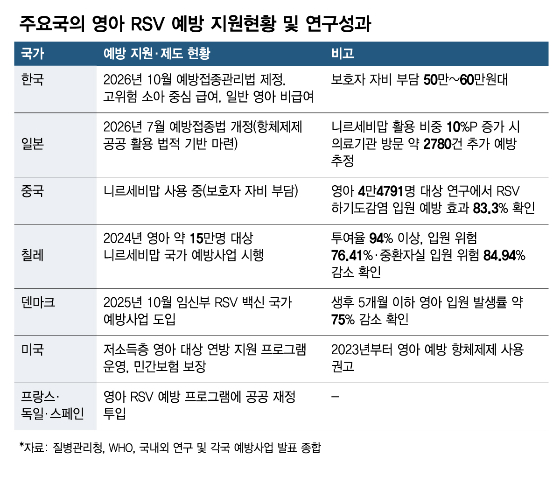
As overseas nations expand national support for respiratory syncytial virus (RSV) prevention in infants, a foundation for supporting preventive antibody preparations has also been established domestically. The government plans to review the necessity of introducing RSV into the National Immunization Program based on relevant research results.
According to the Korea Disease Control and Prevention Agency (KDCA) on the 22nd, a legal basis has been established to expand the scope of immunization from vaccines to equivalent pharmaceuticals under the "Immunization Management Act," which passed the National Assembly in October. This allows the existing vaccine-centric immunization system to encompass various preventive pharmaceuticals, including antibody injections. The law is scheduled to take effect in October next year.
The enactment of this law has increased the possibility of public support for RSV preventive antibody preparations for infants. The KDCA plans to review the necessity of expanding national support for RSV preventive agents. A KDCA official stated, "We are continuously monitoring trends in new RSV preventive agents and will review the necessity of introducing them into the National Immunization Program based on accumulated research results." The agency noted that an analysis of the domestic disease burden and cost-effectiveness of RSV is required first.
RSV is a respiratory virus that causes bronchiolitis or pneumonia in infants. In particular, infants under six months old have narrow airways, making them prone to breathing difficulties and feeding problems upon infection; severe cases may require hospitalization or intensive care. A study of five European countries published in the international academic journal "The Lancet Respiratory Medicine" in 2022 found that one out of 56 healthy full-term infants was hospitalized due to RSV infection in their first year of life.
In response, experts recommend RSV preventive injections for infants. Professor Yoon Ki-wook, a pediatrician at Seoul National University Hospital, emphasized the importance of immunization, stating, "While premature infants or those with congenital heart disease or chronic lung disease are at higher risk of severe complications, the majority of infants hospitalized with RSV are healthy full-term babies without underlying conditions," adding that "it is difficult to predict in advance which infant will progress to a severe state." The World Health Organization (WHO) also recommended last year the adoption of RSV prevention strategies utilizing vaccines for pregnant women or preventive antibody preparations for infants.
There are two methods for preventing RSV in infants: administering antibodies directly after birth, or having pregnant women receive a vaccine to transfer antibodies to the fetus. In Korea, Sanofi's RSV preventive antibody injection "Beyfortus" (generic name nirsevimab) was launched in February last year, and Merck Sharp & Dohme Korea's antibody injection "Enflonza" (generic name clesrovimab) was launched in September this year. In August last year, Pfizer's vaccine for pregnant women, "Abrysvo," was also approved.
However, RSV preventive antibody preparations for general infants are not covered by national health insurance in Korea, meaning guardians must bear the full high cost. The price of Beyfortus is in the range of 500,000 to 600,000 won. This is the background behind expert suggestions that national immunization support for RSV preventive injections is necessary.
Overseas, research continues to back up national support and preventive effects of RSV preventive injections. The United States has supported low-income infants with RSV preventive antibody preparations through a federal program since 2023. France, Germany, Spain, and other countries are also investing public funds.
Japan amended its Immunization Act in July this year to establish a basis for public support of infant RSV preventive antibody preparations. In a real-world study conducted from December 2024 to June 2025 targeting 44,791 infants in China, it was confirmed that Beyfortus had an 83.3% effectiveness in preventing hospitalizations due to RSV-related lower respiratory tract infections.
Cases have also been reported where the burden of infant hospitalization decreased after the implementation of national prevention programs. Chile implemented a national Beyfortus prevention program for approximately 150,000 infants in 2024. The administration rate was over 94%, and related observational studies showed that the risk of hospitalization due to RSV lower respiratory tract infections decreased by 76.41% and the risk of intensive care unit admission decreased by 84.94%.
In Denmark, which introduced the RSV vaccine for pregnant women into its national prevention program, infant hospitalizations also dropped significantly. According to Danish researchers, the incidence rate of RSV-related hospitalizations among infants under five months old from October 2025 to April 2026 was 9.9 per 1,000, a decrease of approximately 75% compared to the average of 39.3 during the previous three epidemic periods.

 in THEBIO
