

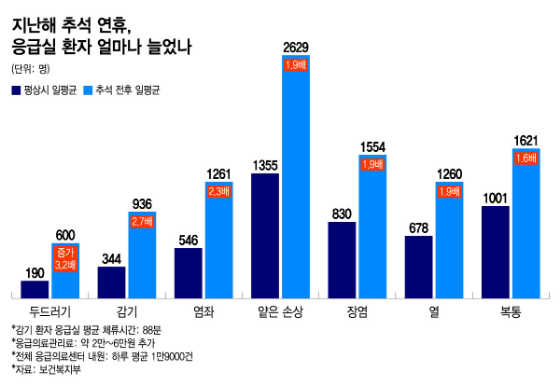
Patients who visited emergency rooms with cold symptoms during last year's Chuseok holiday period stayed in the emergency room for an average of approximately one and a half hours (88 minutes). As the number of patients seeking emergency care for relatively mild conditions such as hives, colds, and sprains increased by more than double compared to usual levels during this period, the government is recommending that patients with minor ailments prioritize local clinics and hospitals this Chuseok.
According to data from the Ministry of Health and Welfare's "Analysis of Patients Visiting Emergency Medical Centers During the 2025 Chuseok Holiday," approximately 76,000 patients visited 182 regional and local emergency medical centers nationwide during last year's Chuseok holiday, which ran from October 5 to 8. The daily average was approximately 19,000 cases, which is 1.9 times the usual weekday average of about 10,000 cases and 1.5 times the weekend average of about 13,000 cases. Approximately 20,000 patients visited emergency medical centers on the day before Chuseok and on Chuseok itself, respectively, while approximately 19,000 visited the following day.
In particular, the increase in relatively mild conditions such as hives, colds, and sprains was significant around Chuseok. The daily average number of patients with hives increased from 190 under normal circumstances to 600 around Chuseok, reaching 3.2 times the usual level. Patients with colds increased by 2.7 times, from 344 to 936, and patients with sprains increased by 2.3 times, from 546 to 1,261.
Other conditions also saw higher patient numbers than usual. The daily average number of patients with superficial injuries increased by 1.9 times, from 1,355 to 2,629. Patients with gastroenteritis increased from 830 to 1,554, and patients with fever increased from 678 to 1,260, each representing a 1.9-fold increase. Patients with abdominal pain also increased by 1.6 times, from an average of 1,001 per day under normal circumstances to 1,621 around Chuseok. Overall, the number of patients with major conditions, which averaged 11,532 per day under normal circumstances, increased by 1.7 times to 20,062 around Chuseok.
Using the emergency room also entails a greater financial burden than visiting general clinics or hospitals. While there are no separate costs applied solely during the Chuseok holiday, using the emergency room requires paying an additional emergency medical management fee on top of standard consultation fees. The additional cost presented by the Ministry of Health and Welfare is approximately 20,000 to 60,000 won. Accordingly, the Ministry of Health and Welfare advises that if symptoms are mild, patients should prioritize nearby clinics, hospitals, or public health centers that remain open during the holiday over emergency rooms.
During the holiday period, emergency room visits due to various accidents also increased significantly in addition to illnesses. The daily average number of accident patients around last year's Chuseok was 5,114, approximately double the usual average of 2,564. Among these, burn patients saw the largest increase, rising by 3.3 times from an average of 52 per day under normal circumstances to 173. Patients with penetrating injuries increased by 2.7 times, from 329 to 899.
The daily average number of patients involved in slipping accidents increased by 1.8 times, from 618 to 1,138, and blunt trauma cases increased by 1.7 times, from 403 to 703. Traffic accident patients also increased by 1.5 times, from an average of 386 per day under normal circumstances to 571 around Chuseok.
By time of day, emergency medical center usage was concentrated in the morning. The highest number of visits occurred between 9 a.m. and noon on Chuseok itself, with 3,980 patients seeking care. On the day after Chuseok, 3,900 patients visited during the same time slot, while 3,542 patients visited on the day before Chuseok. In contrast, visits were relatively low during the early morning hours of 3 a.m. to 6 a.m., with 1,043 patients on the day before Chuseok, 1,098 on Chuseok itself, and 1,065 on the following day.
The government will operate 416 emergency medical institutional investors nationwide from the 24th to the 27th, this year's Chuseok holiday period, on a 24-hour basis as usual. This includes 44 regional emergency medical centers, 139 local emergency medical centers, and 233 local emergency medical institutional investors. Separately, 113 emergency medical facilities will also be in operation. Hospitals, clinics, public health centers, and other facilities will open with a daily average of 3,495 locations, while 4,383 pharmacies will remain open. Including emergency medical institutional investors, an average of 8,294 medical institutional investors and pharmacies are expected to operate per day during the holiday period.
The Ministry of Health and Welfare recommended that if mild symptoms occur during the holiday, patients should first visit a nearby clinic or hospital that is open for treatment. If test results suggest a severe disease, patients may be transferred to a higher-level medical institutional investor at the discretion of medical staff. On the other hand, in cases where severe conditions are suspected, such as difficulty breathing, sudden numbness in the limbs, or tongue paralysis making it difficult to speak, one must immediately call 119.
Clinics, hospitals, and pharmacies that remain open during the holiday period can be checked through apps such as "Emergency Smart" and "Emergency Medical Information Provision," as well as the Central Emergency Medical Center's "E-Gen." Guidance is also available via the Ministry of Health and Welfare call center 129 and provincial/municipal call centers 120. Since operating schedules for medical institutional investors may change, it is necessary to confirm actual availability by phone before visiting.

 in THEBIO
