

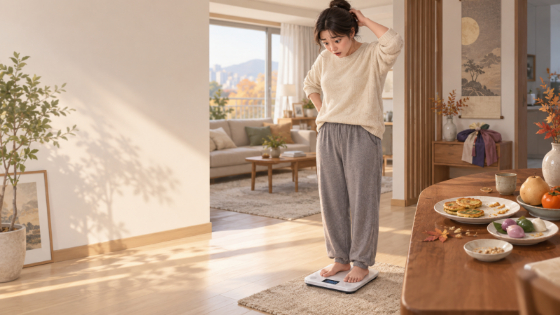
There are times when it is puzzling that one's weight has increased after the Chuseok (Korean Thanksgiving) holiday. There is no memory of eating a large amount of holiday food all at once, yet the number on the scale has gone up. In such cases, it is necessary to recall not only the three meals eaten while seated at the table but also the food picked up in between. If one took a bite while frying jeon, another while serving songpyeon, and picked up snacks several times while chatting with guests, the amount of food consumed could have increased compared to usual without a single instance of binge eating.
This behavior of repeatedly eating small amounts of food regardless of set meal or snack times is called 'grazing.' The key point is not that the amount eaten at once is small, but that the act of eating is repeated without a plan. It differs from eating snacks in a set amount when hungry. It is like unconsciously picking up food placed in front of one and then eating another food shortly after.
During holiday breaks such as Chuseok, an environment where grazing is likely to occur is created. Unlike usual times, jeon, songpyeon, fruits, and snacks are left on the table for a long time, and opportunities to eat arise even while preparing food or receiving guests. Even after finishing a meal, if one remains at the table to chat or sets up the snack table again, the beginning and end of the meal become blurred.
Grazing differs in pattern from binge eating. Binge eating is the act of consuming a large amount in a relatively short time, whereas grazing is a pattern of eating small amounts over multiple occasions. Therefore, each 'bite' may not be memorable. Even if one thinks they ate the usual amount for breakfast, lunch, and dinner, the daily intake changes when the jeon, songpyeon, and beverages consumed between meals are added up.
Engaging in grazing does not necessarily lead to weight gain. However, a point of caution is that it is difficult to realize when and how much one has eaten. In particular, if eating repeatedly due to food being visible or suggestions from those around, rather than hunger, it is difficult to identify the cause by looking only at meal portions. Recording foods and beverages consumed outside of meals is also a method. The U.S. National Institute of Diabetes and Digestive and Kidney Diseases guides recording foods and beverages consumed during the day as a means to check eating habits.
Rather than avoiding holiday food, clarifying the moment of eating is a realistic approach. If one wants to eat jeon or songpyeon, instead of picking up pieces one by one in front of the counter, serve the amount to be eaten on a plate and sit down to eat. Once the meal is finished, clear the table, and when eating snacks next time, measure out a set amount. This makes it much easier to figure out what was eaten.
The pattern of skipping meals and satisfying hunger with snacks is also worth examining. A senior nutrition education and training specialist for Herbalife Asia Pacific's [Pyongyang] region stated, "Even just consuming 20 to 30 grams of protein in the morning maintains a feeling of fullness for a long time, reducing frequent cravings for junk food," and recommended adding eggs or tofu to breakfast.
The speed of eating is also important. Even if snacks are served on a plate, eating quickly and picking them up again reduces the effect of setting a portion size. The specialist advised, "For holiday foods that require much handwork, such as jeon and songpyeon, chewing each bite thoroughly allows one to feel fullness more accurately."
This means practicing 'mindful eating' by savoring the taste and texture of food. It is also recommended as a good method to drink a glass of water before coffee or beverages and to pair snacks with high-moisture items such as cucumbers or cherry tomatoes.

 in THEBIO
