

The number of female lung cancer patients, most of whom are 'non-smokers,' is increasing every year. It appears that cases influenced by risk factors other than smoking, such as secondhand smoke and air pollution, are on the rise.
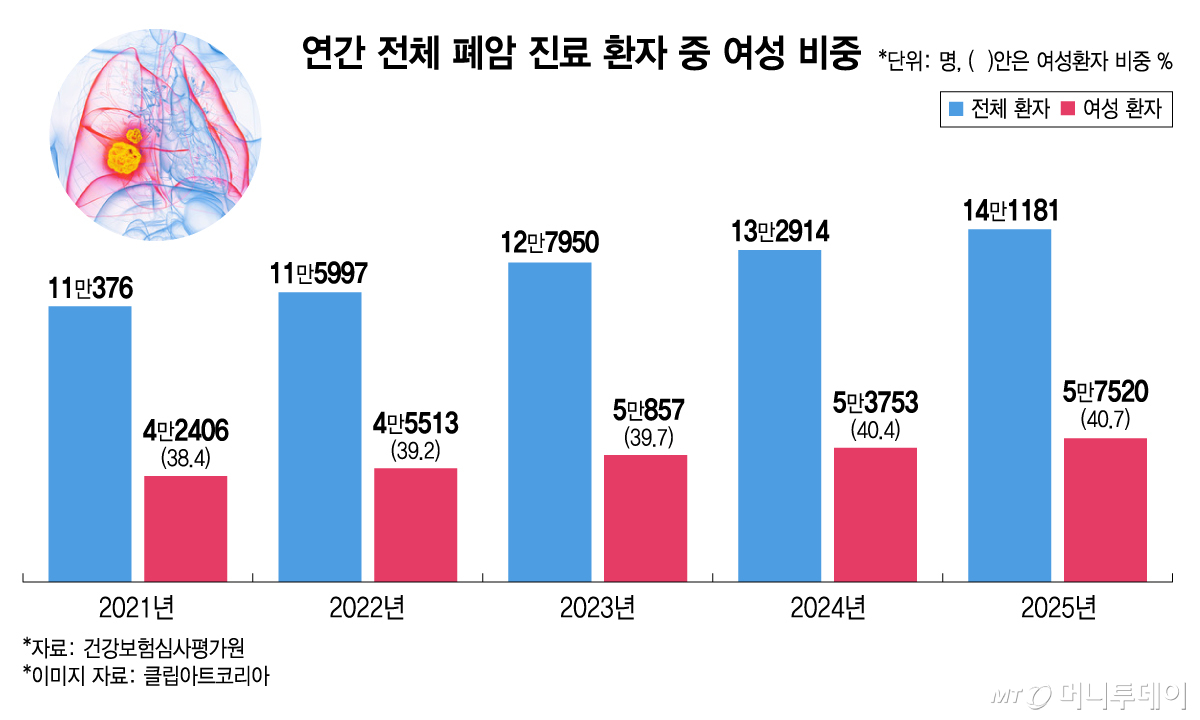
According to the Health Insurance Review & Assessment Service (HIRA), the number of domestic patients who received treatment for suspected lung cancer increased from 110,376 in 2021 to 141,181 in 2025, a rise of approximately 28%. During this period, the proportion of female patients among all patients grew from 38.4% to 40.7%.
The causes of lung cancer are complex, but smoking is the most lethal and well-known risk factor. In fact, approximately 70-85% of lung cancer cases are related to smoking. In particular, lung damage caused by smoking may result in lower long-term survival rates compared to other tumors, even after undergoing standard lung cancer surgery.
Recently, with the increase in 'non-smoking lung cancer' patients, attention has also turned to risk factors other than smoking. The number of female lung cancer patients in Korea, who are predominantly non-smokers, continues to show an upward trend. According to the National Cancer Center's "Status of Major Cancer Prevalence," the number of female lung cancer survivors increased from 54,581 in 2022 to 59,522 in 2023. Based on the scale of prevalence, lung cancer was found to be the sixth most common cancer among women in Korea, following thyroid, breast, and colorectal cancers.
In reality, factors contributing to lung cancer include not only direct smoking but also secondhand smoke, air pollution, occupational dust and asbestos, and poor cooking environments. Some cases of lung cancer are reported to be associated with chronic lung diseases and genetic factors. Kim Min-ji, a professor in the Department of Pulmonology at Seoul Asan Hospital, stated, "Lung cancer is not a disease that can be explained by smoking alone," adding, "If you experience persistent coughing, hemoptysis (coughing up blood), unexplained weight loss, or shortness of breath, it is advisable to seek medical attention even if you have no history of smoking."
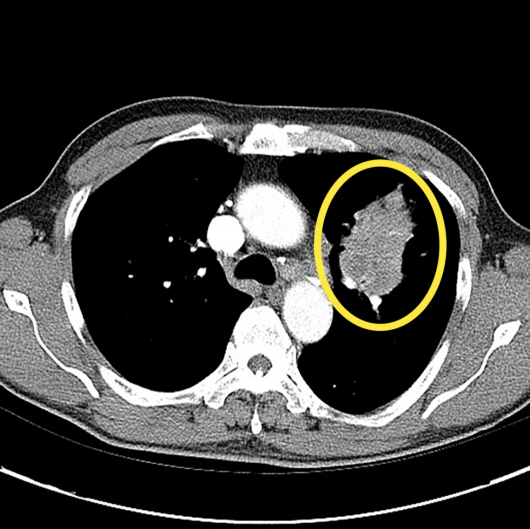
The lungs lack sensory nerves, so in most cases, symptoms are not felt even when the interior is significantly damaged. In fact, only about 15% of patients are diagnosed with lung cancer while asymptomatic. If symptoms do appear, it is usually because the lung cancer has already progressed. When the disease advances to the point of invading airways and blood vessels, symptoms such as coughing up blood or shortness of breath may manifest. As it metastasizes to the brain, bones, and spine, patients may experience headaches, gait abnormalities, and lower limb paralysis.
However, with the development of personalized precision treatment technologies, lung cancer survival rates have improved significantly in recent years. According to the Ministry of Health and Welfare, the 5th-year relative survival rate for lung cancer (the probability of a cancer patient surviving for five years compared to the general population) improved from 12.5% in 1993-1995 to 42.5% in 2019-2023.
Lee Seung-hyun, a professor in the Department of Pulmonology and Allergy at Kyung Hee University Hospital, said, "Lung cancer treatment is shifting away from a focus on surgery and chemotherapy toward personalized treatments that comprehensively consider the patient's condition and the biological characteristics of the cancer." He added, "Next-generation sequencing (NGS) allows for the simultaneous analysis of hundreds of genes. This enables rapid determination of targeted therapies or immunotherapies suited to specific mutations, thereby increasing survival rates for patients with advanced lung cancer."
In particular, the expansion of low-dose CT (computed tomography) screenings is positively changing treatment trends. Korea is currently conducting national lung cancer screening using low-dose chest CTs for smokers who are at high risk of developing lung cancer. There is also an increase in early detection cases related to non-smoking women.
Kim Young-du, a professor in the Department of Cardiothoracic Surgery at Catholic University of Korea Seoul St. Mary's Hospital, emphasized, "Cases where small lung cancers are detected before symptoms appear are increasing not only among smokers but also among non-smoking women, and the number of patients cured through early surgery continues to rise." He stressed, "In particular, lung cancer in non-smoking women rarely presents with symptoms such as coughing or hemoptysis, making early detection through screening crucial regardless of smoking status."

 in THEBIO

