

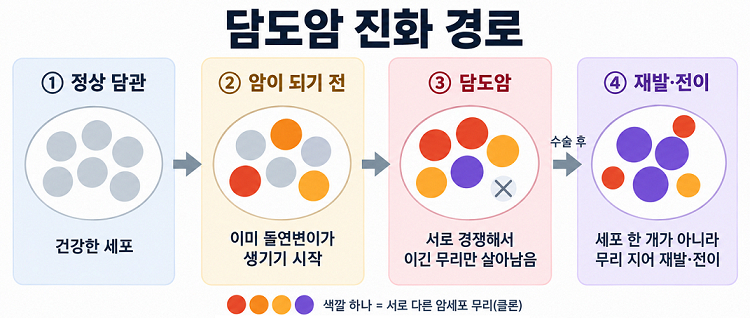
Cholangiocarcinoma is notoriously difficult to treat due to its late detection and low survival rates. A recent study has revealed that genetic changes begin before the disease becomes cancerous, and that post-surgical recurrence involves the regrowth of multiple clusters of cancer cells rather than a single cell, raising expectations for improved treatment outcomes in the future.
A research team led by Kim Ji-won (Prof.) from the Department of Hematology-Oncology and Na Hui-yeong (Prof.) from the Department of Pathology at Bundang Seoul National University Hospital (co-first authors: Kang Min-su (Prof.) from the Department of Hematology-Oncology, and Researcher Lee Ju-hyun) elucidated the "evolutionary pathway" cholangiocarcinoma undergoes from its pre-cancerous stage to recurrence and metastasis. The findings were published in "npj Precision Oncology," an international academic journal in the field of oncology and a sister publication of NATURE (Nature).
Cholangiocarcinoma is a cancer that develops along the biliary tract, including the bile ducts, gallbladder, and ampulla of Vater. The incidence rate is particularly high in certain countries, including South Korea. More than half of patients are diagnosed at an advanced stage where surgery is not possible, resulting in a survival period of only 11 to 15 months. Even when surgery is performed with the goal of a cure, approximately half of patients experience recurrence, making it a refractory cancer. However, studies tracking the entire process of how cholangiocarcinoma develops and recurs or metastasizes at the genomic level have been extremely scarce until now.
To address this, the research team analyzed 72 samples obtained from 17 cholangiocarcinoma patients using whole-exome sequencing (an analytical method that reads all protein-coding regions of the genome to identify mutations). The samples included normal tissue, pre-cancerous lesions (the stage immediately before cancer develops), primary tumors (initially developed cancers), and metastatic or recurrent tumors. Based on this analysis, the team constructed patient-specific phylogenetic trees illustrating the order in which cancer cell clusters (clones) emerged and branched, thereby tracing back the evolutionary path of the cancer.
The analysis revealed that core genetic mutations associated with cholangiocarcinoma, such as TP53, KRAS, and SMAD4, were already present in pre-cancerous lesions. Although these lesions did not appear to be cancerous on the surface, changes toward malignancy were already underway at the genetic level.
Furthermore, among the cell clusters within the pre-cancerous lesions, only those with a survival advantage survived and grew into primary tumors. The research team explained that this observation reflects a phenomenon of "selective sweep," where, much like Darwinian natural selection, cell clusters competing with one another are selected based on their advantages in survival and proliferation, eventually dominating the lesion.
This selective expansion continued during the metastatic process. Rather than cells from the primary tumor spreading uniformly, specific cell clusters that were a minority in the primary tumor became dominant at the metastatic sites. Given that the environment differs from organ to organ, the clusters best suited for survival in each specific location were selected.
A particularly noteworthy finding was that even in cancers that recurred after surgical removal of the tumor, multiple cell clusters that constituted the primary tumor remained intact. It had previously been assumed that cancer recurrence occurred because a single cancer cell hidden somewhere in the body regrew over time. However, the fact that the cellular composition of the primary tumor remained entirely intact indicates that recurrence occurs via a "multiclonal" mechanism, where multiple cell clusters migrate and establish themselves together as a single unit.
On the other hand, evidence was also found suggesting that cancer treatment may have influenced the evolution of the tumor. Mutations leave unique patterns depending on their cause, and patterns known to be left by chemotherapy agents used in cholangiocarcinoma treatment were increased in metastatic and recurrent lesions. This means that cancer cells that survived the attack of chemotherapy proliferated while carrying these traces. However, Kang Min-su (Prof.) from the Department of Hematology-Oncology cautioned against misunderstandings regarding chemotherapy, stating, "This does not mean that chemotherapy worsens the cancer; rather, it demonstrates that the treatment process itself can influence the evolution of cancer cells."
Conversely, some elements remained unchanged. Mutations targeted by targeted therapies (drugs designed to attack cancer cells by targeting specific genetic mutations), such as ERBB2 gene amplification and KRAS mutations detected at diagnosis, were maintained even after recurrence or metastasis.
Kim Ji-won (Prof.) from the Department of Hematology-Oncology stated, "The fact that major genetic mutations identified at diagnosis are maintained even after recurrence or metastasis underscores the importance of developing treatment strategies based on precise genomic analysis from the point of diagnosis." He added, "Our research team's goal is to improve treatment outcomes for cholangiocarcinoma through treatment strategies that reflect the principles of cancer evolution."
Na Hui-yeong (Prof.) from the Department of Pathology noted, "The significance of this study lies in confirming, as a single continuum, the genetic changes and evolutionary process cholangiocarcinoma undergoes from its pre-cancerous stage to metastasis and recurrence." He added, "The finding that competition and selection among cell clusters begin at the pre-cancerous lesion stage will serve as an important clue for understanding the pathogenesis of cholangiocarcinoma."
Meanwhile, this study was conducted with support from the Ministry of Education and the National Research Foundation of Korea's Korean-style SGER (Small Grant for Exploratory Research) program, among others.

 in THEBIO
