

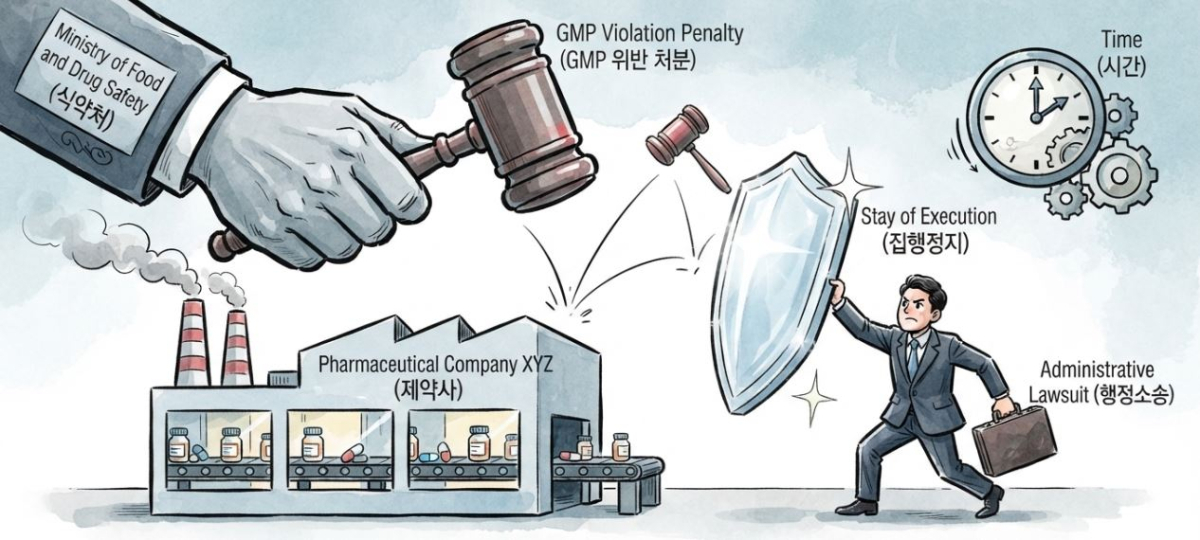
It was revealed that even when pharmaceutical companies receive administrative penalties for violating Good Manufacturing Practice (GMP) standards, the penalty is suspended in 7 out of 10 cases. By obtaining a stay of execution through administrative litigation, the companies have continued their business operations with the effect of the penalty halted for up to more than two years.
Through this, pharmaceutical companies have continued to sell drugs and generate sustained revenue through National Health Insurance. Consequently, there are calls for the introduction of punitive surcharges linked to sales revenue in cases where pharmaceutical companies intentionally violate GMP standards.
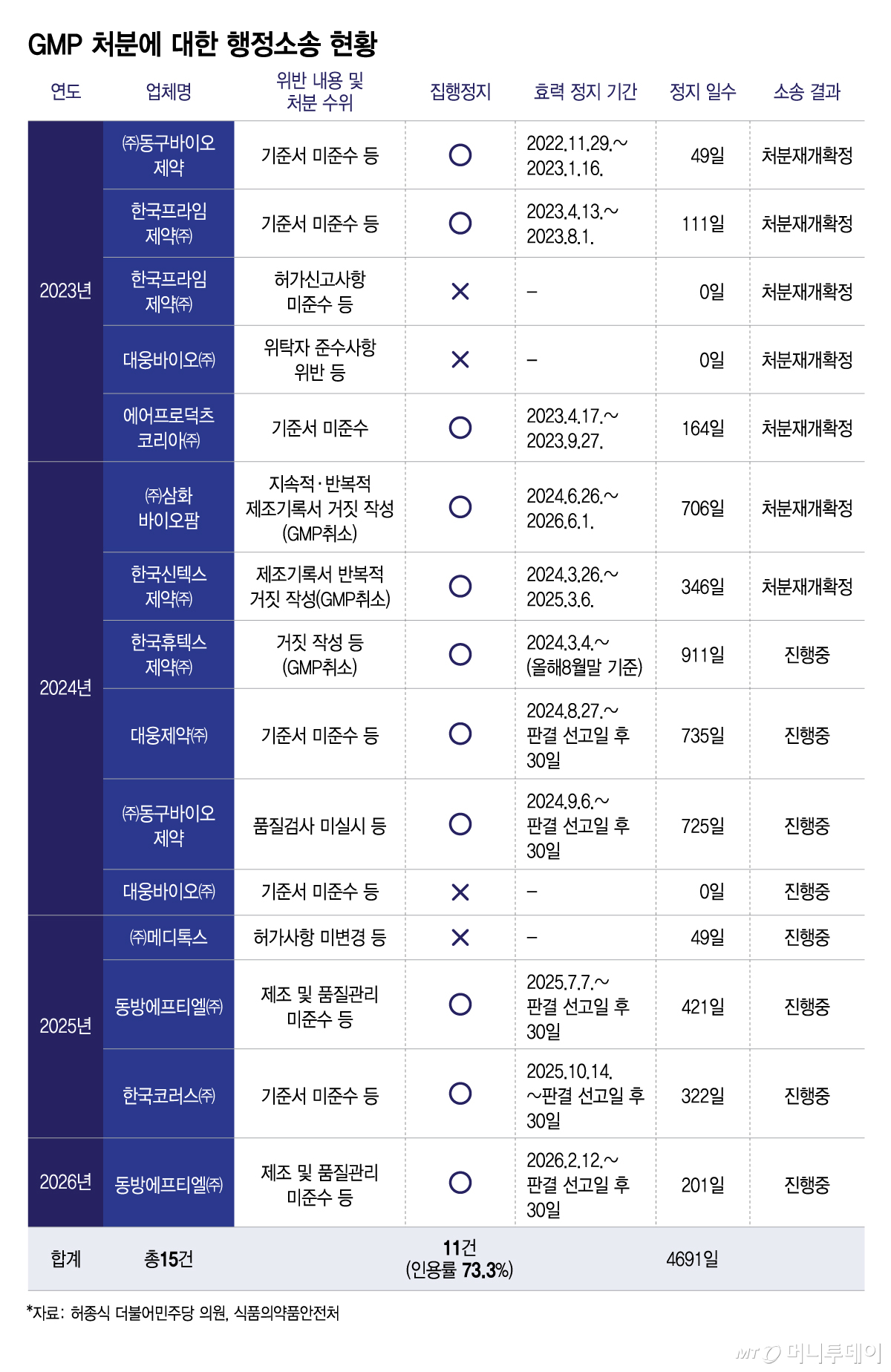
According to an analysis by Rep. Heo Jong-sik of the Democratic Party of Korea, a member of the National Assembly's Health and Welfare Committee, of the "Status of GMP Violation Administrative Penalties and Administrative Litigation from 2023 to August 2026" submitted by the Ministry of Food and Drug Safety on the 13th, there were 15 administrative lawsuits (13 for pharmaceuticals, 1 for herbal preparations, and 1 for biopharmaceuticals) filed in protest against GMP penalties for pharmaceuticals, herbal preparations, and biopharmaceuticals during this period.
Of these, courts accepted stays of execution in 11 cases (73.3%), halting the effect of the penalties. This means that when a pharmaceutical company applies for a stay of execution along with its lawsuit, the penalty is suspended in 7 out of 10 cases. The total duration of the suspensions across the 11th cases amounts to 4,691 days, or approximately 12.9 years. Cases still in litigation were calculated up to the end of August this year.
GMP certification revoked for 'repeated falsification' of manufacturing records… penalty suspended for 706 days
Samhwa Biopharm, a raw pharmaceutical manufacturer, had its GMP suitability determination for synthetic active pharmaceutical ingredients revoked in 2024 after it was discovered that it had "continuously and repeatedly falsified manufacturing records." This is the most severe level of penalty related to GMP. However, as the court granted a stay of execution, the effect of the penalty was suspended for 706 days (approximately 1 year and 11 months) from June 26, 2024, to June 1, 2026, and the revocation order was only executed on June 2 this year.
Samhwa Biopharm continued to commit violations even before the revocation order. In 2023, six products were recalled due to GMP violations, and in 2024, it received penalties including a five-month and 15-day suspension of manufacturing operations for non-compliance with standards.
Hanuk Sintex Pharmaceutical, an herbal preparation company, also had its GMP suitability determination revoked in 2024 due to "repeated falsification of manufacturing records," but the effect was suspended for 346 days before being executed on March 7, 2025. Sintex Pharmaceutical has recorded a cumulative total of 10 GMP violations over the past five years (from 2022 to the second quarter of 2026), placing it among the top five pharmaceutical manufacturers with the highest number of cumulative violations. Even after the revocation order was executed in 2025, 58 products, including Sintex Shuanghua Tang Ect, received penalties such as a four-month suspension of manufacturing operations.
Hanuk Hutechs Pharmaceutical had the longest suspension period. The effect of the penalty has been halted for 911 days, or approximately two years and six months, from March 4, 2024, to the end of August this year.
Separately from the lawsuits, revocation orders due to record manipulation have continued to occur, including Nensis (2025, falsification of manufacturing records) and Alpha Pharmaceutical (2026, repeated falsification of test reports), which also had their GMP suitability determinations revoked during the same period.
Daewoong Pharmaceutical, Donggu Biopharmaceutical, and three others: 5 cases suspended indefinitely… "Punitive surcharges should be introduced"
Among the ongoing lawsuits, five cases have a suspension period defined as "until the day that is 30 days from the date of the judgment on the merits." This means the penalty has effectively been halted without a deadline until a final verdict is issued. As of the end of August this year, Daewoong Pharmaceutical (735 days) and Donggu Biopharmaceutical (725 days) have suspension periods approaching two years.
All seven cases that reached a conclusion ended with "confirmation of resumption of penalty," meaning the penalties were ultimately re-executed. However, it remains unconfirmed how much of the relevant drugs were produced and shipped during the period when the effect of the penalties was halted.
Heo (Rep.) requested data on shipment amounts and National Health Insurance claim amounts during the suspension periods. However, the Ministry of Food and Drug Safety submitted only the status of the lawsuits and could not provide shipment or claim amounts. Even if the penalty is ultimately executed, the government has not verified how much of the relevant drugs were supplied to the market in the interim. Heo (Rep.) also requested review materials and legislative promotion plans regarding the introduction of revenue-linked or punitive surcharges for repeated and intentional GMP violations, but the Ministry of Food and Drug Safety did not submit any review materials or legislative promotion plans.
Heo (Rep.) pointed out, "The reality is that even companies whose GMP suitability determinations were revoked due to repeated manipulation of manufacturing records can avoid penalties for nearly two years simply by filing a lawsuit and applying for a stay of execution." He added, "Even if the penalty is executed later, drugs released into the market in the meantime cannot be recalled, yet the Ministry of Food and Drug Safety has not even confirmed how much was shipped."
He further emphasized, "The Ministry of Food and Drug Safety must first determine shipment volumes and National Health Insurance claim amounts during suspension periods." He stressed, "For intentional violations such as record manipulation, punitive surcharges linked to sales revenue should be introduced instead of substituting business suspensions with small fines, and the system should be improved to prevent litigation related to penalties from becoming prolonged."

 in THEBIO

