

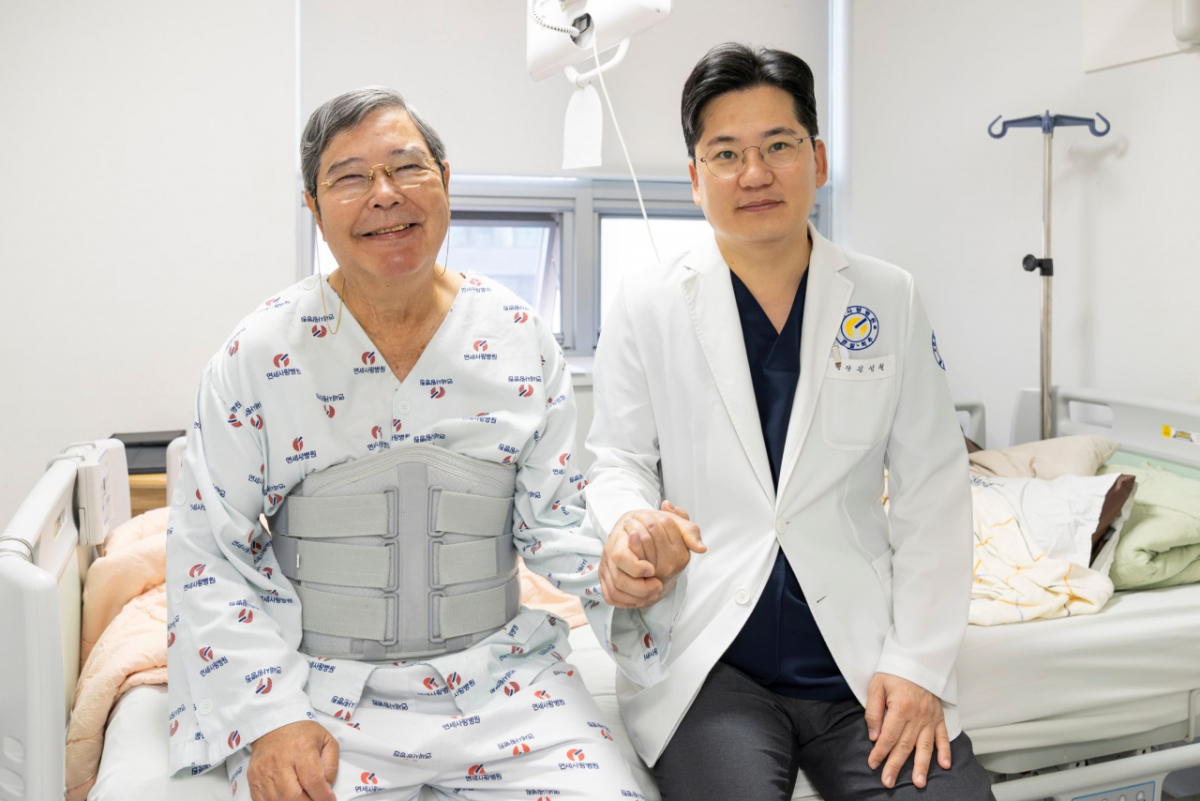
It has been revealed that an American doctor residing in Hawaii quickly underwent spinal surgery and recovered his health in a critical situation where symptoms of leg paralysis and sensory impairment were progressing immediately after arriving in Korea.
On the 14th, the Kim Seong-cheol (Director) team at the Spine Center of Yonsei Sarang Hospital (Hospital Director Goh Yong-gon) announced that they successfully performed spinal surgery on Young Hiram (71), an American, over a long period on the 1st.
Mr. Young is an internal medicine physician in the United States who has been actively providing clinic services at public health centers and volunteering for disadvantaged neighbors in the Hawaii region. He visited Korea to attend a friend's wedding, but paralysis occurred in both legs immediately after arriving in Korea following a long-haul flight of more than 8 hours.
As sensation disappeared, he urgently visited Yonsei Sarang Hospital, a joint specialty hospital designated by the Ministry of Health and Welfare, through a friend. There, he received one-stop medical services, including consultation with a spine specialist, MRI (magnetic resonance imaging) examination, interpretation, results, and explanation of the treatment plan.
Kim Seong-cheol (Director), a neurosurgeon and his primary care physician, recalled, "The patient experienced severe lower back pain, radiating pain spreading to both legs, progressive sensory impairment in both feet, decreased sensation in the perineum, and developed gait disturbance." In particular, detailed examinations revealed that spinal stenosis at lumbar vertebrae 3 through 5 was very severe. Clinically, it was diagnosed as stenosis accompanied by "cauda equina syndrome," rather than simple stenosis, making emergency surgery urgent.
Cauda equina syndrome is a condition that occurs when the lumbosacral nerve roots within the spinal canal are damaged. If the nerve bundle is severely compressed, it can lead to permanent damage in bladder and bowel control, sexual function, and bilateral leg function. It is a serious disease. The key to treating this condition is the "golden time." This is because if paralysis symptoms are not recovered quickly, permanent disability may remain.
Mr. Young underwent surgery on the 2nd, the day after his entry into the country. Director Kim performed a laminectomy between lumbar vertebrae 3 through 5 and foraminotomy (surgery to expand the passage through which nerves pass) for extensive decompression to relieve nerve compression in the patient. The surgery was successfully completed with posterior screw fixation and spinal fusion (a surgical method that permanently stabilizes unstable joints by fixing the space between vertebral bodies with screws after decompression).
After the surgery, Mr. Young's gait disturbance improved, and he recovered without bladder or bowel dysfunction, remaining sensory impairment, or sequelae. On the 12th, ten days after the surgery, Mr. Young expressed his gratitude to the medical staff and was discharged.
Mr. Young said, "During this visit to Korea, my body unexpectedly deteriorated rapidly, but I underwent surgery quickly and recovered my health," adding, "It is lucky and joyful that my back has straightened and I seem to have grown a bit taller."
He then stated his treatment impressions, saying, "In the United States, costs for surgery and such range from $60,000 to $70,000 (Hanwha 80.55 million to 93.97 million won), but in Korea, it is only about one-third of that, which was surprising," adding, "Nevertheless, I am very satisfied with the kindness of Korean medical staff, the consultation system, and the surgical results."
Director Kim responded, "Sudden lower limb paralysis and decreased sensation indicate that nerve damage is progressing, so rapid evaluation and surgical treatment are important," adding, "Although the patient was elderly, he endured a complex, emergency, and difficult long-duration surgery, allowing us to complete the surgery safely."

 in THEBIO
