

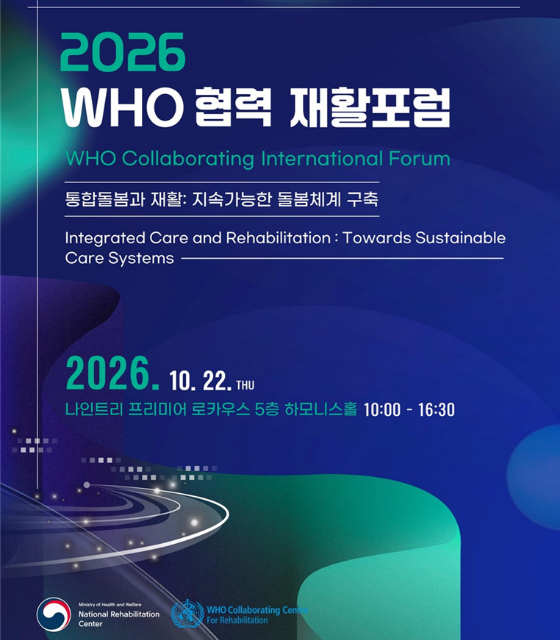
An international forum will be held to discuss strengthening the role of rehabilitation within the community-based integrated care system and supporting patient independence. The plan is to establish a linkage system so that rehabilitation and care can continue in the community after hospital treatment, while seeking sustainable integrated care strategies such as securing rehabilitation specialists and funding.
The Ministry of Health and Welfare's National Rehabilitation Center announced that it will host the "2026 World Health Organization (WHO) Collaborative Rehabilitation Forum" on the 22nd at the Nine Tree Premier Locaus Hotel in Yongsan-gu, Seoul, under the theme of "Integrated Care and Rehabilitation."
This year marks the ninth edition of the forum. Participants include the WHO, the international health research network Cochrane, and experts from domestic and international universities and healthcare institutions. The event will consist of a keynote speech, two thematic sessions, and an expert panel discussion, and will be broadcast live online.
The core agenda of this forum is the role that rehabilitation should play within the integrated care system and the institutional foundation for supporting patient independence. It will address measures to ensure patients can receive necessary rehabilitation services after returning to the community following treatment at medical institutions, as well as strategies to reduce long-term care burdens.
In the keynote speech, the head of Cochrane's Rehabilitation, Function and Disability field will present on the future of function-centered integrated care and rehabilitation. Cochrane is an international consortium that systematically synthesizes and evaluates health research findings to support evidence-based medicine and health policy formulation.
The first session will be conducted under the theme "The Current State of Rehabilitation within the Integrated Care System." It will examine the direction of community-based rehabilitation with a focus on stroke patients and introduce cases of rehabilitation and care linkages between hospitals and communities in Japan.
Technology-driven care and rehabilitation are also key discussion topics. Plans to explore technology-based support measures that allow patients to continuously access necessary services in the community after leaving medical institutions will be reviewed.
The second session will address "Rehabilitation Strategies for Sustainable Integrated Care." Discussions will cover WHO-proposed rehabilitation financing and sustainable healthcare system development plans, as well as securing rehabilitation specialists, alleviating care burdens, and supporting independence.
In particular, the case of Denmark's independence-supporting care model, known as "reablement," will be introduced. Reablement is an approach that goes beyond merely providing care services to support users in maintaining or recovering the functions and independent living abilities necessary for daily life.
The expert panel discussion will focus on "From Care to Independence: The Next Challenges of Integrated Care," discussing the role of rehabilitation services and future policy challenges. Participants include WHO consultant Pauline Kleinetz, Professor Kim Buckley from the University of Sydney in Australia, and Bank of Korea Director Jeong of the National Health Insurance Service, among other domestic and international experts.
Kim Dong-ah, Director of the National Rehabilitation Center, stated, "I hope this forum will serve as a venue for close discussion to examine the role of rehabilitation in the era of integrated care and address challenges toward independence beyond mere care."

 in THEBIO
