

Shortages of essential anticancer drugs have been occurring one after another. These anticancer drugs are widely used for patients with leukemia, breast cancer, and other conditions, but supply disruptions are expected to negatively impact cancer treatment. There are calls for proactive government-level measures to stabilize drug supplies.
Medical field on alert as shortages of anticancer drugs such as 'Endosan Injection' continue
According to the medical and pharmaceutical industries on the 23rd, a shortage of Bupharm's anticancer drug 'Endosan Injection' (active ingredient: cyclophosphamide) 500mg has occurred since the 12th. Endosan Injection is a national essential anticancer drug used for seven indications, including malignant lymphoma, multiple myeloma, leukemia, and breast cancer, with no alternative drugs of the same active ingredient available.
A Bupharm official explained, "The shortage occurred due to shipment suspension following deviations from quality test (sterility test) standards after importation," adding, "We plan to conduct quality tests as a top priority immediately, and expect the supply shortage to be resolved within November."
Pfizer Cytarabine Injection (active ingredient: cytarabine), imported by Pfizer Korea, has been in a state of supply shortage since August. This drug is used for acute leukemia, erythroleukemia, the acute transformation phase of chronic myeloid leukemia, and combination anticancer therapy for some solid tumors. Due to the supply shortage, treatment schedule adjustments or changes to treatment plans may be necessary for some patients.
Flooding at a manufacturing plant located in India led to a halt in plant operations and a suspension of product supply. Pfizer Korea reported to the Ministry of Food and Drug Safety that supply normalization is expected to be possible on December 31, 2028, approximately two years and two months from now.
Among drugs distributed domestically, Pfizer Cytarabine Injection is the only one containing the cytarabine ingredient. JW Pharma had manufactured 'JW Cytarabine Vial Injection' with the same ingredient but ceased production after manufacturing until 2023.
A Pfizer official told this outlet, "Cytarabine is a critical drug used in various blood cancer treatment regimens, and the company is working to minimize the impact on patient treatment due to supply disruptions," adding, "On a global scale, we are proceeding with work to safely restore and resume operations of existing manufacturing facilities while reviewing measures to mitigate supply impacts, such as alternative manufacturing facilities within the global manufacturing network and the possibility of third-party contract manufacturing."
The medical field is also on alert due to anticancer drug shortages. Jeong Gyeong-ju, head of the Pharmacy Department at Yonsei University Health System Severance Hospital, said, "It is a difficult situation as supplies of essential anticancer drugs are being cut off one after another," adding, "Endosan Injection is widely used but has no alternative drug; if there is no supply, anticancer treatment protocols using Endosan Injection cannot be used."
Government must respond proactively for health security... Need to reflect realistic prices for essential drugs, prefer domestic raw materials, and secure production capacity
In May last year, a National Assembly public petition urging the establishment of countermeasures was also submitted, citing continued instability in anticancer drug supplies. The petitioner appealed, "Hodgkin lymphoma can be expected to have a high cure rate with appropriate standard treatment, but the core drug 'Dacarbazine' faced a supply disruption crisis in July this year, and basic anticancer drugs such as cisplatin and bleomycin are experiencing repeated supply instability." They further urged measures including △realistic pricing and cost recovery for essential anticancer drugs, △establishment of a proactive national-level stockpiling system, and △operation of a permanent public-private joint consultation body.
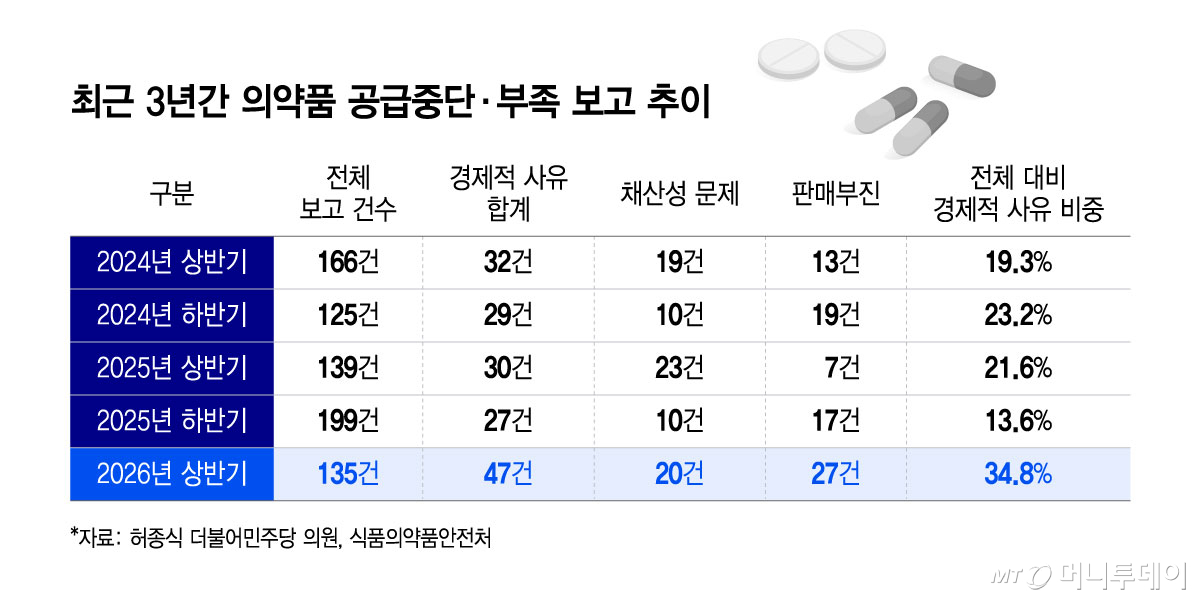
Reports of drug supply disruptions and shortages number in the hundreds annually. According to data received by Democratic Party of Korea lawmaker Heo Jong-sik from the Ministry of Food and Drug Safety, 135 cases of drug supply disruptions and shortages were reported in the first half of this year, and 338 cases last year. Heo (Rep.) emphasized, "For items reported as supply-disrupted, the government must check actual market supply capacity," adding, "The government should urgently establish a system to intervene first for essential drugs with low profitability, such as realistic pricing and expanded contract manufacturing."
Jeong Yun-taek, head of the Pharmaceutical Industry Strategy Research Institute, said, "To secure pharmaceutical supply chains as a matter of health security, improvements are needed, such as offering preferential drug pricing to medicines that use domestically produced active pharmaceutical ingredients, regardless of whether they are made by subsidiaries or other companies. It is the government's responsibility to examine the entire supply chain for essential medicines and drugs for rare and intractable diseases and propose solutions."
A Korea Pharmaceutical and Biotechnology Association official said, "Drug supply instability occurs due to various factors such as profitability, raw material/overseas manufacturing and export suspensions, rather than a single cause, so tailored responses by cause are necessary," adding that △realistic drug pricing, △timely reflection of production cost fluctuations in drug prices, △government compensation for essential drug production costs, and △support for R&D (research and development) and equipment investment to secure domestic production facilities and technology for core raw materials are needed.
They further added, "From a health security perspective, raw material drugs should be viewed as one pillar of the national materials, components and equipment industry, and domestic production capacity for core and essential raw materials must be actively secured."

 in THEBIO
