


With telemedicine set to launch on Dec. 24, just two months away, private-practice doctors, including dermatologists, otolaryngologists and neurologists, are mounting a collective backlash.
Although the system, which focuses on chronic disease management, relies on private-practice doctors to provide care, some are even considering a boycott of telemedicine.
According to the Ministry of Health and Welfare on Monday, an amendment to the Enforcement Decree of the Medical Service Act, which outlines the scope of telemedicine and prescription criteria, has been open for public comment since the 19th.
The core of this amendment is to limit the number of days for prescriptions issued during initial telemedicine consultations to within seven days, while allowing up to 30 days on a one-time basis under certain conditions.
However, the Korean Dermatological Association, an organization of dermatologists in private practice, stated in a statement on the 23rd that "skin diseases cannot be diagnosed with 'a single photo'" and that "the expansion of telemedicine without guaranteed patient safety must be comprehensively reconsidered."
In a phone interview with reporters on the 26th, Lee Sang-ju, president of the Korean Dermatological Association, pointed out that "skin diseases can only be diagnosed by directly palpating lesions to check texture and depth, and by performing dermoscopy (magnifier) examinations, full-body skin inspections, fungal and tissue biopsies as needed."
He added, "In telemedicine, smartphone photos show the same lesion differently depending on lighting, angle, and resolution." For instance, if a melanoma, a type of skin cancer, is examined via a smartphone, there is a concern it could be misdiagnosed as a simple mole.
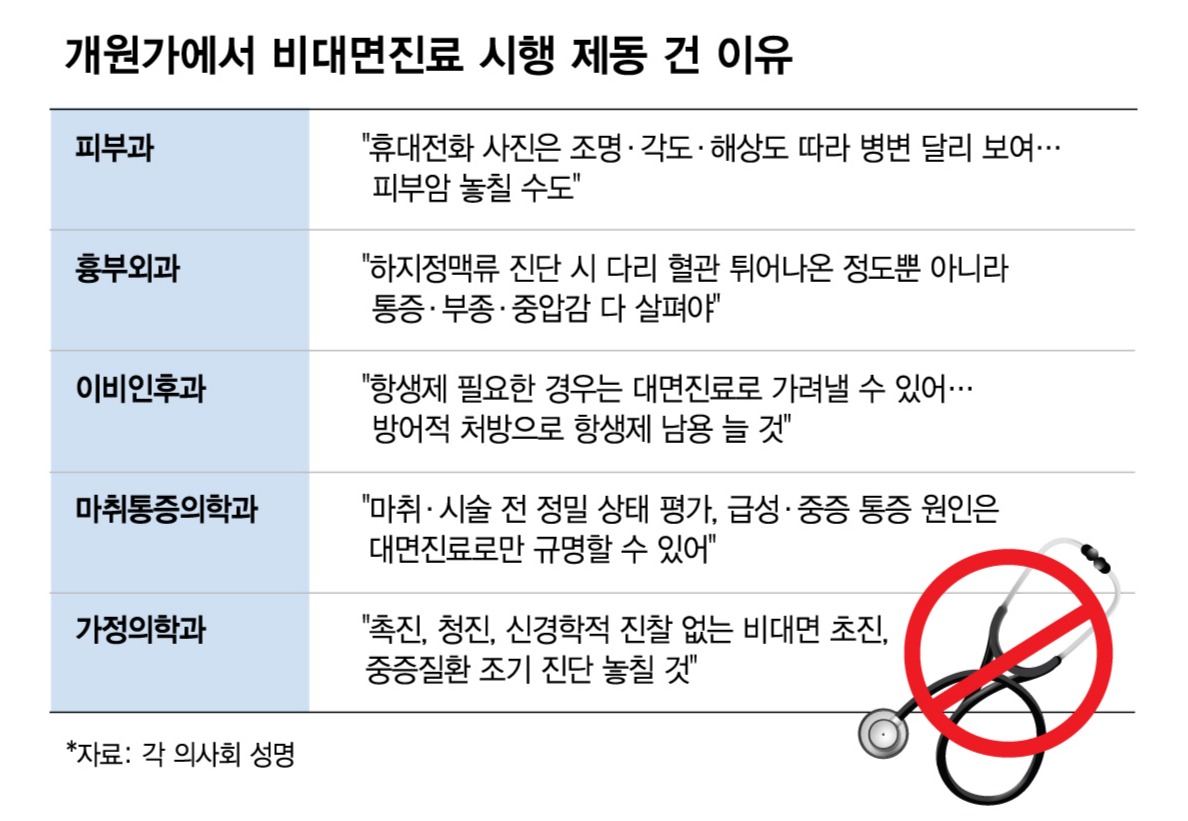
Private clinic thoracic surgeons who primarily treat varicose veins also sharpened their criticism, arguing that photo and video consultations would increase the rate of misdiagnosis.
According to the Korean Society of Cardiovascular and Thoracic Surgeons, varicose veins cannot be diagnosed or have treatment plans determined solely by observing whether blood vessels are bulging in the legs. All symptoms such as pain, swelling, and a sense of pressure must be confirmed, and the structure and blood flow of superficial and deep veins must be evaluated to determine the presence, location, and extent of venous valve dysfunction and reflux.
In particular, it is essential to perform ultrasound examinations that check real-time Doppler waveforms and the duration of reflux while adjusting the patient's posture and provocation methods such as compression and relaxation in order to accurately diagnose reflux.
Kim Seung-jin, chairman from this medical association told MoneyToday on the 26th, "Video resolution and lighting, communication delays or interruptions, voice transmission errors, and signs not visible on the screen can be missed."
He pointed out that "the risk of misdiagnosis resulting from these factors will inevitably be greater in 'initial consultations' where existing information about the patient is lacking, compared to 'follow-up visits.'"
Concerns are also emerging that telemedicine may encourage medication misprescription and misuse. Ahn Young-jin, president of the Korean Otolaryngological Association, lamented, "In telemedicine, it is difficult to distinguish between 'acute otitis media,' which requires antibiotic treatment, and 'otitis media with effusion,' which does not, based solely on ear pain reported by the patient. Similarly, it is difficult to differentiate between 'simple pharyngitis' and 'acute epiglottitis' based on sore throat."
He further argued that "major otolaryngological diseases such as acute otitis media, sinusitis, and pharyngitis often require direct examination of lesions to determine the necessity of medication," adding that "prescribing without face-to-face consultation could lead to an increase in defensive prescribing to avoid misdiagnosis, thereby encouraging the misuse of antibiotics and steroids."
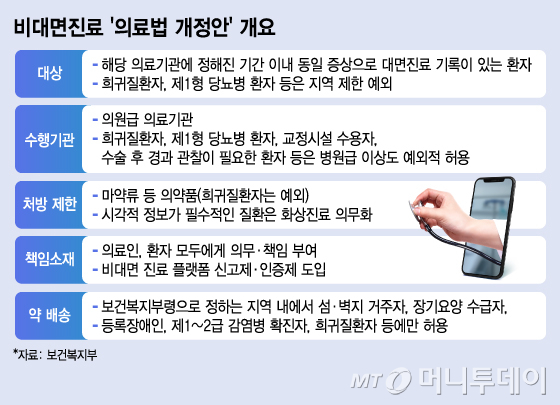
Private clinic anesthesiologists even issued a warning that they would refuse to participate in telemedicine. The Korean Society of Anesthesiology and Pain Medicine released a statement on the 21st, stating that "anesthesiology and pain medicine is a specialized field where prescription of high-risk drugs, precise pre-anesthesia and pre-procedure condition assessments, and identification of acute and severe pain causes are essential."
It warned that "the limitations of telemedicine, where direct physical examination is impossible, will ultimately lead to fatal harms such as misdiagnosis, delayed treatment, and drug misuse."
It continued, "Accurate diagnosis through face-to-face examination and patient safety are fundamental principles of healthcare that cannot be compromised for any reason," declaring that "if the government forces a hasty amendment that ignores even minimal safety devices in order to push forward with the full-scale telemedicine project in December, we will launch an all-out struggle, including 'refusal of full participation in telemedicine,' through solidarity across the medical community."
In addition, the Korean Society of Neurosurgery stated that "while convenience is an important value, it cannot be pursued at the expense of diagnostic accuracy and patient safety," and the Korean Society of Family Medicine urged a policy review, stating that "telemedicine initial consultations without physical examination may miss severe diseases."
Meanwhile, the Ministry of Health and Welfare plans to gather opinions until the 9th of next month to establish detailed operational guidelines in line with the implementation of the amended Medical Service Act on December 24. The Ministry of Health and Welfare stated that it will "finalize the amendment after broadly gathering opinions from the public and relevant institutional investors during the legislative notice period."

 in THEBIO


