

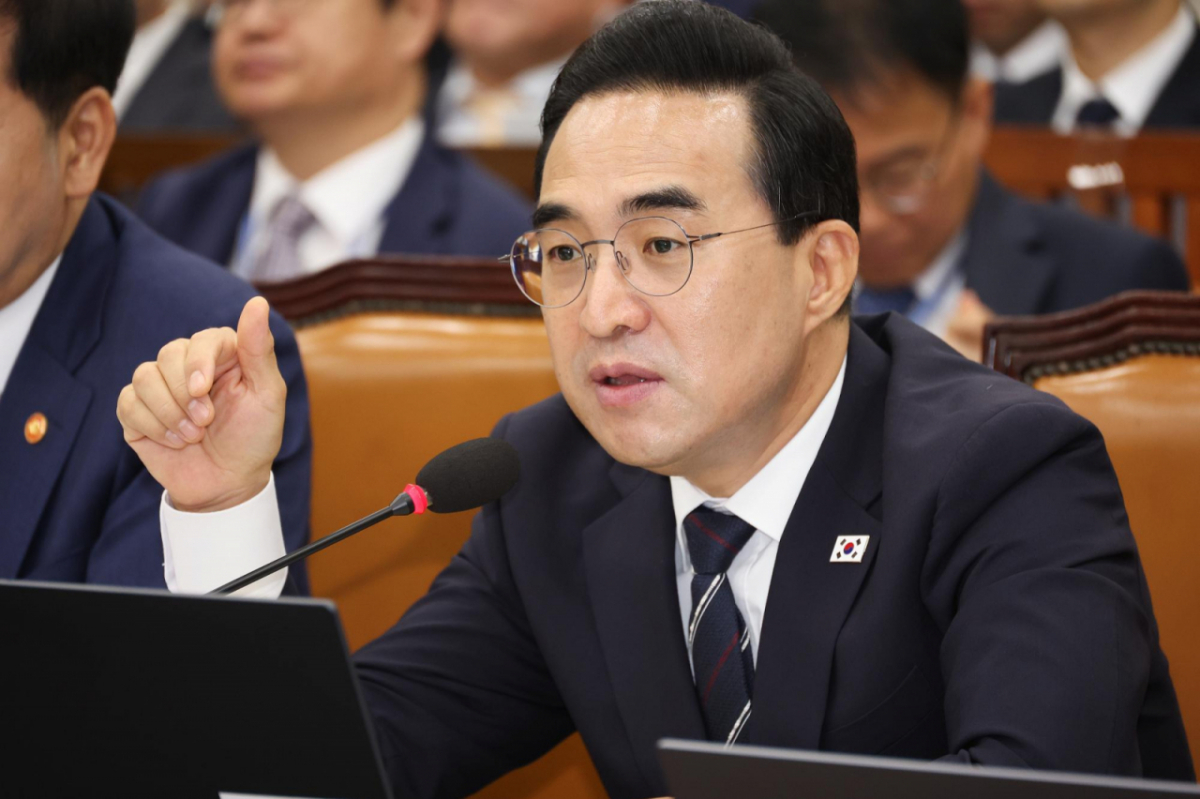
Park Hong-geun stated that the current system, which automatically allocates 20.79% of domestic taxes to the Local Education Fiscal Grant (hereinafter "Education Grant"), is a structural reform task that cannot be delayed further.
Park (Minister) made these remarks while appearing on SBS's "Joo Young-jin's News Briefing" on the 5th afternoon.
The Education Grant system was introduced in the 1970s when approximately one million children were born annually. It was designed to automatically allocate 20.79% of domestic taxes to address poor educational financing. However, as the school-age population has declined each year due to low birthrates while the scale of domestic taxes has grown, the need for structural reform has been consistently raised.
Park (Minister) said, "The Education Grant system was introduced in 1972, when one million children were born annually, linked to domestic taxes. However, we are now in an era where only 200,000 children are born."
He continued, "After analyzing the Education Grant over the past 20 years, I found that there were six years in which it actually decreased compared to the previous year. This was due to (the linkage structure with) domestic taxes." He particularly noted, "Even during the Yoon Suk-yeol administration, for two years, the Education Grant did not reach its originally planned amount."
Regarding this issue, Park (Minister) emphasized that per-student grants, currently at the highest level among OECD countries (approximately 13 million won annually), will not be reduced but will continue to increase in line with long-term trends. He explained that breaking the linkage structure with domestic taxes would actually enhance the fiscal stability of the Education Grant.
He repeatedly stated that funds saved through structural reform would be used for higher education, lifelong learning, and early childhood education.
Meanwhile, regarding the establishment of a Future Response Fund utilizing additional tax revenues, Park (Minister) said, "If we spend all the revenue generated from semiconductors in a single year solely on consumption, it would be an extremely inefficient investment for the nation. Therefore, we are planning to create a Future Response Fund to allocate (additional tax revenues) strategically rather than only for consumption."
He further emphasized, "South Korea's potential growth rate has fallen to the mid-1% range, and there are projections that it may drop to 0% in the future. The Future Response Fund is a platform designed for strategic investment to reverse this decline in potential growth."
The Future Response Fund will operate on two main pillars. First, it will serve as a catalyst for reversing the potential growth rate through investments in youth, growth drivers, local regions, and talent development. Second, it will function as a stabilization mechanism to supplement fiscal capacity.
Park (Minister) explained, "One aspect is strategically investing part of the fund. The other aspect involves investing in areas that generate returns higher than interest rates through asset management companies via bonds or stocks. This allows the fund's surplus to be utilized when tax revenues fall short or when supplementary budgets must be compiled, operating the fund in two directions."

 in ECONOMY
