

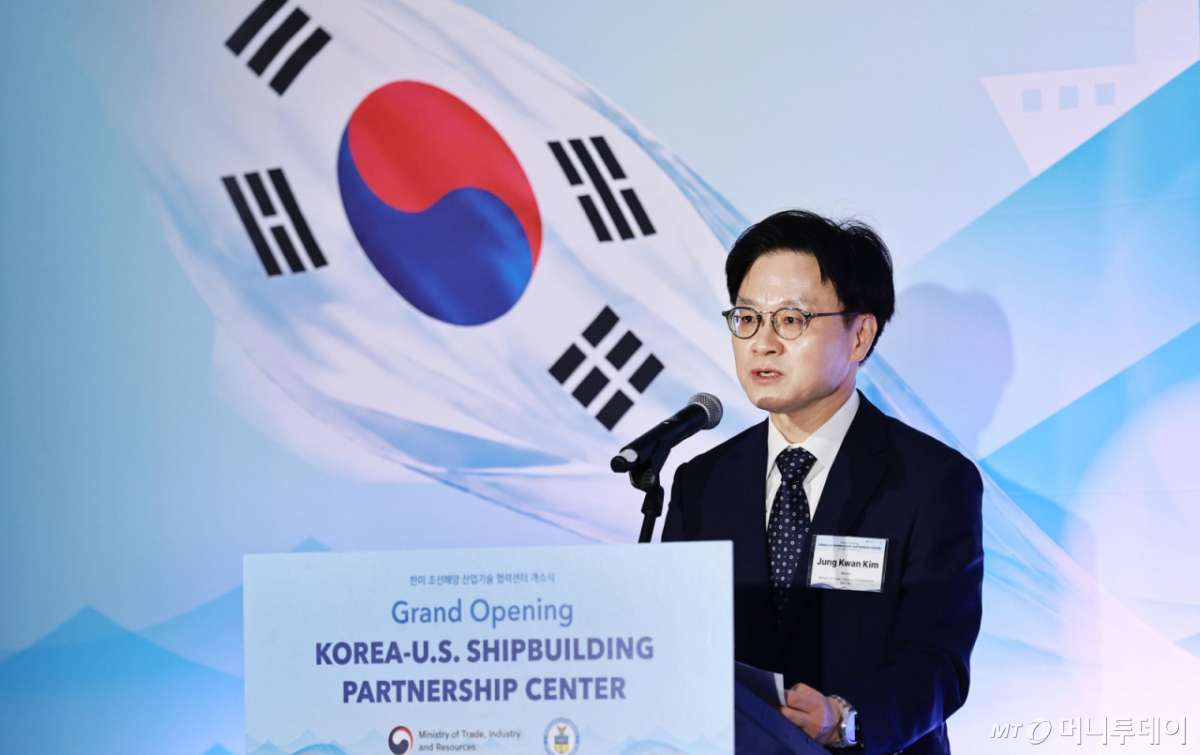
Kim Jeong-kwan, Minister of Trade, Industry and Energy, emphasized a "race against time" to strengthen semiconductor competitiveness and raised the need for adjustments to the 52nd-hour workweek system and reforms to the performance pay system. He also outlined his stance on industrial and trade issues, including the direction of operating semiconductor production bases and joining the CPTPP (Comprehensive and Progressive Agreement for Trans-Pacific Partnership).
Kim Jeong-kwan said at a Gwanhun seminar held at the Seoul Press Center on the 6th that "the semiconductor market, which is expected to grow to 1 trillion won within the next five years, is an industry where once customer relationships are secured, they do not easily change," and added, "We must seize the market at the fastest possible speed we can achieve."
He continued, "When the current $200 billion market grows to 1 trillion won, if we fail to maintain our current market share, strategic assets like semiconductors could weaken. Since it is difficult for companies to re-enter the market once they lose customers or fail to respond to demand in time, both the government and companies must move faster than they are now," he stressed.
He also expressed strong concern over China's pursuit of semiconductor capabilities. Kim Jeong-kwan stated, "China's semiconductor technology, scale, and speed are truly shocking and give me goosebumps. I get the feeling that China is advancing rapidly in materials, components, and equipment sectors. I hope all economic actors in our country accept this reality with a sense of crisis."
Kim Jeong-kwan also noted that improving the research and development environment is necessary to secure semiconductor competitiveness. He said, "I do not believe the 52nd-hour workweek issue applies only to the Semiconductor Act. The system should not crush the will of people striving to achieve something through hard work or their enthusiasm for R&D. While some minimum rules are necessary, the 52nd-hour workweek system needs to be adjusted."
He then shared an anecdote heard in Chongqing, China, explaining, "I heard that when China introduced working hour regulations, IT company workers protested by asking, 'How can we compete with other companies if we work like this?' and 'Why are you preventing us from wanting to work?' The internal competition in China is truly immense."
He added, "Especially the R&D sector and startups are domains for young people who have nothing but the will to use their brains and work hard. The government must not forcibly block the will of young people who want to work hard."
Kim Jeong-kwan also stated that system improvements regarding performance pay distribution methods are necessary for continuous reinvestment in the semiconductor industry. He pointed out, "The owners of a company are shareholders and investors; management and labor cannot be placed above the interests of shareholders and investors."
Furthermore, he said, "Semiconductors are strategic assets that must be reinvested for future generations when profits are made. To pay extraordinary performance bonuses, a system requiring at least approval from the shareholders' meeting or board of directors is necessary." He added that discussions with relevant ministries on amendments to the Capital Markets Act and Commercial Act are underway.
He also explained the reasons for selecting the Honam region as a new semiconductor production base. Kim Jeong-kwan noted that while he will push forward to accelerate the Yongin semiconductor cluster, relying solely on planned production facilities in Yongin would make it difficult to meet future demand. He stated that since the metropolitan area faces limitations in securing power, water resources, and transmission grids, the Honam region was selected as an additional production base due to its relatively higher regional acceptance.
Regarding trade issues, he emphasized the necessity of joining the CPTPP. Kim Jeong-kwan said, "As a nation that lives by trade, South Korea needs to join the CPTPP. This is a matter that must be judged from the perspective of national interest after sufficient communication and persuasion with the agricultural, fisheries, and forestry sectors."
He added that negotiations on U.S. Trade Act Section 301 tariffs are continuing to conclude at a level no more disadvantageous than that of competing countries, and regarding the Coupang personal information leak incident, he is actively explaining the situation to prevent misunderstandings within the U.S. political sphere.

 in ECONOMY
