

The industry and legal circles are pushing back against the Fair Trade Commission's decision to fine Samsung Electronics about 20 billion won for allegedly deceptive advertising of its Game Optimizing Service (GOS) on Galaxy smartphones.
The case appeared to be nearing closure after consumers in South Korea and abroad withdrew their lawsuits and complaints, and a court ruled that the advertising could not conclusively be deemed deceptive. However, the FTC has now revived the case four years later and imposed a separate administrative sanction.
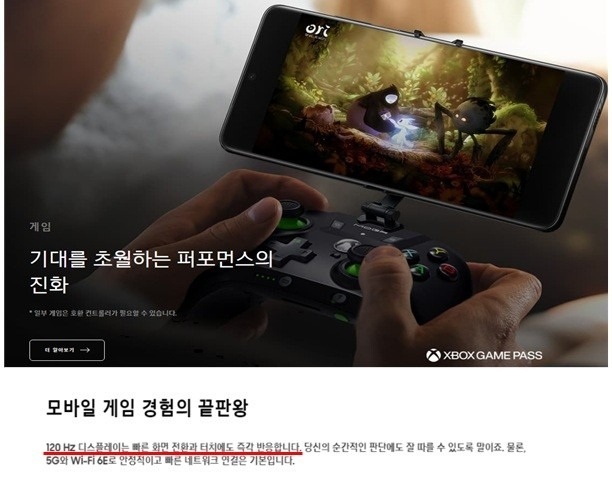
On Tuesday, the FTC said it had determined at a plenary meeting on Oct. 14 that Samsung Electronics had engaged in deceptive advertising by promoting the gaming performance of the Galaxy S21, Galaxy S22 and Galaxy Tab S8 without disclosing that the Game Optimizing Service (GOS) restricted device performance.
The commission issued a corrective order prohibiting similar advertising and imposed a fine of about 20 billion won, equivalent to roughly 0.5 percent of the relevant sales.
What is GOS?
GOS is software that adjusts Application Processor (AP) performance to suppress heat generation and manage battery consumption when running high-specification games. However, in 2022, false information claiming that “GOS uniformly degrades smartphone performance” spread online. Some consumers filed complaints with the Korea Fair Trade Commission and initiated class-action lawsuits, alleging that products were advertised without disclosing performance degradation.
In this regard, a first-instance court last year dismissed all claims for damages, ruling that no damage had occurred to consumers. The Seoul High Court issued a compulsory mediation decision in February, determining that it was difficult to definitively classify Samsung Electronics’ advertising as deceptive under the Act on Consumer Protection in Electronic Commerce and Mail Order Sales.
In its decision document, the Seoul High Court stated that individual GOS policies were necessary measures adopted to suppress heat generation, maintain battery performance, and ensure stable Frames Per Second (FPS), and that device performance must be assessed by comprehensively considering heat, battery, and FPS, not just AP clock speed (application processing speed). Therefore, it is difficult to definitively conclude that GOS itself degraded device performance. The decision also noted that the plaintiffs’ complaints had been resolved through software updates.
Over the following four years, none of the 1,690 plaintiffs and mediation participants objected to this decision, which became final on March 18. On that day, the complainants also withdrew their complaints and petitions filed with the Korea Fair Trade Commission. Lawsuits in the United States, Israel, and other countries were also concluded through withdrawal of claims.
Korea Fair Trade Commission imposes sanction based on YouTuber videos instead of direct experiments… Weak basis
Of course, the court’s mediation decision and the dismissal of civil damage claims do not serve as a basis for the Korea Fair Trade Commission’s administrative sanctions. The Commission can determine whether advertising misled consumers, independent of individual consumer liability for damages.
However, the industry and legal community are questioning the basis for the sanction and the calculation of the fine. Specifically, they question whether it is appropriate to impose a fine based on significant consumer impact and unjust enrichment, given that the Korea Fair Trade Commission relied on test videos posted online by some YouTubers rather than conducting direct experiments, resulting in somewhat weak evidentiary support, even though consumers had withdrawn their lawsuits and complaints.
The GOS settings subject to the sanction are no longer in use, and a GOS update was provided in March 2022, immediately after the issue arose. No court domestically or internationally has ever issued a ruling recognizing legal liability for Samsung Electronics.
Lee & Ko, the law firm representing Samsung Electronics, stated, “Heat management and performance sustainability are common challenges faced by all smart device manufacturers, and GOS is the result of Samsung Electronics’ efforts to address these issues. It is difficult to accept the determination that failing to include GOS operating methods in advertisements constitutes deceptive advertising.”
The firm added, “The specific optimization content at issue was intended to ensure smooth, uninterrupted gameplay for a small number of games where high heat generation was actually confirmed, thereby enabling superior game execution performance.”
The firm continued, “The GOS settings subject to the sanction are no longer in use, and a GOS update was provided in March 2022, immediately after the issue arose. Since then, neither domestic nor international authorities have issued any sanction or ruling recognizing legal liability for Samsung Electronics. Nevertheless, we regret this decision, which isolated specific settings at a particular point in time from the software and deemed them deceptive advertising.”
Samsung Electronics also said, “After receiving the Korea Fair Trade Commission’s resolution document and reviewing its specific contents, we will demonstrate through litigation proceedings that the advertising in question does not violate the Act on Consumer Protection in Electronic Commerce and Mail Order Sales.”

 in TECH
