

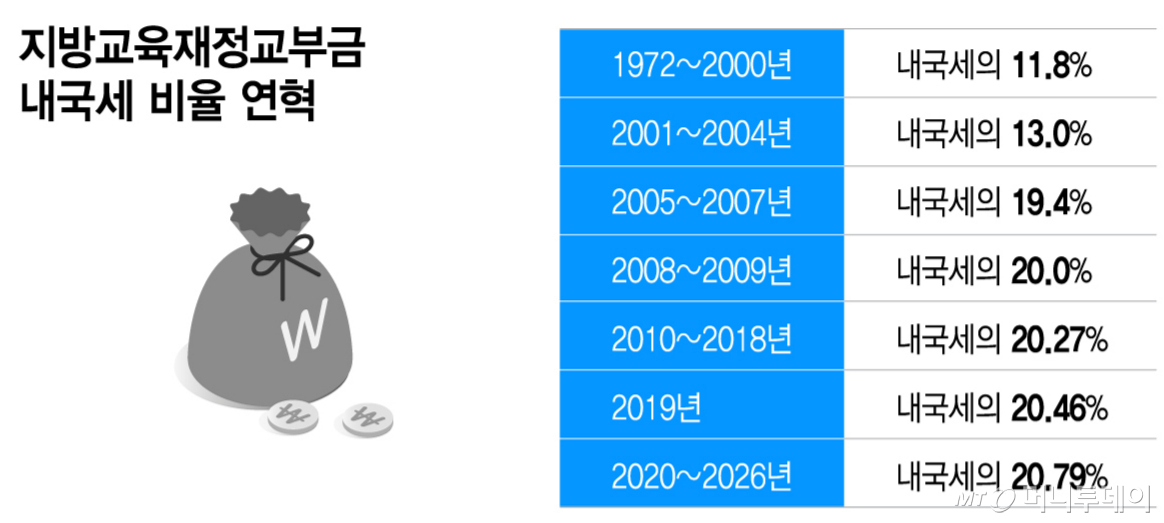
The government is moving to abolish, for the first time in 54 years, the structure linking the Local Education Grant (hereinafter "Education Grant") to domestic tax revenues. For the government's proposal to pass, it must clear the National Assembly hurdle. Even within the ruling party, opposition has emerged early on, making the legislative process at the National Assembly a key point of attention.
The Ministry of Economy and Finance held a Fiscal Operation Strategy Council meeting on the 21st and unveiled plans to reform the Education Grant. The proposal was developed based on consultations between the Ministry of Economy and Finance and the Ministry of Education, with its core being the dismantling of the domestic tax-linked structure.
The Education Grant is funded at 20.79% of domestic taxes and used by local education offices. The domestic tax-linked structure, which began in 1972, saw its linkage rate rise year after year. Fiscal authorities have maintained that the structure should be abolished amid a declining school-age population.
In fact, the school-age population dropped from 8.8 million in 2010 to 5.91 million in 2025. However, due to its linkage with domestic taxes, the Education Grant has trended upward. Moreover, fluctuations in tax revenue have led to inconsistent amounts for the Education Grant—59.6 trillion won in 2021, 76 trillion won in 2022, and 65.4 trillion won in 2023—failing to show a stable trend.
Furthermore, since the Education Grant can only be used by education offices responsible for elementary and secondary education, concerns have frequently been raised about its "compartmentalized structure." As a result, fiscal authorities have consistently advocated for reforming the Education Grant, while education officials have defended the status quo. This time, however, the government's proposal emerged after a consultation process.
According to the reform plan, future Education Grants will be calculated by reflecting economic conditions and changes in the school-age population. The method involves multiplying last year's grant amount by 35% of the three-year average annual real GDP growth rate plus the three-year average annual change rate in the school-age population.
The government guarantees that, excluding transfers to the newly established Future Response Fund, the difference between the current 20.79% domestic tax allocation and the reformed grant amount will be secured as revenue for the education and talent account of the Future Response Fund. This account will be used for early childhood and high school (university) education, lifelong learning, talent recruitment, and other purposes.
In particular, if the Education Grant amount decreases compared to the previous year, the shortfall will be compensated from the Future Response Fund, ensuring that the total amount does not decline. This provision is explicitly stated in the Education Grant Act, taking into account backlash from the education sector over potential reductions in total funding due to the reform.
A Ministry of Economy and Finance official stated, "While reasonably reflecting changes in the educational environment such as the declining school-age population, we will stably expand elementary and secondary education finances to support growing future education demands." The official added, "We plan to expand strategic education investments across all life stages using resources secured through the Education Grant reform."
For this Education Grant reform proposal to be finalized, the Education Grant Act must be amended. The Education Grant is managed not by the National Assembly's Finance and Economy Committee, which oversees the Ministry of Economy and Finance, but by the Education Committee.
The situation is not favorable. At the party-government council meeting held on the 20th, members of the Education Committee from the Democratic Party of Korea expressed opposition to abolishing the domestic tax-linked structure. A member of the Education Committee named Baek Seung-a (Rep.) said, "Education Committee members generally hold the view that the linkage system should be maintained."

 in ECONOMY
