

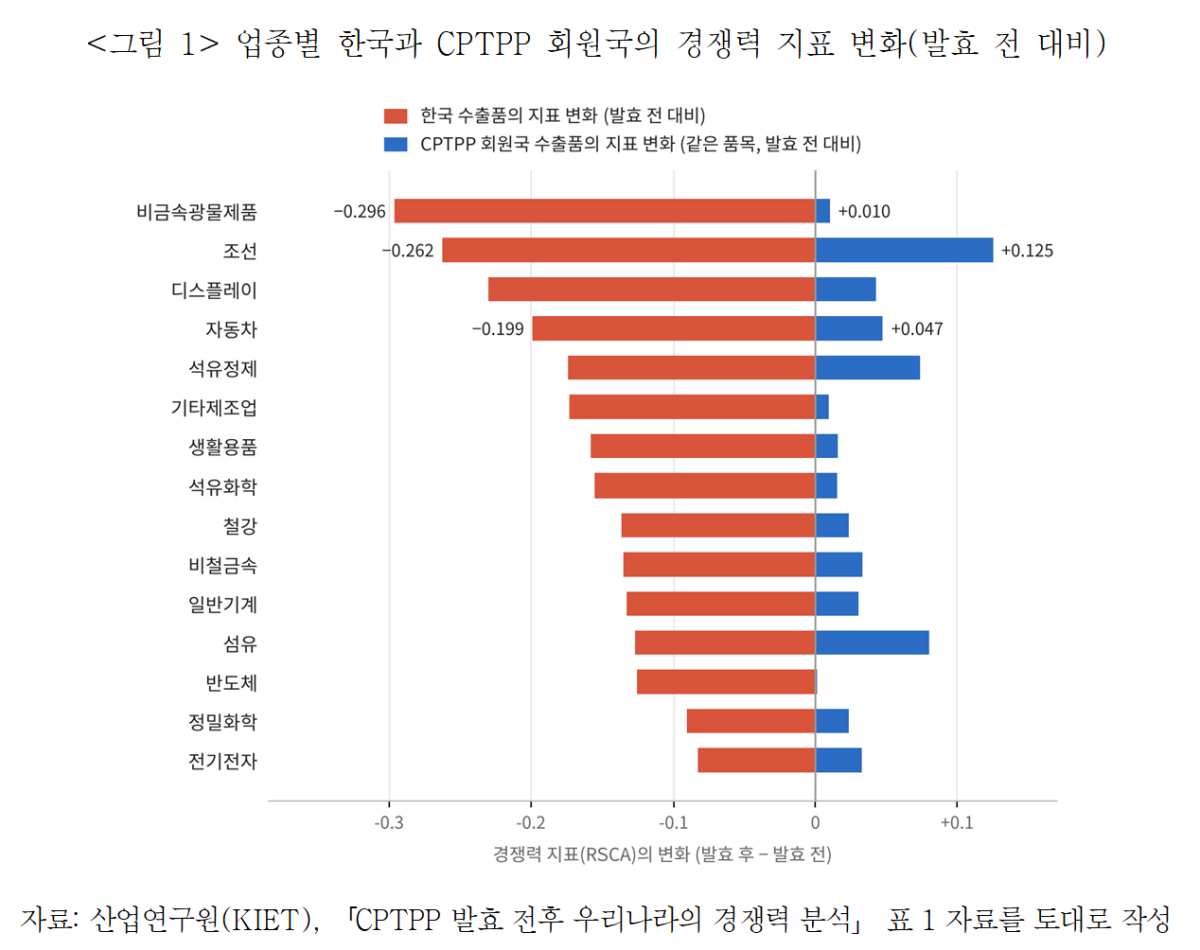
A study found that the export competitiveness of major Korean products, including semiconductors and automobiles, has declined in countries covered by the Comprehensive and Progressive Agreement for Trans-Pacific Partnership (CPTPP) since its entry into force. The analysis suggests that the tariff reduction effects among member states have lowered the competitiveness of Korean products not part of the CPTPP. Concerns are also raised that continued non-membership could lead to further declines in competitiveness.
The CPTPP is a multilateral free trade agreement (FTA) designed to lower trade barriers and promote free trade among member countries, officially entering into force in December 2018. Currently, 12 countries participate, including Japan, Canada, the United Kingdom, Australia, and Mexico. South Korea is currently conducting review work for CPTPP accession.
According to a report titled "Analysis of South Korea's Competitiveness Before and After the Entry into Force of the CPTPP," published by the Institute of Industrial Technology on the 14th, among the 5,185 items analyzed, 2,474 items—accounting for 47.7%—showed a decline in competitiveness indicators for Korean exports in the CPTPP market after entry into force (2021–2024) compared to before (2012–2018).
The Institute of Industrial Technology measured product competitiveness using an indicator called the Revealed Symmetric Comparative Advantage (RSCA). This indicator has values ranging from minus (-) 1 to 1, with higher values indicating that a particular item holds a relative strength in that market. The report compared periods before and after entry into force for 11 CPTPP member countries (excluding the United Kingdom due to its short membership period), excluding 2019–2020 when the impact of the novel coronavirus was significant.
Based solely on the RSCA indicator, there are more items with increased competitiveness (2,711) than those with decreased competitiveness (2,474). The issue is that while competitiveness declined for these specific Korean items, the intra-regional competitiveness of CPTPP member countries' products rose, creating a contrast.
When classifying the declining items into 15 industries, non-metallic minerals showed the largest drop at -296, followed by shipbuilding (-0.262), displays (-0.23), automobiles (-0.199), petroleum refining (-0.174), other manufacturing (-0.173), daily necessities (-0.158), and petrochemicals (-0.155). Semiconductors (-0.126) and electrical electronics (-0.083) showed relatively smaller declines.
For the declining items, CPTPP member country indicators rose across all 15 industries. In shipbuilding, which had the second-largest drop, the CPTPP member country indicator rose by 0.125, showing the largest gap. The CPTPP member country indicator also rose in petroleum refining (0.074), automobiles (0.048), and displays (0.043), presenting a contrast. This means that while the position of Korean items in the CPTPP market has shrunk, product competitiveness among CPTPP member countries has increased.
Automobiles were identified as an item where differences in tariff conditions with CPTPP member countries likely affected competitive conditions. The report stated, "Among automobiles, a clear contraction in intra-regional competitiveness was observed after the entry into force of the CPTPP for three items (passenger cars with 1,000–1,500cc engines, passenger cars with 1,500–3,000cc engines, and electric vehicles)," adding, "South Korea is the only country among the 11th CPTPP members without a preferential trade agreement with Mexico, so the resulting tariff gap may have had an impact."
A contraction in competitiveness within the CPTPP market was also observed among South Korea's top export items. The indicator for memory semiconductors fell by 0.019 after entry into force, and declines were also seen in paraxylene (-0.743), tankers (-0.175), and other integrated circuits (-0.077).
The report expressed concern that if South Korea's non-member status continues, the intra-regional competitiveness of Korean products could further deteriorate. The report stated, "The status of being a non-member of the CPTPP needs to be approached not from the perspective of 'additional benefits,' but as a matter of survival where our position in the intra-regional market could weaken if we do not join," and added, "Follow-up discussions are also needed, including reviewing ways to improve trade relations with Mexico, monitoring by item, and providing tariff and origin information to companies."

 in ECONOMY
