

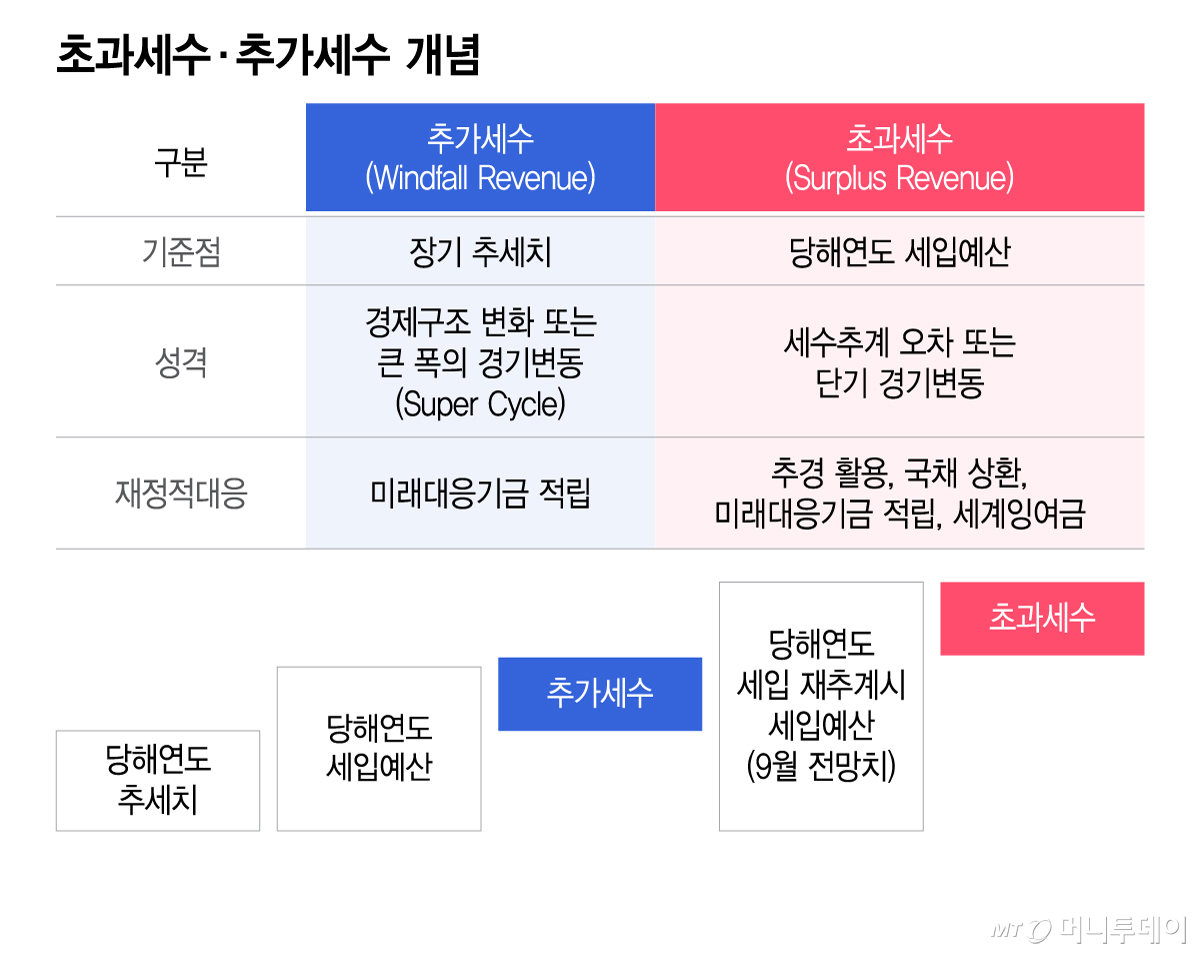
The background behind the establishment of the 'Future Response Fund' is the semiconductor super-boom. Record-breaking financial results from Samsung Electronics and SK Hynix have led to corporate income taxes and personal income taxes being collected more than expected, making the utilization of additional tax revenue a key issue. The government has decided to use the Future Response Fund not as a one-time or populist expenditure, but as a catalyst to reverse potential growth rates.
In this process, a structural reform of the Local Education Grant (hereinafter Education Grant), which has maintained an internal tax linkage structure for 54 years, will also be implemented. The Local Allocation Tax will also be reorganized. As a result, the central government's influence over education and local finances is expected to expand.
Future Response Fund exceeds 100 trillion won
According to relevant ministries on the 21st, the Ministry of Planning and Budget, the Ministry of Education, and the Ministry of the Interior and Safety will publicly announce a package bill for the establishment of the Future Response Fund from the 24th to the 29th. The related bills are scheduled to be submitted to the National Assembly next month along with next year's budget proposal.
The Future Response Fund is a kind of 'fiscal warehouse' that stores surplus fiscal capacity for use when funds are short. This is the background for securing the fund's resources from △additional tax revenue, △excess tax revenue, and △surplus balance of world surplus funds.
A scale of 100 trillion won plus alpha (α) is being discussed for the Future Response Fund. The government defined the benchmark for additional tax revenue as the average annual increase rate of domestic taxes over the past 10 years in terms of long-term trends. It is estimated that only the pure surplus amount, calculated by subtracting the long-term trend application value from next year's tax revenue budget, will exceed 60 trillion won. Additionally, resources transferred to the fund due to changes in the Education Grant calculation formula are estimated at about 20 trillion won. If excess tax revenue resulting from this year's strong tax collection is also absorbed into the fund, projections suggest that a fund exceeding 100 trillion won will be accumulated through simple calculations.
However, the government has not disclosed the specific scale of the fund. It plans to announce details along with the 2027 budget proposal and other documents after reflecting the Ministry of Economy and Finance's forecast for next year's national tax revenue and the re-estimation results of this year's tax collection.
The government plans to concentrate investments in four key areas through the Future Response Fund: △youth, △growth engines, △local regions, and △education and talent.
The Future Response Fund also serves as a stabilization device to supplement fiscal capacity. In the case of semiconductors, which form the background for additional tax revenue, boom and bust cycles repeat. In fact, during the semiconductor industry downturn in 2023 and 2024, large-scale tax revenue deficits could not be avoided. This was a complex result of factors such as Samsung Electronics recording operating losses during this period and paying not a single won in corporate income tax.
The government's plan is to invest the Future Response Fund through asset management companies in areas that generate returns higher than interest rates, such as bonds or stocks, and to utilize fund surplus when tax revenue collapses or supplementary budgets must be compiled.
However, even with the government's plan to establish the Future Response Fund, controversy over the utilization of additional tax revenue is expected to continue. This is because the long-standing debate between 'fiscal prudence' and 'active fiscal policy' remains an ongoing issue. The People Power Party is immediately arguing that surplus funds from additional tax revenue should be used for national debt repayment in accordance with the National Fiscal Act.
In this regard, a Planning Bureau official stated, "While one may think national debt should be repaid first, it is necessary to comprehensively consider the need to mitigate overall tax revenue volatility and quickly strengthen finances in cases of tax revenue deficits." The official added, "We will strive to operate the Future Response Fund's surplus funds so that they exceed the national debt interest rate."
Education Grant abolishes 54-year-old domestic tax linkage structure... Local Allocation Tax also reorganized
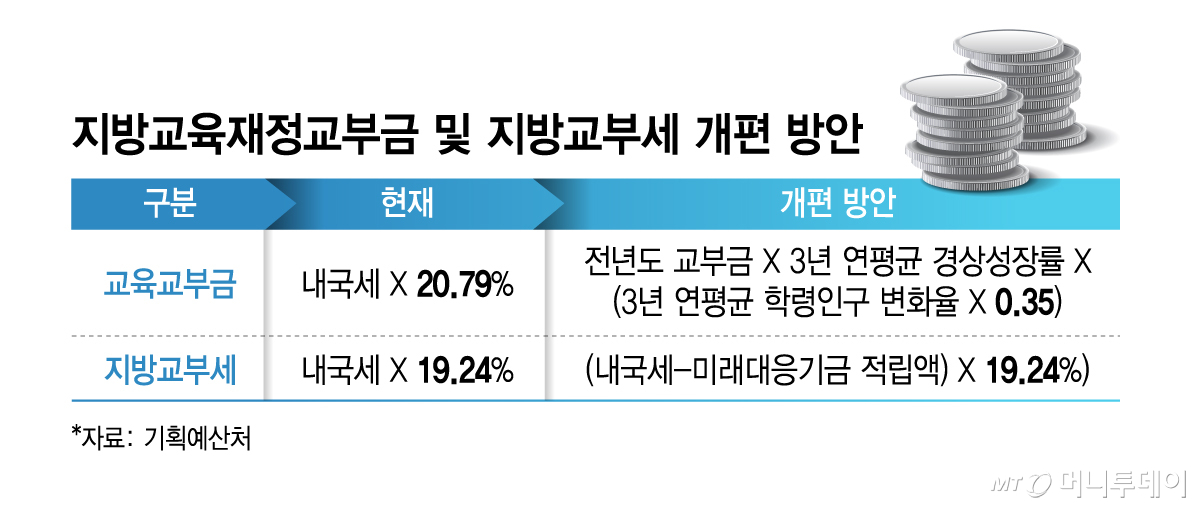
The Future Response Fund is composed of △General Account, △Youth Account, △Growth Engine Account, △Local Account, and △Education and Talent Account according to investment purposes.
A field of note is the Education and Talent Account. This is related to the Education Grant, which will abolish the domestic tax linkage structure for the first time in 54 years.
The Education Grant system was introduced in the 1970s when approximately 1 million children were born annually. It was designed with a structure that automatically allocates 20.79% of domestic taxes to address poor education finances.
However, as the school-age population (6-17 years old) has decreased annually due to low birth rates while the scale of domestic taxes has grown, the need for structural reform has been consistently raised. In fact, the school-age population, which was 10.73 million in 1972 when the system was introduced, has shrunk to 4.922 million this year (mid-range population projection by the National Data Agency). Meanwhile, the Education Grant increased from 43.2 trillion won in 2016 to 76.4 trillion won based on this year's supplementary budget, an increase of about 76.8%.
Another problem with the Education Grant is that it is a representative 'partitioned' budget. This is because the Education Grant can only be utilized for kindergarten, elementary, and secondary education. While South Korea's investment in primary and secondary education reaches 166% of the OECD average, investment in higher education is only 69%.
Consequently, fiscal and education authorities reached an agreement to introduce a new calculation formula after marathon negotiations. Instead of abolishing the domestic tax linkage structure, the method involves multiplying the previous year's grant by the recent three-year average nominal economic growth rate and 35% of the school-age population change rate.
By reflecting the nominal economic growth rate, a safety mechanism has been established to ensure that the total amount of the Education Grant does not decrease compared to the previous year but continues to increase steadily. This also helps prevent the side effect of the Education Grant scale jumping up and down annually depending on tax revenue conditions.
Resources saved through the reorganization of the Education Grant (the difference in 20.79% of domestic taxes excluding additional tax revenue) will be accumulated in the Education and Talent Account within the Future Response Fund. The plan is to reinvest these funds into early childhood, higher, and lifelong education. This is to remove partitions in the education budget.
In particular, a safety mechanism that compensates for any decrease in the Education Grant compared to the previous year from the Education and Talent Account will be explicitly stipulated in the law.
Furthermore, as part of establishing a fiscal stabilization device, the government is also pushing for the reorganization of the Local Allocation Tax. Currently, 19.24% of domestic taxes are automatically allocated to the Local Allocation Tax revenue source. The government plans to maintain the linkage structure of 19.24% but will pursue a structural reform that excludes the amount accumulated in the Future Response Fund from domestic taxes.
However, from the perspective of local governments, there may be dissatisfaction as the Local Allocation Tax could decrease compared to before the structural reform. This is because when excess tax revenue and additional tax revenue occur, the allocation structure results in a reduction of the tax compared to now.
The government plans to include provisions in the Local Allocation Tax Act that allow local governments to be supported through the 'Local Account' within the Future Response Fund if the Local Allocation Tax falls below the long-term trend line or if a tax revenue deficit occurs.
Regarding this, some observers predict that the central government's influence over education and local finances will expand through the government-led Future Response Fund.
Park Hong-geun Gi Hoek-cheo (Minister) stated, "Despite adjustments to the allocation tax and reforms to the grant system, support for local and education finances will never decrease. If financial conditions deteriorate rapidly, the central government will actively assist." He added, "Furthermore, under the principle of preferential treatment for local regions, more projects will be supported through the fund."

 in ECONOMY

