

Both the growth rate and absolute increase in the number of births in the first half of this year reached record highs. The total fertility rate (the average number of children a woman is expected to have over her lifetime) averaged 0.92 in the first half, drawing attention to whether it will return to the 0.9 range for the full year for the first time in seven years.
In particular, last year's age-specific fertility rate (the number of births per 1,000 women in a given age group) rebounded or reached record highs across most age groups.
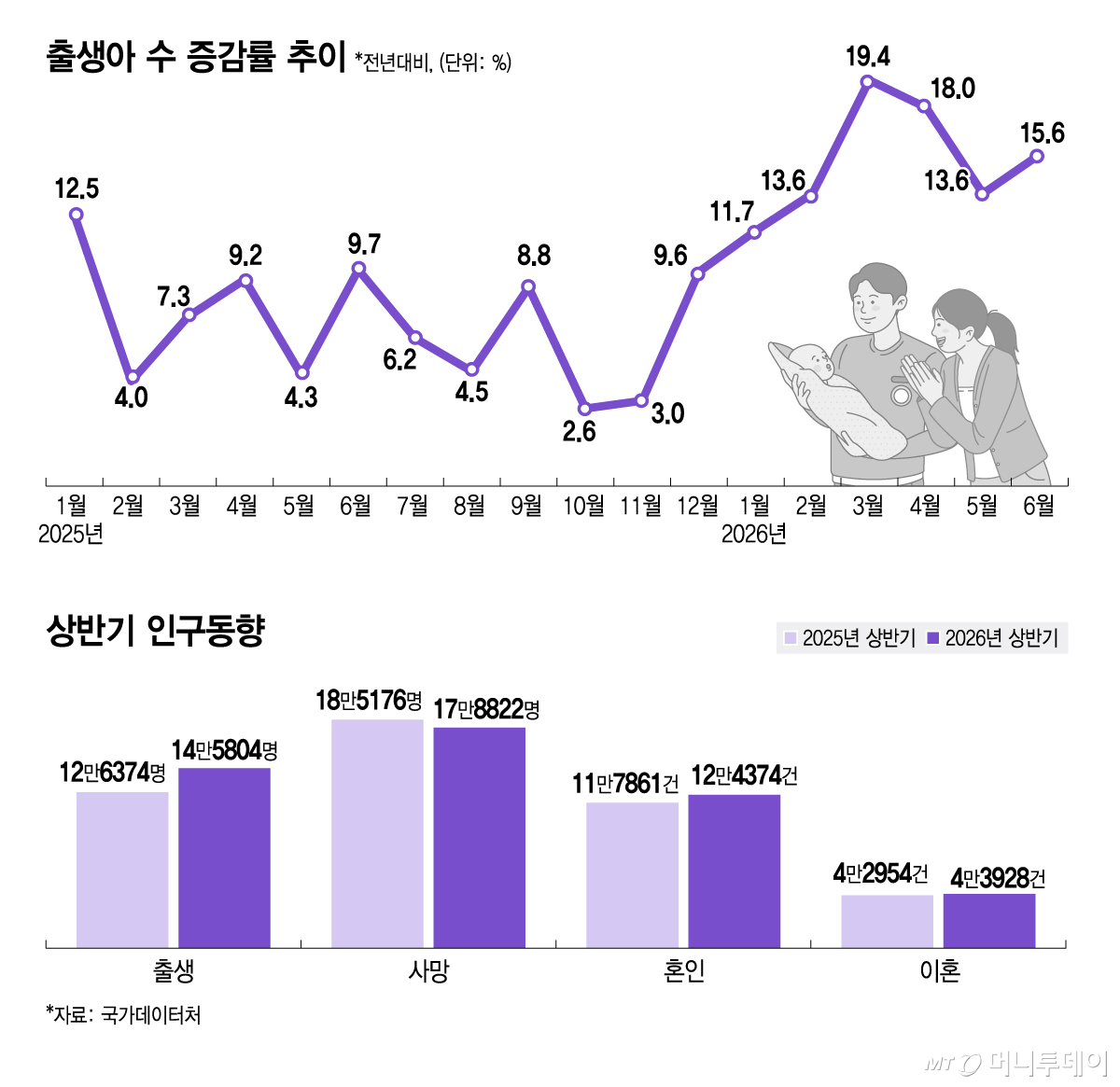
According to the "June 2026 Population Trends" released by the National Data Administration on the 26th, the number of births in June was 23,111, an increase of 15.6% (3,115) from the previous year. This marks a 24-month consecutive increase. The birth growth rate was the highest for any June on record, and the absolute increase also reached its largest figure in 34 years.
The cumulative number of births in the first half of this year (January to June) totaled 145,804, a 15.4% (19,430) increase from the previous year. Both the growth rate and the absolute increase are record highs. On a quarterly basis, the upward trend has continued for nine consecutive quarters since the first quarter of 2024.
Park Hyun-jeong, chief of the Population Trends Division at the Data Administration, said, "The recovery in marriages following the transition to endemic status in May 2023, an increase in the female population in their 30s, and a positive shift in perceptions about childbirth have all contributed in complex ways."
The total fertility rate for last June was 0.88, an increase of 0.11 from the previous year. Looking at this year's monthly fertility trends: the 0.99, the 0.93, the 0.93, the 0.93, the 0.85, and the 0.88. The rate remained in the 0.9 range through April but has been in the 0.8 range for two consecutive months. A simple calculation of the first-half total fertility rate yields approximately 0.92; if this trend continues, there is a high probability of returning to the 0.9 range for the first time in seven years.
Chief Park said, "We expect the trend to continue as the population in their early 30s—the core age group for marriage and childbirth—has recovered," adding, "Marriages were higher in the second half of both 2024 and 2025. If this pattern continues, there is a possibility of recording the 0.9 range, but we need to wait and see."
Although the number of births continues to rise, the number of deaths exceeded it. The number of deaths in the first half of this year was 178,822, down 3.4% from the previous year, resulting in a natural decrease of 33,018 for the first half. This marks an 80th consecutive month of natural decrease since November 2019 (-1,685).
The number of marriages is also maintaining high levels. Last June recorded 21,075 marriages. The Data Administration analyzes that, considering the reduction in reported cases due to public holidays, this represents a 27-month consecutive increase since March 2024. In the second quarter, there were 62,065 marriages, the highest for any second quarter since 2018, eight years later. This marks the 10th consecutive quarter of increases since the first quarter of 2024.
The Data Administration also released last year's finalized birth statistics. Last year's number of births was 254,300, an increase of 16,000 (6.7%) from the previous year. The total fertility rate rose to 0.80, an increase of 0.05. This year's birth numbers are expected to see a second consecutive increase after last year's annual birth count and total fertility rate rebounded for the first time in nine years.
By region, the total fertility rates were highest in Jeollanam-do (1.09), Sejong (1.06), and Chungcheongbuk-do (0.96), and lowest in Seoul (0.63), Busan (0.74), and Gwangju (0.76). In particular, all provinces and cities recorded increases compared to the previous year: Chungcheongbuk-do (+0.08), Jeollanam-do (+0.07), and Busan, Gwangju, Incheon, Ulsan, and Gyeongsangnam-do (+0.06).
Age-specific fertility rates were as follows: 15–19 years (0.4), 20–24 years (3.8), 25–29 years (21.2), 30–34 years (73.1), 35–39 years (52.1), 40–44 years (8.5), and 45–49 years (0.3). In particular, the proportion of multiple births (twins or more) reached 6.1%, surpassing 6% for the first time.
Chief Park said, "Women in their late 20s saw an increase for the first time since 2007," and added, "Women in their late 30s and early 40s also recorded the highest fertility rates on record. Those aged 45 and over also reached the highest figures since 1988."

 in ECONOMY

