

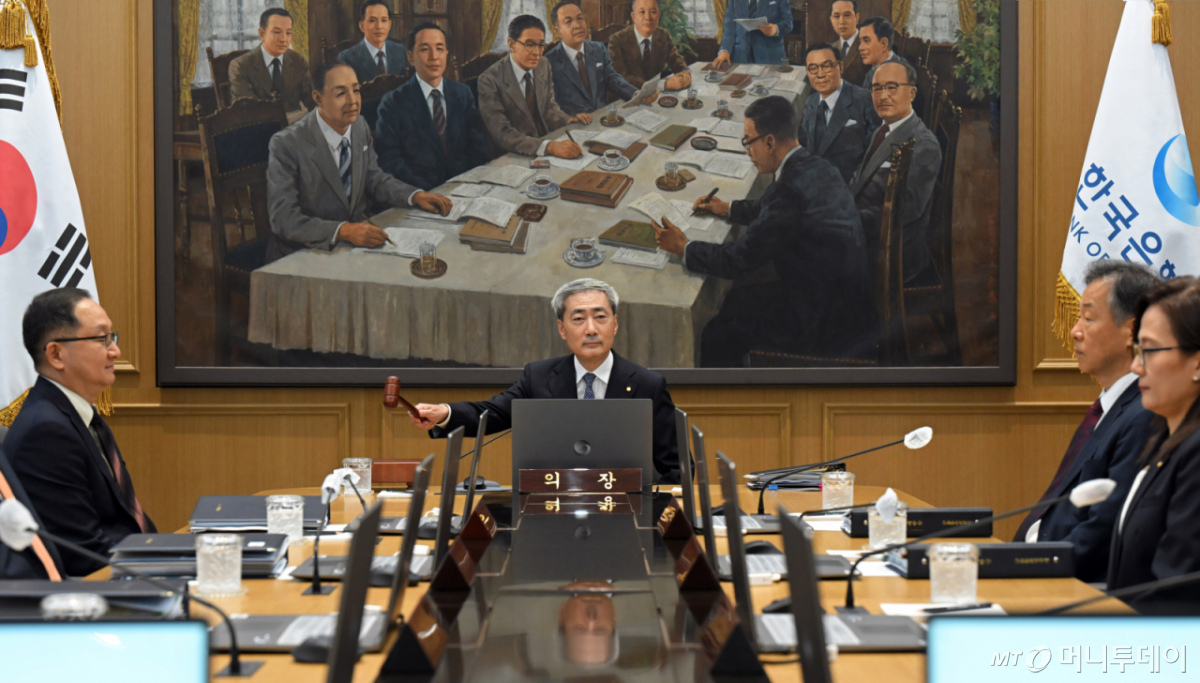
The Bank of Korea Monetary Policy Board raised the base rate to an annual 3.00%. This marks a second consecutive rate hike following last month's decision to resume rate increases after a three-and-a-half-year pause, in what is termed a "back-to-back" increase. The move is interpreted as a preemptive response to stronger-than-expected growth momentum, demand-side inflationary pressures, and financial imbalances such as real estate prices and household debt.
On the morning of the 27th, the Bank of Korea Monetary Policy Board held a monetary policy direction meeting at its headquarters in Jung-gu, Seoul, and announced an increase in the base rate from an annual 2.75% to 3.00%, a rise of 0.25 percentage points.
The decision to raise rates for two consecutive months was driven by sustained export growth centered on semiconductors alongside improving domestic demand indicators, which led to stronger-than-anticipated economic growth. As the economy recovered, concerns grew that demand-side inflationary pressures could push up core inflation, further influencing the decision.
Rising real estate prices and increasing household loans also contributed to the rationale for the rate hike. By the end of the second quarter this year, total household credit reached 20.198 trillion won, an increase of 25.9 trillion won from the previous quarter, surpassing the historic milestone of 20 trillion won for the first time. Particularly amid a stock market boom, other loans such as credit card loans surged significantly, prompting heightened vigilance from the Bank of Korea regarding financial stability.
On this day, the Bank of Korea revised its economic outlook in its updated forecast, raising the growth projection for this year from 2.6% to 3.3%, reflecting stronger semiconductor exports and the effects of expansionary fiscal policies. The growth forecast for next year was also adjusted upward from 2.1% to 2.9%. Meanwhile, the consumer price inflation forecast remains unchanged at 2.7% for this year and 2.3% for next year, consistent with previous projections.
Ahead of this decision, market expectations were sharply divided. According to a survey conducted by MoneyToday among ten experts in the economy and bond markets, five anticipated a rate hike while the other five expected rates to remain unchanged.
Yoon Yeok-sam, an economist at Daishin Securities, stated, "The real economy is improving rapidly enough to significantly raise growth forecasts." He added, "Export growth has consistently exceeded expectations, and domestic demand indicators have sequentially improved as well." He forecasted that rates would be raised once more in the fourth quarter of this year and again in the first quarter of next year, bringing the final rate to an annual 3.50%.
Kim Myeong-sil, an economist at iM Securities, noted, "With growth fundamentals taking shape, demand-side inflationary pressures remain high, and international oil prices have recently risen again." She emphasized, "Considering risks related to financial stability such as real estate prices, a preemptive rate increase is necessary."
Yoon Yeok-sam of Meritz Securities remarked, "While focusing solely on current inflation, the urgency for consecutive rate hikes may not appear high, but it is essential to proactively address oil price fluctuations and future demand-side inflationary pressures." He added, "Even after this increase, there remains a possibility of additional rate hikes in the fourth quarter of this year and the first quarter of next year."

 in ECONOMY
