

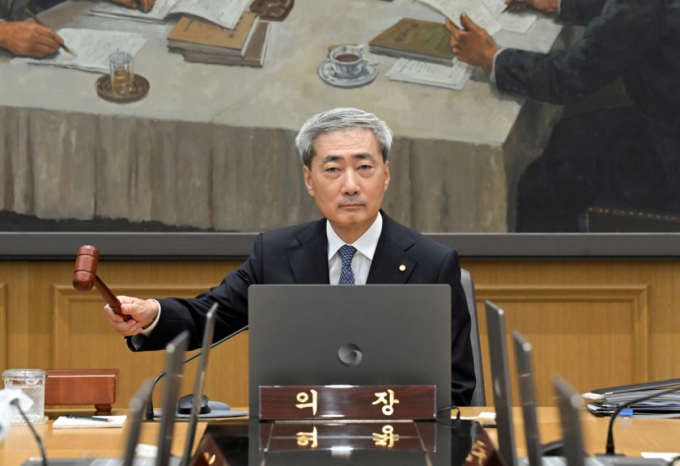
The Bank of Korea's Monetary Policy Board (hereinafter referred to as the Monetary Policy Board) raised the base rate to an annual 3.00%. This marks a "back-to-back increase," raising interest rates for two consecutive months following last month's hike. Alongside this move, the Bank of Korea significantly revised its growth forecast for this year upward from 2.6% to 3.3%.
On the morning of the 27th, the Monetary Policy Board held a monetary policy direction meeting at the Bank of Korea headquarters in Jung-gu, Seoul, raising the base rate from an annual 2.75% to 3.00%, an increase of 0.25 percentage points. All six members of the Monetary Policy Board, including Governor Shin Hyun-song, voted in favor of the hike. Commissioner Hwang Geon-il expressed a minority opinion favoring maintaining the rate at an annual 2.75%.
The Monetary Policy Board projected that the domestic economy is continuing to achieve higher-than-expected growth driven by strong exports and recovery in domestic demand, while inflation rates are expected to remain above target levels for a considerable period. Accordingly, it determined that proactive measures are necessary to prevent the spread of rising prices and to guard against financial stability risks. The upward trend in housing prices in the Seoul metropolitan area and significant increases in household loans also supported the interest rate hike.
The Bank of Korea raised its economic growth forecast for this year from 2.6%, previously announced in May, to 3.3%—an increase of 0.7 percentage points—and lifted its forecast for next year from 2.1% to 2.9%, an increase of 0.8 percentage points. The strongest contributor to the upward revision for this year was the strong semiconductor market, accounting for 0.35 percentage points. Forecasts for consumer price inflation remain unchanged at 2.7% for this year and 2.3% for next year.

 in ECONOMY
