

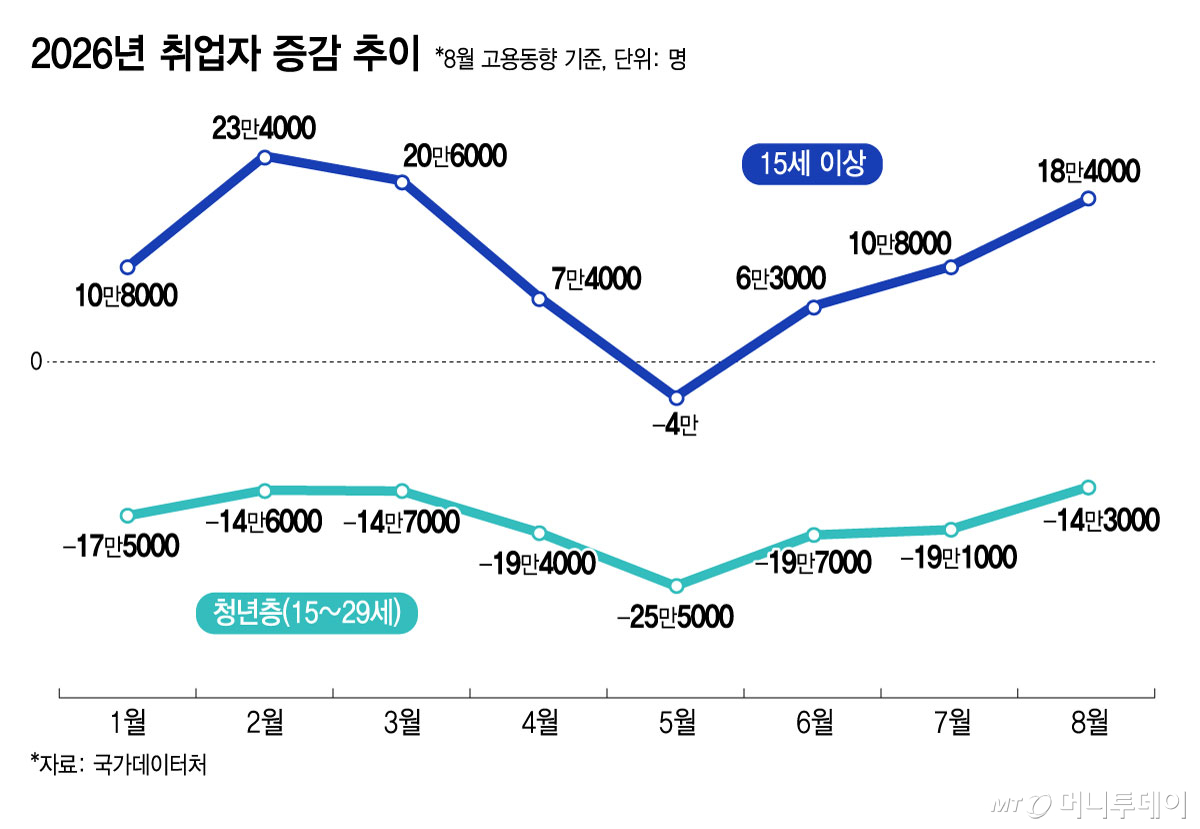
While the youth (ages 15–29) employment rate has been falling for 28 consecutive months, the unemployment rate also reached its highest level in four years. Although the overall employment situation is improving, young people continue to be marginalized in the labor market.
According to the 'August 2026 Employment Trends' released by the National Data Administration on the 9th, the number of employed youth decreased by 143,000 compared to the same month last year (hereinafter using the same basis), marking a decline for the 46th consecutive month.
Looking at the monthly trend in the number of employed persons this year: January -175,000; February -146,000; March -147,000; April -194,000; May -255,000; June -197,000; July -191,000. While the magnitude of decline has lessened, the downward trend continues over a long period.
Other indicators show no different situation. The youth employment rate fell to 44.1%, down by 1.0 percentage point (p). This marks 28 consecutive months of decline since May 2024. Analysis suggests the decline is due to reductions in employed persons in industries with high employment shares, such as accommodation and food services and manufacturing.
The youth unemployment rate rose to 5.4%, up by 0.5 percentage points (p). This is the highest level recorded for August since 2022 (5.4%), reaching a four-year high. The employment rate is falling while unemployment is rising. In particular, as the employment rate declined further, the youth labor force participation rate dropped to 46.6%, down by 0.8 percentage points (p). This is the lowest level for August in six years since 2020 (46.4%).
Bin Hyun-joon, head of the Social Statistics Bureau at the Data Administration, stated, "In a situation where the youth employment rate is declining, the number of applicants for police and local government Grade 7 civil service exams increased compared to the past due to application periods during the survey period." He added, "The rise in unemployment reflects a complex interplay of expanded public sector hiring and an increasing trend in new job openings."
The government is paying attention to the declining number of youth classified as 'resting.' Last month, this group decreased by 51,000, marking seven consecutive months of decline. The increase in students enrolled or taking courses had the greatest impact. Non-economic activity population is categorized by status into childcare, housework, enrollment/course-taking, and others (resting).
The government views this as a signal to restore the early stages of the 'training-job search-employment' ladder. With the full-scale implementation of training programs such as Youth New Deal announced by the government in April, it is expected that institutional investors and expanded enrollment in job preparation academies have led to an inflow from 'resting' into training, according to analysis.
The government also presented an analysis suggesting that youth who were previously 'resting' may have entered the labor market by beginning job search activities. This is because the recent decline in the number of economically active youth has been smaller than the decline in the number of employed youth.
Economically active population is divided into employed and unemployed persons. Analysis indicates that young people are gradually moving from job seekers to unemployed status as they engage in job search activities. The movement of youth from non-economic activity (resting) to economic activity (unemployed) can be interpreted positively, as it shows young people have the intention to seek employment.
However, key indicators such as the number of employed youth and the employment rate remain weak. In particular, in September, recent heightened tensions in the Middle East are likely to act as a downward factor, while the base effect from an increase of 312,000 in September last year may constrain employment growth.
A Ministry of Economy and Finance official said, "We will review the status of major job creation projects reflected in the 2027 budget, including the 'Youth Job Recovery Plan,' and ensure thorough preparation for implementation as well as promotion and advance guidance."

 in ECONOMY
