

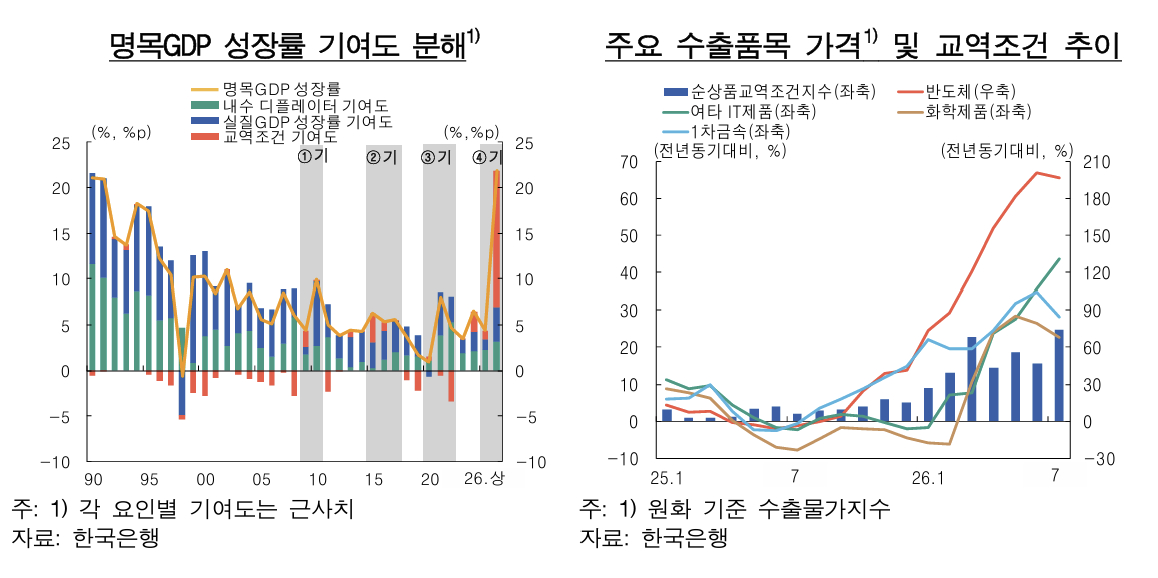
The Bank of Korea projected that the sharp rise in the nominal growth rate driven by the semiconductor boom will support consumption recovery through increased investment, wages, and tax revenues. However, it warned that rising incomes could also heighten demand-side price pressures and stimulate housing purchase demand, thereby increasing the risk of financial imbalances.
The Bank of Korea made these remarks in its Monetary Policy Report released on the 10th, under the section titled "Review of Financial and Economic Impacts of Sharp Nominal Growth Rate Increases and Their Implications."
The nominal gross domestic product (GDP) growth rate for the first half of this year reached 21.8%, buoyed by a strong semiconductor market. Nominal GDP is calculated using prices at the time without adjusting for inflation.
The Bank of Korea stated, "Unlike in the past, the recent surge in the nominal growth rate has been driven primarily by a significant improvement in terms of trade due to rising export prices." It added that the benefits from improved terms of trade will first boost corporate profits and then gradually spill over to the government and households.
In the corporate sector, profitability has improved not only in information technology (IT) but also in other manufacturing industries such as shipbuilding and machinery, leading to a sharp rise in equipment investment growth. This trend is expected to continue into next year. With corporate performance improving, national tax revenues in the first half of this year increased significantly compared to last year, and further substantial tax revenue growth is anticipated next year, which will expand the government's fiscal capacity.
The Bank of Korea expects that the effects on household income and consumption will materialize with a time lag. It noted, "Although wage growth slowed somewhat during the first half of this year, household income conditions are expected to gradually improve, leading to expanded consumption capacity."
However, it added that if the positive impact of the booming IT sector remains confined to related companies and workers in that sector, the spillover effects on overall income improvement and consumption recovery may be limited.
The Bank of Korea also indicated a possibility that these developments could exert upward pressure on prices. It stated, "With persistent cost pressures from earlier periods and gradually expanding demand-side pressures, inflation rates are expected to exceed target levels for a considerable period." However, the extent of the impact on prices will depend on how much of the increased income is channeled into private consumption rather than savings or asset acquisition.
The Bank emphasized that household debt management must continue. While an increase in nominal GDP would lower the ratio of household debt to GDP, this ratio remains high compared to major advanced economies. The Bank of Korea judged that "given the possibility of increased housing purchase demand due to improved income conditions, the need for continued household debt management remains significant."
In a context where expectations for asset price increases are high, the Bank also warned against the risk that expanding borrowing and its interaction with asset markets could heighten financial imbalances. It further noted that widening gaps between households and corporations should be closely monitored as a key concern.
The Bank of Korea concluded, "A sharp rise in the nominal growth rate is expected to have significant impacts on the broader macroeconomy, including growth, prices, and financial stability. Effective policy combinations are needed to maintain overall macroeconomic stability and strengthen potential growth."

 in ECONOMY
