

President Lee Jae-myung posted an article titled "Are Salary Earners Just Beasts?" on Facebook in February last year during his tenure as leader of the Democratic Party of Korea. He cited a report stating that taxes paid by salary earners had surpassed 60 trillion won. The term "salary earner taxes" refers to income tax on employment earnings.
President Lee then stated, "Due to inflation, only nominal wages rise while real wages remain stagnant, yet taxes continue to increase under the progressive system. While the ultra-wealthy have received tax cuts, salary earners have effectively faced tax hikes. Isn't this a problem that needs fixing?"
Employment income tax revenue was 68.4216 trillion won last year, is projected at 73.2482 trillion won this year, and will rise to 102.4446 trillion won next year. An increase in employment income tax means more taxes are being collected from workers.
If salaries and performance bonuses rose significantly, leading to higher tax payments, that would be a natural phenomenon. However, if excessive taxes are paid due to systems failing to keep pace with reality, the situation changes. This is precisely what is happening with employment income tax. As President Lee noted, an "effective tax hike" or "quiet tax increase" is occurring.
Employment income tax is determined by the taxable base and tax rates. The taxable base is calculated by subtracting various deductions from employment income. Tax rates are applied differently depending on the taxable base. It follows a progressive structure where higher taxable bases result in higher tax rates.
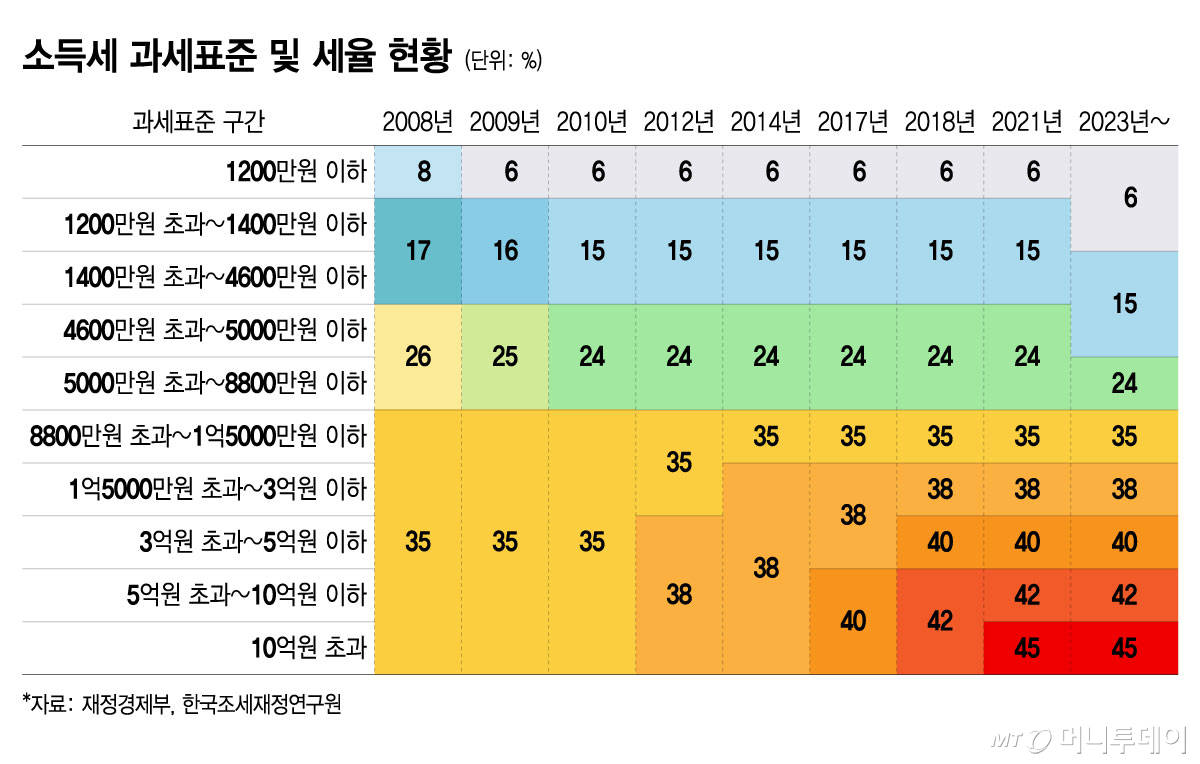
Current employment income tax brackets for the taxable base are: △up to 1.5 million won (6%—lowest rate) △up to 0.5 billion won (15%) △up to 88 million won (24%) △up to 1.5 million won (35%) △up to 300 million won (38%) △up to 500 million won (40%) △up to 10 thousand won (42%) △over 10 thousand won (45%), totaling eight brackets.
Assuming the taxable base after deductions is 60 million won: 840,000 won is calculated at 6% for the first 1.5 million won; 5.4 million won is calculated at 15% for the bracket between 14 million and 0.5 billion won; and 2.4 million won is calculated at 24% for the remaining 50 million to 60 million won bracket, resulting in a total tax liability of 8.64 million won.
Most employees see their annual salaries increase each year, reflecting inflation rates and other factors. Consequently, employment income tax rates also change. If an employee earns up to 88 million won annually, the maximum tax rate is 24%. However, if their salary rises over several years to reach 10 thousand won, the tax rate for the portion exceeding 88 million won becomes 35%.
Thus, employment income tax is structured to collect a higher proportion of taxes as salaries rise. The problem lies in the fact that the system fails to keep pace with the speed at which incomes increase.
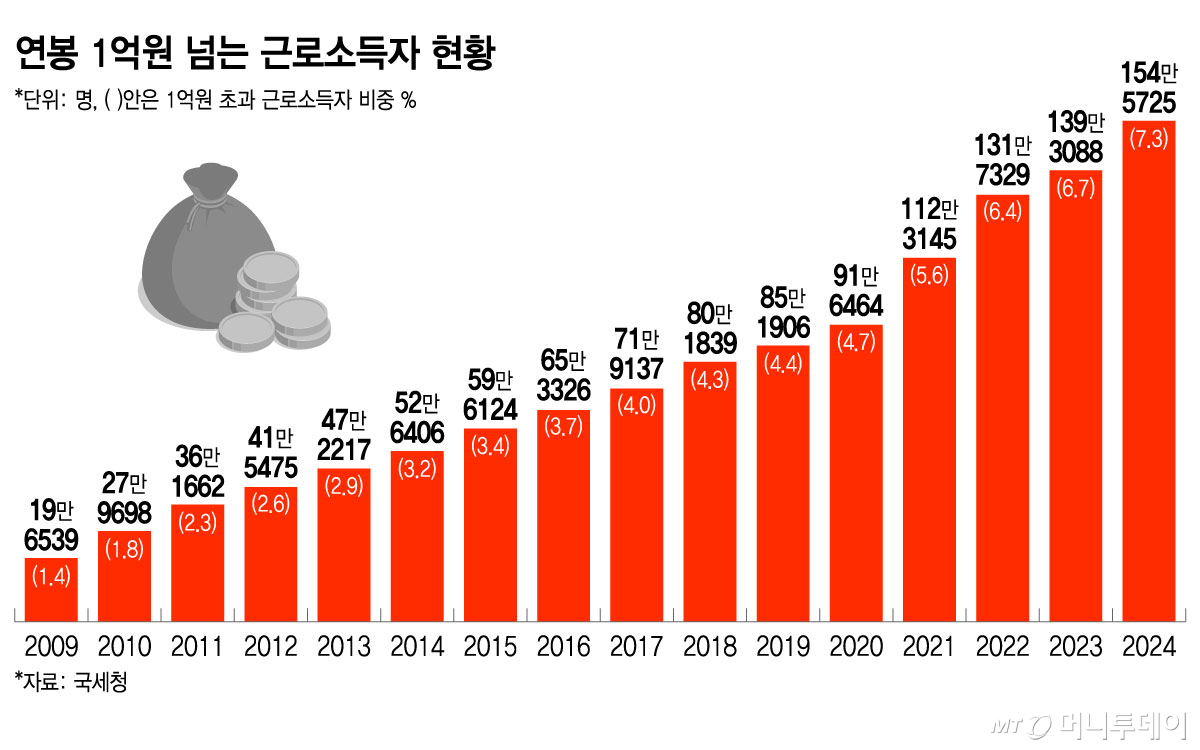
The dream of past employees, "million-won annual salary earners," numbered 1.545725 million people as of 2024, representing 7.3% of all taxable individuals. In 2009, million-won earners accounted for only 1.4% (196,539 people) of the total taxable population. Over 15 years, the number of million-won earners increased by 7.86 times, making them far more common.
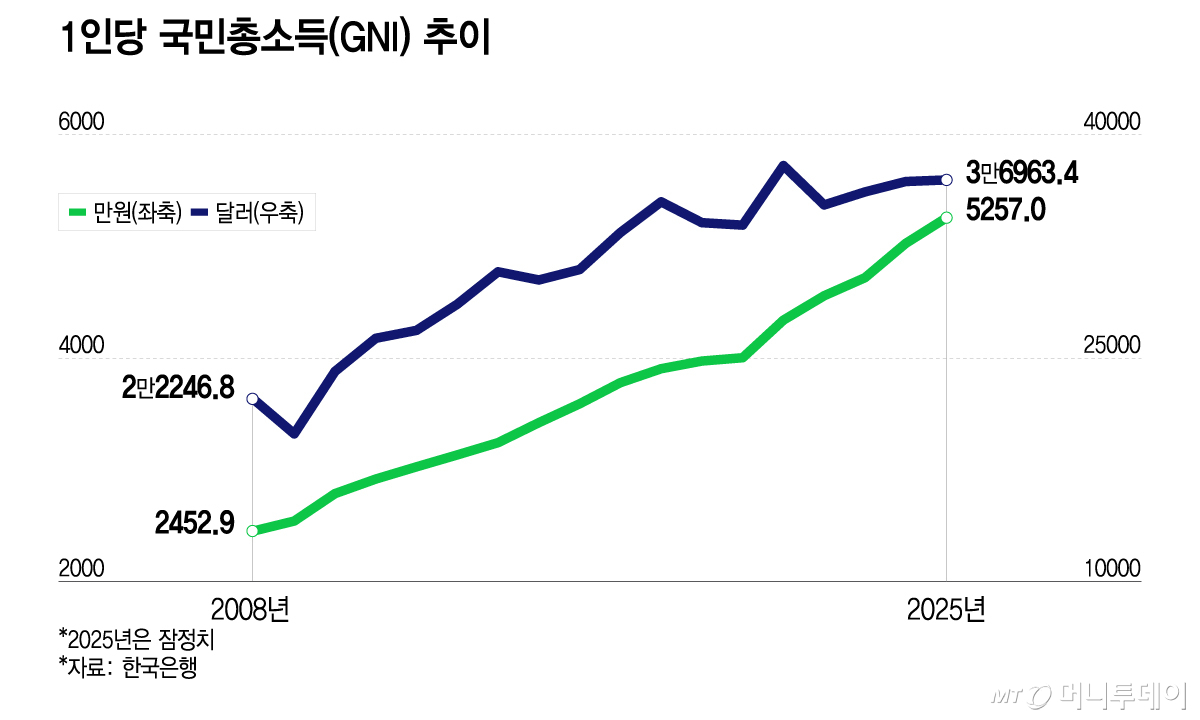
Per capita Gross National Income (GNI) also rose from 25.421 million won in 2008 to 52.57 million won (preliminary estimate) in 2025, a 2.14-fold increase. In dollar terms, it grew from $19.916 million to $36.963 million over the same period. A breakthrough of $40,000 this year is highly likely.
However, during this period, only minor adjustments were made to the employment income tax system. Before 2008, the taxable base was divided into four brackets: △up to 0.1 billion won (8%) △up to 40 million won (17%) △up to 80 million won (26%) △over 80 million won (35%).
Starting in 2008, the taxable base was adjusted upward by up to 10%: △up to 1.5 million won (8%) △up to 46 million won (17%) △up to 88 million won (26%) △over 88 million won (35%). This measure reflected inflation and other factors.
Subsequently, measures were taken to further the taxable base. The number of brackets increased from four in 2008 to eight in 2023. This approach reduced burdens on low-income groups while increasing them for ultra-high-income earners. However, the 88th million won bracket, which includes the middle class, has remained unchanged for 18 years since 2008.
This is why criticisms such as President Lee's statement that "salary earners are treated like beasts" have emerged. Even without formal tax hikes, workers gradually move into higher-tax brackets, effectively facing increased taxation.
The basic deduction for income tax also contributes to this effective tax increase. The basic deduction was set at 1.5 million won in 2009 and has remained unchanged for 17 years. Although the Democratic Party proposed raising the income deduction from 1.5 million won to 1.5 million won last year, it did not ultimately become law.
Some propose linking income tax adjustments to inflation as a solution. During the 2007 tax law revision, the National Assembly stated in its review report that "in-depth discussions should be conducted on measures such as integrating an inflation-linked system into taxable base adjustments or income deductions to ensure stability."

 in ECONOMY


