

As prices and wages rise, the taxable income base for income tax has remained stagnant for a long time, leading to concerns that workers' tax burdens are effectively increasing. Experts suggest that taxable income brackets and various deduction amounts should be linked to inflation or adjusted periodically.
Experts consistently point out the disconnect between nominal income and real income. Even if monthly wages rise due to inflation, if purchasing power remains unchanged, real income does not increase. However, if the taxable income base remains fixed, individuals may move into higher tax brackets, increasing their tax burden.
Under the current income tax system, progressive tax rates ranging from 6% to 45% are applied based on taxable income. While the lower taxable income bracket was adjusted once in 2023, the threshold of 88 million won for the 35th% tax rate has remained unchanged since 2008, marking its 18th year without adjustment.
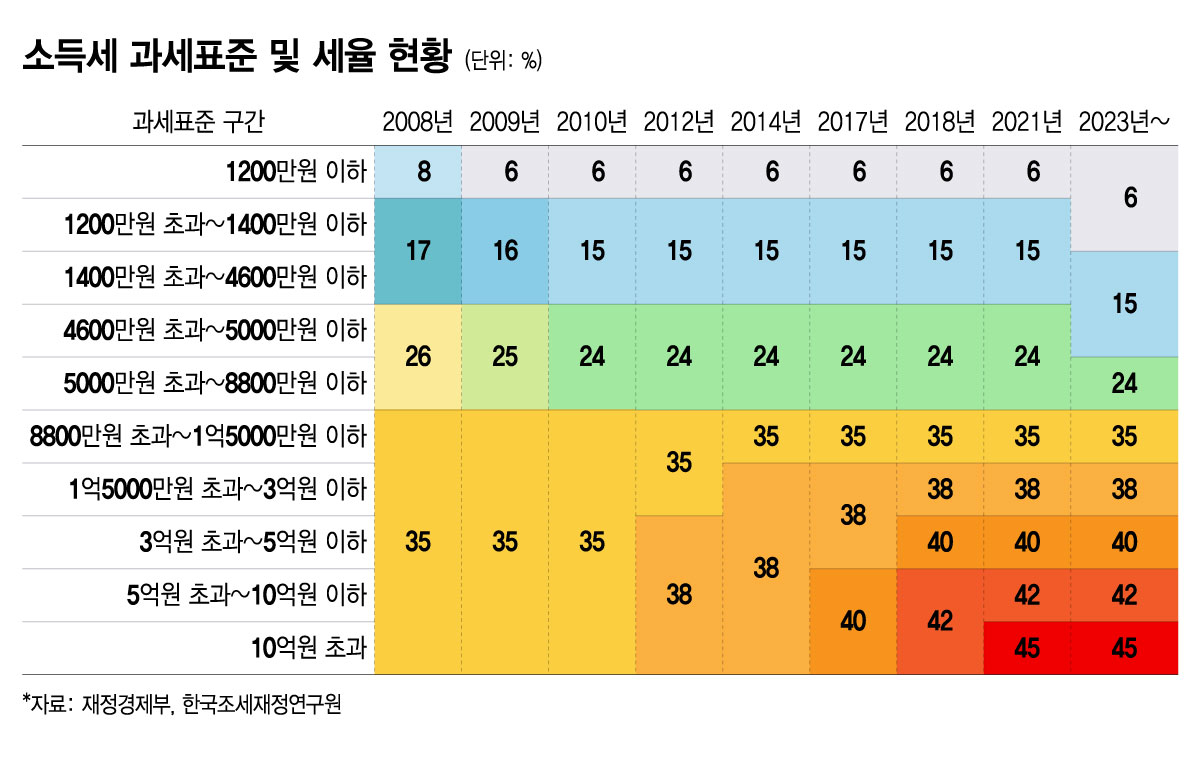
Oh Moon-seong, a professor at Hanyang Women's University Department of Taxation, stated, "If nominal income increases due to inflation leads to a disproportionate increase in tax burden relative to income, real purchasing power could decline." He added, "Inflation fluctuations must be reflected in taxable income brackets and income deduction amounts." Critics also note that fixed deductions, such as those for dependents, have not been adjusted for a long time, weakening their function in alleviating household burdens.
Regarding the adjustment cycle, Professor Oh proposed explicitly stipulating in the Income Tax Act that inflation fluctuations be reviewed every three to five years rather than mechanically applying the annual consumer price increase rate. He remarked, "It is not desirable to leave adjustments untouched for 10 or 20 years and only make changes when problems arise."
Ahn Chang-nam, former professor at Gangnam University Department of Taxation, advocated for automatically adjusting all tax law standards annually by linking them to inflation. Professor Ahn stated, "If taxable income brackets and deduction amounts are not adjusted together, the result will be taxing higher nominal incomes driven by inflation." He emphasized, "Adjustments should not occur just once; they must be automatically updated annually based on the consumer price index."
Addressing claims that South Korea's income tax burden is low, Professor Oh pointed out, "Given that high-income earners face high marginal tax rates when combining the top income tax rate and local income tax, along with additional burdens such as social insurance premiums, it is difficult to definitively conclude that South Korea's income tax burden is low."
Kang In-soo, a professor at Sookmyung Women's University Gyeong Je-hak-gwa (Prof.), also stated, "International comparisons should consider the overall tax burden, including indirect taxes and quasi-taxes like social insurance premiums." He added, "Rather than starting from the total revenue the government needs to secure, we must first determine what level of tax burden is appropriate for citizens."
Some argue that now is the right time for tax reform, given the recent increase in tax revenues driven by a semiconductor boom. Professor Ahn remarked, "With semiconductor companies performing well and tax revenues rising, there is now room to reform the tax system." He continued, "As the economy grows, we should broaden the tax base while reducing the tax burden on workers."
Professor Oh also addressed concerns about potential revenue losses from adjusting taxable income brackets, stating, "With corporate and income taxes collecting more than expected currently, it is not the time to worry about insufficient revenue."
In contrast, Kim Woo-cheol, a professor at University of Seoul Department of Taxation, agreed with the principle of inflation-linked systems but cautioned against hasty implementation. Professor Kim stated, "While South Korea's income tax system has a high degree of progressivity, the amount collected through individual income tax is relatively low, so redistribution effects are not fully realized." He added, "Raising the 88th million won taxable income threshold could further weaken a key revenue base."
Professor Kim argued that instead of further increasing tax rates for high-income earners, various deductions should be streamlined and the tax base expanded to include middle- and lower-income groups to boost overall income tax revenues. He remarked, "It would be preferable to introduce an inflation-linked system only after income tax burdens and revenue shares reach appropriate levels." He concluded, "While recent increases in semiconductor-related tax revenues have reduced immediate pressure for tax hikes, long-term revenue expansion is necessary to prepare for rising expenditures due to aging populations."
Legislative efforts on this issue continue within the political sphere. Lee In-seon, a People Power Party member of parliament, introduced an amendment to the Income Tax Act last March that would first raise taxable income brackets applicable in 2027 and subsequently reflect annual inflation rates. Another member of the same party, Kim Mi-ae (Rep.), also proposed an amendment last April to adjust benchmark amounts for each taxable income bracket annually based on inflation rates.

 in ECONOMY

