

The government's plan to revise the ISA (Individual Comprehensive Asset Management Account) collapsed due to investor complaints that it would hinder long-term investment.
With ISA accounts nearing 10 million, the government had sought to adjust terms such as contract periods and contribution limits, but public opinion did not side with the government.
According to relevant ministries on the 10th, the government approved a tax reform plan at its State Council meeting on the 1st that maintains the current ISA contract period and contribution limits. This marks a retreat from the government's original proposal aimed at revising the ISA system.
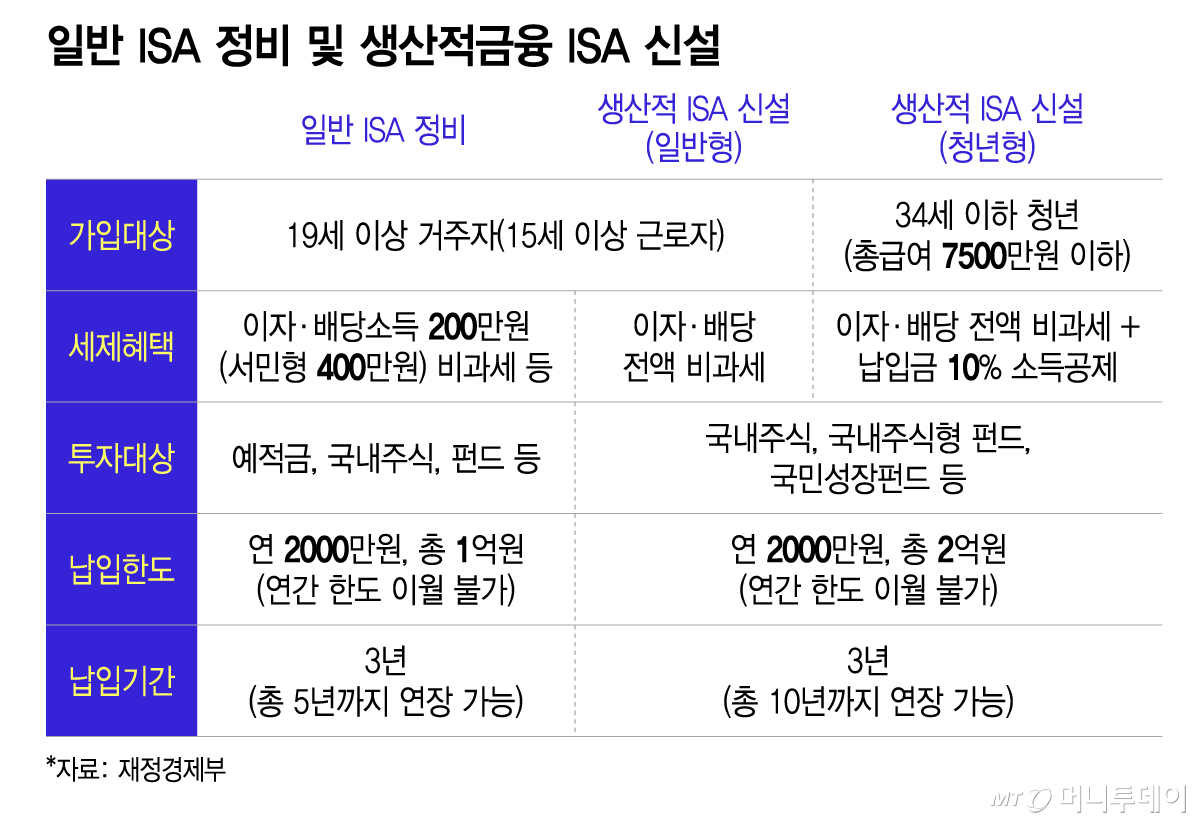
The Ministry of Economy and Finance had included in its tax reform plan announced on the 3rd last month provisions to adjust the ISA contract period to an initial term of three years, with a maximum of five years. Currently, the structure allows for virtually unlimited extension after the mandatory enrollment period of three years.
The Ministry of Economy and Finance explained that limiting the contract period to a maximum of five years was intended "to settle and tax income within the account at the time of maturity or cancellation, as ISA accounts provide non-taxable benefits within the contribution limit."
The Ministry of Economy and Finance had also planned to eliminate the carryover of unused portions of the annual 20 million won contribution limit. The rationale was to encourage systematic investment rather than short-term or temporary investments through carryovers.
In other words, this adjustment aimed to establish ISA as a tool for long-term asset formation. Under the current system, accounts could remain dormant for extended periods just to secure tax benefits, which contradicts the original purpose of ISA—to promote consistent annual investment of a fixed amount.
The Ministry of Economy and Finance's push to revise ISA was also linked to the establishment of a new "Productive Financial ISA." This product limits investments to domestic assets, offers full non-taxable treatment on interest and dividend income, and features expanded contribution limits and investment periods compared to general ISAs.
When the tax reform plan was announced, investors reacted with opposition. They judged that reducing contract periods would diminish the compounding effect gained from managing assets within a single account over the long term. As existing ISA benefits were effectively reduced, even President Lee Jae-myung raised concerns about the issue.
President Lee reportedly instructed a full review during a meeting with aides on the 7th last month, stating, "This is a reduction of existing benefits; why was it advanced without proper reporting?"
Consequently, the Ministry of Economy and Finance re-evaluated its ISA revision plan from scratch and finalized the tax reform plan at the State Council meeting on the 1st without the adjustment measures. The tax reform plan currently remains at the government proposal stage and will undergo final approval procedures in the regular National Assembly session scheduled for the second half of this year.
However, with no supportive voices from the political sphere regarding the ISA adjustment and public opinion heavily favoring maintenance of the current system, contract periods and contribution limits are expected to remain unchanged, as decided at the State Council meeting.

 in ECONOMY
