

"Deduction amount frozen for 29 years"... Inheritance tax rate is 2.6 times higher than the comprehensive real estate tax.
The inheritance tax, once considered the exclusive domain of the "1% wealthy," is shifting into a "middle-class tax." This change comes as the inheritance tax system has remained stagnant for 29 years while prices and asset values have surged significantly. The proportion of taxpayers subject to inheritance tax is now more than double that of the comprehensive real estate tax, another representative "wealth tax."
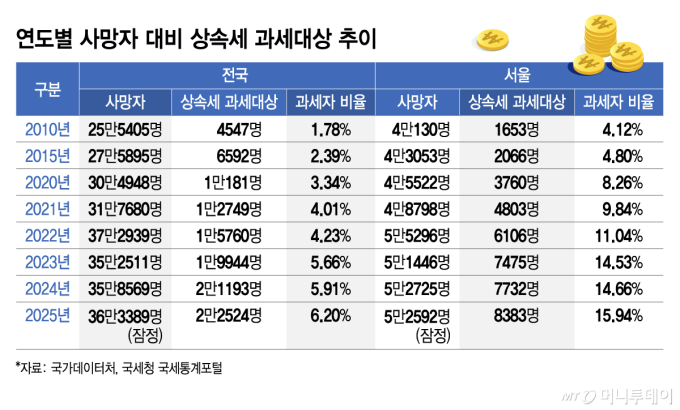
According to data from the National Tax Service and the National Data Administration released on the 20th, among the provisional 363,389 deaths last year, 22,524 individuals were subject to inheritance tax. This means that 6.2% of annual deaths fall under the inheritance tax net.
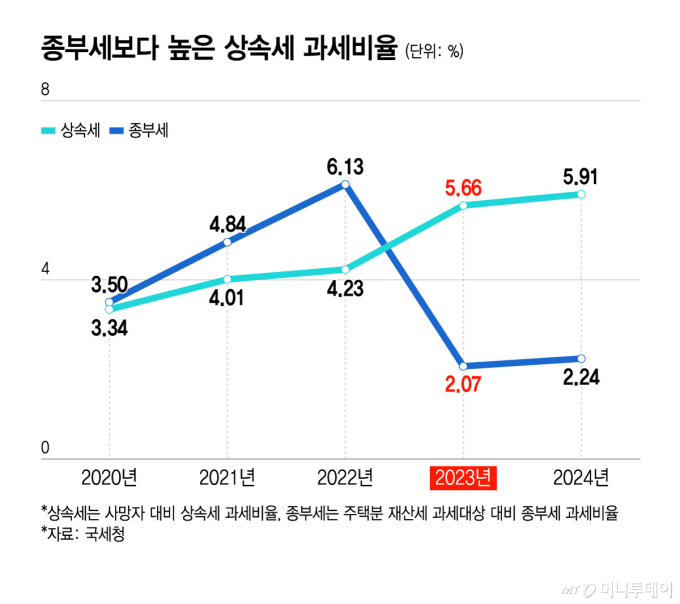
The tax rate based on this criterion was only in the single-digit percentage range up until 2010, but since the 2020s, it has consistently trended upward: 3.34% in 2020, 4.01% in 2021, 4.23% in 2022, 5.66% in 2023, and 5.91% in 2024.
In contrast, the comprehensive real estate tax rate for housing as of 2024 was only 2.24%, significantly lower than the inheritance tax (5.91%). This figure represents the proportion of the 20.33 million cases subject to property tax on housing (the basis for imposing the comprehensive real estate tax) that were actually subject to the comprehensive real estate tax, totaling 455,331 individuals.
Introduced with the goals of improving tax fairness and stabilizing real estate prices, the comprehensive real estate tax carries a "wealth tax" character alongside inheritance tax. Until the mid-2010s, both inheritance tax and comprehensive real estate tax maintained a tax rate of around 2%.
However, during the Moon Jae-in administration, which strengthened the comprehensive real estate tax through rate hikes and an increase in the fair market value ratio, the comprehensive real estate tax rate soared to 6.13% in 2022. Unable to curb housing prices but witnessing public anger over real estate, the Moon Jae-in administration raised the basic deduction for the comprehensive real estate tax from 0.9 billion won to 1.1 billion won for households with one primary residence and from 0.6 billion won to 0.9 billion won for other households. As a result, the comprehensive real estate tax rate dropped to 2.07% in 2023. This is the background for why the inheritance tax rate surpassed the comprehensive real estate tax rate after 2023.
This trend is expected to intensify further. Following the Yoon Suk-yeol administration's increase of the basic deduction for the comprehensive real estate tax for single-household owners from 1.1 billion won to 1.2 billion won, the Lee Jae-myung administration has also signaled a further increase. The Ministry of Economy and Finance has submitted a tax reform plan to the National Assembly that includes raising the basic deduction for the comprehensive real estate tax for owner-occupied single residences from 1.2 billion won to 1.4 billion won.
In contrast, efforts to modernize the inheritance tax system have been sluggish. The lump-sum deduction (500 million won) and spousal deduction (500 million won to 3 billion won), introduced in 1997, remain unchanged for 29 years. The value of 500 million won at that time differs from today's. Even considering only inflation rates, the current value exceeds 1 billion won. Considering housing price increases, the value is even higher.
Consequently, the inheritance tax burden on the middle class is growing like a snowball. According to KB Real Estate, the average transaction price for apartments in Seoul last month was 1.607 billion won. In particular, unlike the comprehensive real estate tax, which is based on assessed value, inheritance tax is calculated based on market prices. This means that unless there are separate debts, most single-household owners in Seoul must worry about inheritance tax.
In fact, among the provisional 52,592 deaths in Seoul last year, 8,383 individuals (15.94%) were subject to inheritance tax. That is one in six people. The inheritance tax rate in Seoul, which was 4.12% in 2010, has increased nearly fourfold in 15 years.
President Lee also pledged during his presidential campaign to raise the limits for the lump-sum deduction and spousal deduction for inheritance tax. However, the government has not included inheritance tax reform measures in its tax reform plans for two consecutive years.
Hong Ki-yong of Incheon University said, "At the time the inheritance tax was introduced, even people who were not at a level to pay inheritance tax were included as subjects, which means the inheritance tax is no longer a tax only for the wealthy."
李President: "Cruel" Inheritance Tax... Receiving just one house in northern Seoul leads to '270 million won'
President Lee Jae-myung stated during a press conference marking 100 days in office last September, "When a homeowner dies and family members remain, if the house is worth over 1 billion won, taxes must be paid. If there is no money, they have to sell the house and leave, which is too cruel." He raised the need to increase the inheritance tax deduction limit, which has remained unchanged for 29 years.
In reality, inheritance tax, once considered only a "wealth tax," is rapidly becoming a "middle-class tax." This is because housing prices have surged in recent years, pushing the price of even an average apartment in Seoul well over 1 billion won. Meanwhile, since the inheritance tax deduction has remained unchanged for 29 years, most families of elderly people owning homes in Seoul now face the dilemma of worrying about inheritance tax.
◆ Inheritance tax children must pay when passing down one average northern Seoul apartment: '270 million won'
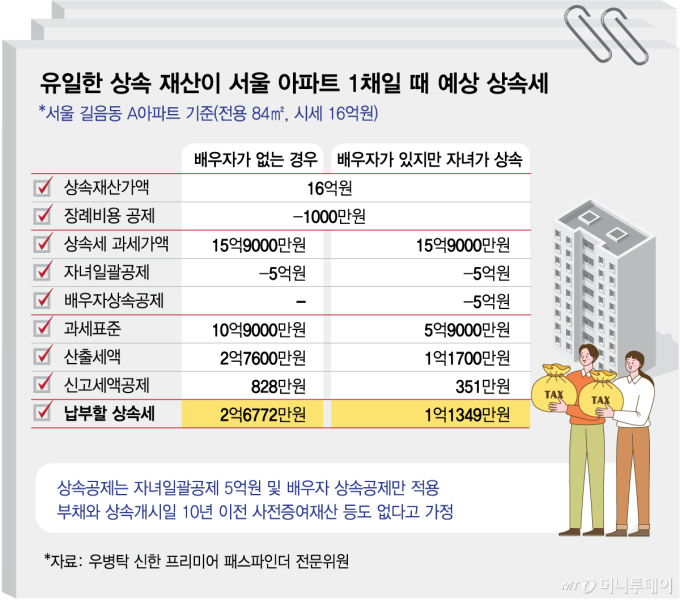
On the 20th, MoneyToday requested a simulation from Shinhan Premier Pathfinder expert Woo Byung-tak regarding an apartment in Gil-eum-dong, Seongbuk-gu, Seoul, which recently sold for 1.6 billion won (assuming no other financial assets or debts). The result showed that if the deceased has no spouse, the inheritance tax to be paid by their children would be 267.72 million won.
This scenario assumes they inherited nothing but a single apartment, with no other cash or financial assets.
If the children had been living in the same house as the deceased, they would face the cruel situation mentioned by President Lee. If they do not have enough liquid assets to pay over 20 thousand won in inheritance tax, they would have to leave the home they have lived in all their lives. Selling the house to pay the inheritance tax is also not easy; it might need to be sold at a fire-sale price, and capital gains tax could additionally be incurred. This is the background for criticisms that inheritance tax has become "punitive taxation" for the middle class.
The situation when a spouse passes away is not significantly different either. Similarly, if a spouse inherits an apartment worth 1.6 billion won (assuming no other financial assets or debts and two children), the inheritance tax to be paid by the spouse is estimated at 68.73 million won. This means that without nearly 70 million won in liquid assets, they could face being forced out of their home.
Until now, inheritance tax was considered a "story from another country" for the middle class. Considering the lump-sum deduction (500 million won) and spousal deduction (500 million won), there were not many middle-class families who could pass on net assets exceeding 1 billion won to their children.
However, the situation has changed as housing prices have surged in recent years. According to KB Real Estate, the average transaction price for apartments in Seoul last month was recorded at 1.607 billion won. Housing prices have risen more than three times compared to May 2009, when statistics were first compiled (521.04 million won).
◆ Promising to reduce middle-class inheritance tax burden, the inheritance tax system has been untouched for nearly 29 years
The current framework of the inheritance tax system was established in 1997.
At that time, the Ministry of Finance and Economy (now the Ministry of Economy and Finance) proposed a basic direction to reform the inheritance tax system: "To significantly alleviate the inheritance and gift tax burden on the middle class and support the continued maintenance of their living foundations." A lump-sum deduction of 500 million won was introduced. The minimum spousal deduction, which allows the surviving spouse to deduct 500 million won to 3 billion won from the assessed value of property inherited upon the death of the deceased, was also set at that time.
Furthermore, tax rates for different taxable income brackets were revised: △10% for up to 0.5 billion won, △20% for over 0.5 billion won to 250 million won, △30% for over 250 million won to 550 million won, and △40% for over 550 million won. For the taxable income brackets themselves: △10% for up to 1 billion won, △20% for over 1 billion won to 500 million won, △30% for over 500 million won to 1 billion won, and △40% for over 1 billion won.
Since then, except for the introduction of a new bracket for amounts exceeding 3 billion won (50%), the current tax framework has remained unchanged for 29 years.
◆ Attempts to reform inheritance tax repeatedly fail... 李President also made it a pledge
There have been attempts to reform the inheritance tax system, which has become a "middle-class tax."
The Moon Jae-in administration pushed for the introduction of an estate acquisition tax to shift the inheritance tax system from being based on the "giver" to the "receiver," but it did not go as far as announcing actual legislative amendments.
The Yoon Suk-yeol administration also pushed for the introduction of an estate acquisition tax from the beginning and announced a reform plan for 2025. The structure is such that as more heirs are involved, the deduction amount increases, and less inheritance tax is paid. Instead of eliminating the lump-sum deduction (500 million won), it set the direct ascendant/descendant deduction at 500 million won, equivalent to the same deduction amount. This is effectively an amendment to raise the existing child deduction of 0.5 billion won to 500 million won. For spousal deductions, it aimed to fully deduct up to 1 billion won even if it exceeded the statutory inheritance share. For example, in a case where a spouse inherits 1 billion won and two children inherit 500 million won each from an estate of 20 thousand won, a basic deduction of 1 billion won for the spouse and 500 million won per child would apply, resulting in no inheritance tax payable.
However, coinciding with a change in administration, the bill to introduce the estate acquisition tax failed to even undergo proper discussion in the National Assembly.
President Lee also agrees on the need to modernize the inheritance tax system. During his presidential campaign, President Lee pledged to raise the limits for the lump-sum deduction and spousal deduction for inheritance tax. In fact, during his time as a member of the National Assembly, Lee Kwang-hyun, former head of the National Tax Service, proposed a legislative amendment to raise the lump-sum deduction for inheritance tax from 500 million won to 800 million won and the spousal deduction from 500 million won to 1 billion won. This is an amendment to adjust the inheritance tax deduction limit upward from 1 billion won to 1.8 billion won.
However, the two tax reform plans announced by the Lee Jae-myung administration did not include any inheritance tax reform measures. Lee Hyung-il, candidate for Deputy Prime Minister and Minister of Economy and Finance, stated in a recent written response during his National Assembly confirmation hearing: "There are conflicting positions regarding the need to alleviate the tax burden considering high inheritance tax rates compared internationally, and the appropriateness of such relief given the deepening asset inequality

 in ECONOMY


