

Many young people are unemployed, yet employment has risen? ...The illusion created by 2.08 million 'public jobs'
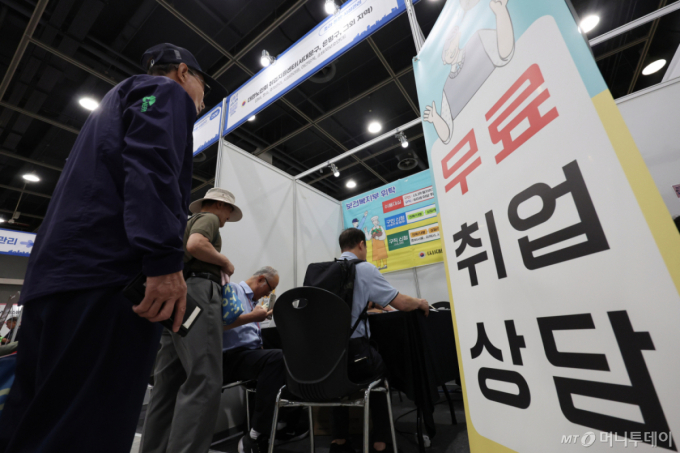
A mismatch between the number of employed and the number of jobs is repeating. While the number of employed continues to rise, quality jobs that young people want are hardly increasing.
Public jobs have increased mainly among older age groups, while private jobs preferred by young people have not grown sufficiently. This explains why employment indicators—key variables in the macroeconomy such as growth, consumption, and inflation—are failing to reflect reality accurately.
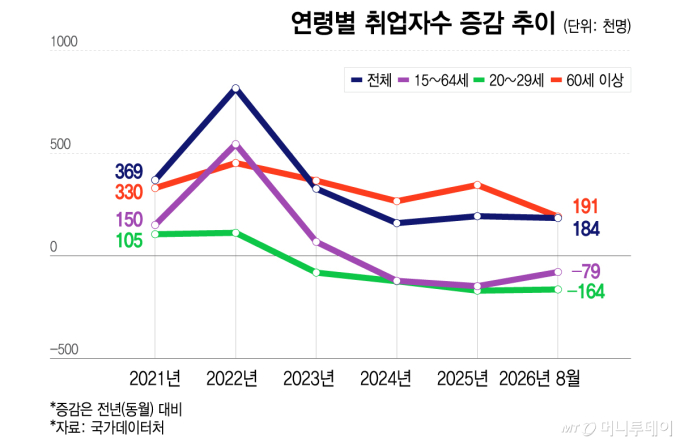
According to the National Data Administration on the 27th, as of August, the total number of employed persons aged 15 and over reached 29.151 million, an increase of 184,000 compared to the same month last year. The rise in employment was the largest in five months. The employment rate for those aged 15 and over stood at 63.3%, the highest for August since 1982.
Looking only at employment indicators, it might seem like a favorable trend. However, digging deeper reveals a different situation. There is a clear divergence by age group between older and younger generations. Last month, the number of employed aged 60 and over increased by 191,000, while the number of employed in their 20s fell by 164,000.
This is not a temporary phenomenon. Even looking at full-year figures from last year, total employment rose by 193,000, yet employment among those in their 20s dropped by 170,000. In contrast, employment among those in their 60s increased by 345,000.
The situation also varies by industry. Last month, employment in health and social welfare services rose by 186,000. These are jobs mainly taken up by older age groups, with many classified as public jobs. On the other hand, employment in manufacturing—a sector considered core to job creation—declined for the 26th consecutive month, falling by 38,000.
The demographic shift of a growing elderly population and a shrinking youth population cannot be ignored. However, it is also assessed that the government's continuous expansion of public jobs has contributed to creating an illusion in employment indicators.
According to the Bank of Korea's January report titled "Evaluation of Recent Employment Situation through Private Employment Estimation," public jobs increased from 1.13 million on average per month in November 2015 to 2.08 million (for the first three quarters of 2025). The share of public jobs relative to total employment rose from 4.3% to 7.2% over the same period.
The Bank of Korea identified public jobs as those in health and welfare, public administration, temporary positions, and among those aged 60 and over. Private employment, calculated by subtracting public jobs from total employment, declined from 237,000 in 2022 to 122,000 in the third quarter of last year.
The Bank of Korea emphasized that as the share of public jobs grows, it has become more difficult to accurately assess the employment situation and the overall economic condition. However, there is no government-level statistics available to track the number of employed in the private sector.
In July, the government raised its growth forecast for this year from 2.0% to 3.0%, while projecting that the increase in employment would be only 150,000—10,000 fewer than previously expected. This signals "growth without employment," suggesting a growing disconnect between current employment indicators and economic conditions.
At the time, Song Byung-ho, head of the Price Trends Team serving as Ko Yong-dong-hyang (Team Lead) at the Bank of Korea who authored the report, stated, "Unlike private employment, public jobs can move in the opposite direction of economic conditions," adding, "I believed that examining private employment would be somewhat more useful for assessing the economy."
Even with semiconductor bonuses reaching hundreds of millions of won... "There are no jobs for young people" — Employment winter
The formula "economic growth = job creation" is breaking down. While export strength driven by the semiconductor supercycle has improved growth indicators and expanded the national economic pie, the actual sense of job availability felt by citizens is cooling. In particular, "growth without employment" is a factor intensifying polarization across generations, regions, and social classes. Although the government is proposing various measures to overcome employment market difficulties not reflected in statistics, critics point out limitations in addressing immediate employment cliffs due to mismatches with on-the-ground demand.
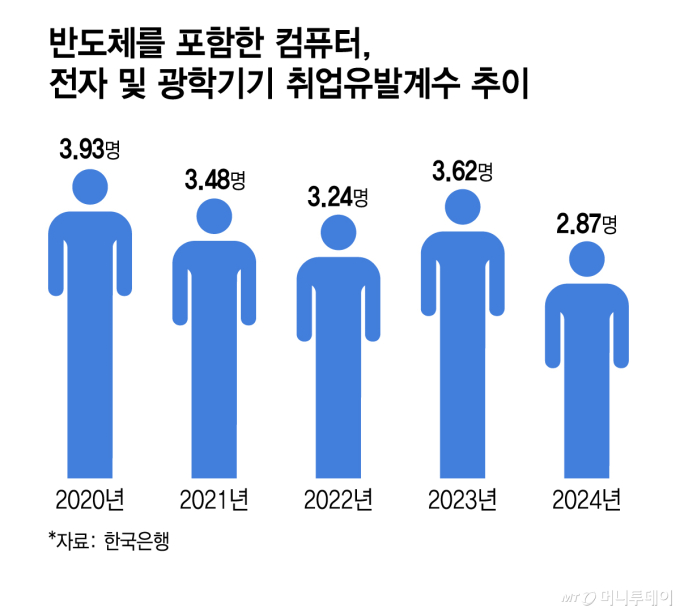
According to the Bank of Korea on the 27th, as of 2024, the employment multiplier for computer, electronic, and optical equipment including semiconductors was 2.87, down by 0.75 from a year earlier. The employment multiplier indicates the number of jobs directly and indirectly generated across all industries when final demand in a specific sector generates 10 thousand won. It shows how much industrial growth translates into job creation.
Because semiconductor production relies heavily on advanced equipment rather than labor, its job creation effect from growth is lower compared to other industrial sectors. This means that Korea's high economic growth centered around the semiconductor supercycle does not necessarily translate into a boom in the employment market.
According to the National Data Administration's "Statistics on Wage Employment by Job Type and Industry," wage employment in the semiconductor manufacturing sector increased by 14.5% compared to eight years ago during the first quarter of this year. However, new hiring jobs actually decreased by 21.6% over the same period.
Consequently, the gap between growth indicators and the employment market is widening. The Ministry of Economy and Finance revised its second-half economic growth strategy in July, raising this year's real GDP growth forecast to 3.0%, a 1 percentage point (p) increase from the January forecast (2.0%). In contrast, the employment outlook has deteriorated. It now expects this year's employment increase to reach only 150,000, which is 10,000 fewer than the January forecast of 160,000.
The Bank of Korea's forecast also differs little. In its revised economic outlook last month, the Bank raised this year's growth forecast from 2.6% to 3.3%, but projected that employment would increase by only 140,000—40,000 fewer than initially expected.
The government is also recently focusing on "growth without employment." Considering that the cold wave in the employment market is hitting young people harder, it announced measures to restore youth employment. The plan involves training 300,000 specialized professionals by 2030 and supplying 300,000 private and public jobs and startup opportunities linked to three major mega-projects currently being promoted by the government (semiconductors, physical AI, and data centers).
The core lies in cultivating "new hires with experience." In response to the diagnosis that young people are being pushed out of the hiring market due to companies' preference for experienced workers, the plan is to inject public funds to help young people gain experience.
However, doubts remain about its effectiveness. It is uncertain whether companies will recognize government-created experience as actual work experience. Moreover, training programs for advanced fields are merely a long-term blueprint and lack immediate effectiveness in solving the job search difficulties faced by young people who are currently confronting an employment cliff due to reduced regular hiring.
A bigger problem is that government policies are moving in the opposite direction of on-the-ground demand. This is because large corporations, which young people prefer most, are being excluded from policy support. Previously, the Ministry of Economy and Finance decided to exclude large companies from the scope of the integrated employment tax credit. This policy provides tax credits to companies that increase their number of regular employees, aiming to encourage job expansion.
The Korea Economic Daily Association submitted an opinion to the National Assembly arguing that large companies should remain included in the integrated employment tax credit target. It explained that removing employment incentives for large companies could negatively affect the expansion of quality jobs.
A representative from The Korea Economic Daily (Hankyung) Association stated, "Under the current system, large companies can only receive support when they hire additional young people, persons with disabilities, or those aged 60 and over, and the level of support is lower than that for small and mid-sized companies. Given that the scope and requirements for support are already limited, we have recommended maintaining the application of this system to large companies."
Some voices also warn against the "employment indicator illusion" caused by elderly jobs created with state funds. The government plans to supply approximately 1.15 million elderly jobs this year—the highest number in history. It has also prepared a 2027 budget to supply about 1.18 million elderly jobs next year, roughly 30,000 more than this year.
As a result, the proportion of people aged 65 and over who are working is increasing, maintaining the statistical illusion that overall employment rates are rising. This is the background for arguments calling for institutional measures to prevent distortion in economic assessment while preserving the positive function of elderly job programs in improving poverty among the elderly.
Lee Hyung-il, Deputy Prime Minister and Minister of Economy and Finance, said at his first senior officials' meeting after taking office, "Do not rest on current indicators; please enhance your capabilities in macroeconomic analysis and forecasting." He also added, "Utilize policy resources secured through economic recovery to ensure that the warmth of growth spreads across regions, social classes, and industries, and leads to concrete results that citizens can feel. Please prepare effective policies accordingly."
[MT Report] Increasing number of employed, decreasing number of jobs (Part 2) "Can't even dare to hire new staff"... Nails driven by 'let's just hit it,' unable to recruit employees

 in ECONOMY


