

200 days since the implementation of the Yellow Envelope Act, the paradox of the 'pro-labor policy drive'

"Since the implementation of the Yellow Envelope Act (amendment to Articles 2 and 3 of the Trade Union and Labor Relations Adjustment Act), whether we can reach a settlement with subcontractor unions is shaking our entire business plan for this year. In an uncertain situation where it is unclear how far legal risks may extend, we dare not increase new regular hires that would immediately become a burden on fixed costs." (Executive in charge of HR at a major manufacturing company)
The Yellow Envelope Act has surpassed 200 days since its implementation on the 25th. Approximately half a year after the long-standing labor movement's goal of expanding the employer status of prime contractors and limiting strike damage claims was fully realized, the side effects of 'labor market rigidity and a cliff in new hiring' hidden behind the stated purpose of expanding labor rights are becoming a reality on the industrial front.
In particular, as the government and ruling party push forward with stringent pro-labor and corporate regulation policies, including amendments to the Commercial Act that expand directors' duty of loyalty, companies are further locking down 'new hiring gates' from a risk management perspective, leading analysts to conclude that this is directly worsening youth employment.
◇ Flood of prime-subcontractor negotiation demands... "Even formulating hiring plans is impossible"
The most significant change in the business landscape since the implementation of the Yellow Envelope Act is the expanded scope of 'employer' leading to increased negotiation burdens and the full-scale introduction of judicial risks. Under the amended law, if a prime contractor 'substantially and concretely controls or decides' the working conditions of subcontracted workers, it triggers an obligation to negotiate, resulting in a deluge of official requests for negotiations from dozens to hundreds of subcontractor unions at major corporations.
According to a 'Corporate Perception Survey on the Amendment to the Trade Union Act' conducted by the Federation of Korean Industries (FKI) among major companies during the push for the Yellow Envelope Act, more than seven out of ten responding companies (72.9%) answered that labor-management relations uncertainty and judicial risks would significantly increase due to the amendment. Now, 200 days after the law's implementation, analysts say the concerns companies had at the time are materializing on the ground.
Companies complain that this increase in legal risks is stripping away flexibility in workforce management. A representative of a major corporation stated, "With negotiation channels diversifying and damage claims arising from strikes becoming practically difficult to pursue, we cannot determine labor costs, making it impossible to formulate even medium-to-long-term hiring plans. Ultimately, we have no choice but to minimize new regular hires through public recruitment and shift back to small-scale ad-hoc hiring focused on experienced professionals."
◇ "Youth employment 'growth plates' closing... Urgent need for policy paradigm shift"
The hiring contraction caused by the pro-labor policy drive is also evident in statistics. According to Statistics Korea's 'August 2026 Employment Trends,' while the total number of employed increased by 184,000 compared to the same month last year, most of this increase came from jobs for those aged 60 and over. In contrast, the number of employed youth (aged 15–29), who represent the future generation, continued to decline consecutively for several months due to the ripple effects of hiring contraction, creating a sharp contrast.
The youth employment cliff is directly linked to the reality that new regular hiring shrinks as major corporate collective bargaining and union influence grow stronger. Research findings also indicate that in major corporations with strong union presence and high employment rigidity, the proportion of youth aged 30 and under in total employment has been continuously declining.
This is why there are criticisms that legislative drives centered on protecting existing workers' rights and expanding judicial risks have ultimately created a 'vicious cycle of labor market dualism,' raising the threshold for young job seekers trying to enter the labor market.
Experts and business circles warn that the pro-labor policy drive, including the Yellow Envelope Act, is fundamentally weakening companies' capacity to create jobs. Even if growth forecasts are adjusted, one of the core causes of 'growth without employment,' where employment-generating effects fail to materialize, is precisely such institutional risks in the labor market.
A representative of an economic organization pointed out, "If the pro-labor legislative drive continues without resolving employment rigidity and labor-management conflict risks in the labor market, companies will inevitably hesitate even more to hire new staff. To achieve a practical solution to youth unemployment issues, measures must be taken first to alleviate over-protection of existing regular workers and secure employment flexibility by increasing corporate hiring incentives."
"Expecting job expansion while tightening businesses?"... Business circles can only sigh
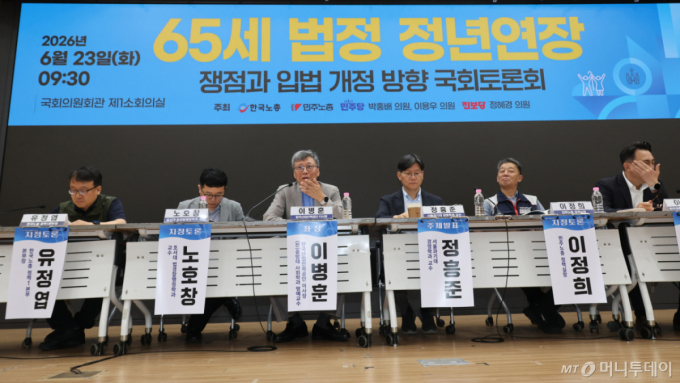
Business circles strongly pointed out that expecting expanded job creation while business activities are contracting due to various government regulations is absurd. They explained that 'real jobs' centered on the youth can only increase when a business-friendly policy environment is in place.
When the Lee Jae-myung administration took office last June, there was high expectation among companies for 'pro-business policies.' This expectation grew even stronger after President Lee emphasized in November last year, "The government will do its utmost to minimize obstacles for entrepreneurs in their business activities. What meaning is there in talking about pro-business or anti-business?"
However, business circles point out that policies were actually pushed in the opposite direction. A representative example is the 'hit and see' style strict enforcement administration by the Fair Trade Commission and others. Their unreasonable investigations and imposition of massive fines have contracted corporate activities, negatively affecting performance and causing employment to shrink, according to analysis.
A representative of a major domestic law firm stated, "Companies are cowering due to the Korea Fair Trade Commission's all-out investigations." He added, "There is even talk that since there are so many unreasonable investigations, many cases where the Korea Fair Trade Commission will lose in administrative lawsuits will arise later, meaning the eventual winners will be law firms representing companies in those lawsuits." He further noted, "If the Korea Fair Trade Commission investigation bureau, once called the 'grim reaper of business circles,' is revived next month as the Key Investigation Planning Unit, the corporate management environment will inevitably contract even more."
Labor policies that are unilaterally unfavorable to companies are also hindering job creation. First, the implementation of the Yellow Envelope Act (amended Trade Union Act Articles 2 and 3) has increased business uncertainty, which is cited as a major problem. With the expanded scope of employers, many companies are suffering from indiscriminate collective bargaining demands, and related response costs are swelling like a snowball.
The statutory retirement age extension pushed by the government and ruling party also places a heavy burden on companies. Business circles worry that as more elderly workers benefit from retirement age extensions, youth unemployment will inevitably worsen. In fact, according to an analysis by the Bank of Korea, after the statutory retirement age was extended to 60 in 2016, for every one increase in elderly workers until 2024, youth workers decreased by 0.4 to 1.5. Analysis suggests that while maintaining seniority-based wage systems, companies had no choice but to reduce new hiring to cut costs when extending the retirement age.
Companies lamented that they are not choosing 'not to hire' employees, but rather 'unable to hire' due to business contraction caused by various regulations. Considering the fierce global competition for talent, they should be actively recruiting more than ever, but given the extreme uncertainty in management, they have no choice but to focus hiring on 'density' rather than 'scale.' They point out that unless this situation improves, expanding jobs will not be easy.
A business circle representative said, "Of course, hiring can proceed regardless of regulations if the business performs well, but now low growth has become entrenched. With various regulations added to this, it has become a structure where increasing jobs is difficult."
[MT Report] Increasing number of employed, shrinking jobs (Part 1) "Employment increased?" Why youth can't relate... The illusion of 'public jobs' funded by national money

 in ECONOMY

