

On the 23rd, in Hwayang-ri, Hyundeok-myeon, Pyeongtaek City, Gyeonggi Province. Grass that had grown to waist height covered a farmland plot. Among the ragweed-like weeds, there were no visible traces of planted crops or evenly spaced furrows. It was also difficult to easily find a path leading into the interior.
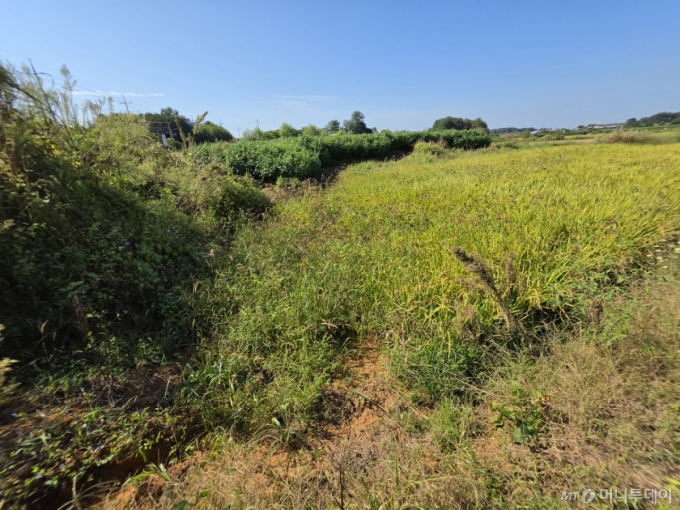
The scene in the field right next door was different. Perilla, green onions, and lettuce were growing neatly, and a path for people to come and go had been made. In a paddy field a short distance away, rice was ripening ahead of harvest. The boundary between land being farmed and land that did not appear to be farmed was clearly visible before our eyes.
In this area, there is suspected speculative farmland traded through subdivided shares. The area is 413 square meters, and there are 109 owners. If the area is simply divided by the number of owners, it amounts to just over 3.3 square meters (1 pyeong) per person. In effect, 109 people have split the shares of this small paddy field. Most of the owners acquired their shares around 2016 for the purpose of farming. Why did so many people buy a single parcel at such a similar time? Whether each intended to farm it themselves, and who actually cultivated the paddy field afterward, has become an issue for the comprehensive investigation.
Choi Dong-ju (65), who has been farming vegetable fields in the vicinity for six years, said, "It appears that the owners of this paddy field are not farming it directly, but rather have people around them cultivating it." When asked whether the owners come to the site, he replied, "They do not seem to come." Choi cautiously mentioned the possibility of transactions through planned real estate regarding the fact that 109 people hold shares. However, he said he could not know why the buyers purchased the land.
A licensed real estate broker, Park Mo (CEO), said, "The paddy field owned by 109 people is not within the Hwayang Zone project area, but it is located in an adjacent area, so it was a place that attracted a lot of attention." He added that there were also many farmland transactions driven by development expectations during the early stages of Hwayang Zone development.
A source at the Hyundeok-myeon Administrative and Welfare Center in Pyeongtaek City stated, "In the case of this farmland, we have confirmed that a single parcel has many owners and that each person's share is small."
Although it appears the owners acquired the land through sales in 2016, the reason for purchasing the parcel and the actual cultivator have not yet been identified. If necessary, plans are in place to request proof of farming, such as agricultural supply purchase records, from those claiming to have farmed the land.
According to the Hyundeok-myeon Administrative and Welfare Center, there are records of crops being cultivated on the paddy field owned by 109 people. However, there is a significant difference between the fact that crops grew and the fact that the share owners themselves farmed the land.
A source at the Farmland Division of the Ministry of Agriculture, Food and Rural Affairs said, "Speculation or violations of the Farmland Act have not been confirmed based solely on basic survey data," adding, "We must look not only at whether the farmland is lying fallow, but also at who the actual cultivator is, and if cultivation was entrusted to someone else, what the circumstances and method were."
Cases where a single parcel has dozens of owners are not limited to Pyeongtaek. A 2,312-square-meter farmland in Yangchon-eup, Gimpo City, Gyeonggi Province, is jointly owned by 44 people, while a 4,012-square-meter farmland in Ilsanseo-gu, Goyang City, is jointly owned by 62 people. Most of the owners in Gimpo are understood to have acquired their shares around 2018 for purposes such as weekend and experiential farming, while most of the owners in Goyang are understood to have acquired their shares around 2016 for farming purposes.
Police investigations have also confirmed cases where farmland transactions driven by development expectations led to illegal charges.
In March this year, the Hwaseong Western Police Station in Gyeonggi Province arrested 219 people on charges such as purchasing farmland in Hwaseong City expecting development profits and then using it without authorization or allowing third parties to use it illegally, and referred them to the Prosecution Service without detention. Some were also charged with dumping construction site soil on farmland.
What the Ministry of Agriculture, Food and Rural Affairs aims to identify through its comprehensive investigation are cases where farmland acquired under the guise of farming is actually left abandoned while waiting for price increases, or entrusted to others in violation of the law. The basic survey utilizing administrative information and aerial photographs has already been completed, and an on-site in-depth investigation has been underway since last August.
The Ministry of Agriculture, Food and Rural Affairs is also actively gathering concerns from the field with the intention of resolving them institutionally. Among farmers, there is consensus on preventing disguised self-cultivation and farmland acquisition for speculative purposes, but many express concern that "while disguised self-cultivation should be caught, a method that bundles everything together is problematic." It was noted that "as people age, it becomes difficult to farm directly, so they may entrust their land to neighbors or jointly cultivate small-scale farmland, so these circumstances must be carefully considered."
On the 21st, through a party-government consultation meeting, the Ministry of Agriculture, Food and Rural Affairs announced that it would handle farmland with clear speculation in accordance with laws and principles, while providing a path to normalize farmland ownership and use for customary violations in rural areas.
413 square meters in Hwayang-ri, Hyundeok-myeon, Pyeongtaek City. Why there are 109 owners of this paddy field has not yet been revealed. Based solely on the scenery seen in Hwayang-ri, they cannot be definitively labeled as speculators seeking development profits. The government's promise to "identify speculation and protect rural life" is put to the test through this comprehensive investigation process.
Yoon Won-sup, Director-General of Agricultural Policy at the Ministry of Agriculture, Food and Rural Affairs, said, "We will actively respond to clear speculation aiming for capital gains or compensation, but we plan to allow general farmers to continue farming more comfortably through these normalization measures," adding, "For normal farmers, measures such as farmland disposal will hardly occur, so please rest assured and cooperate with the farmland survey."

 in ECONOMY
