

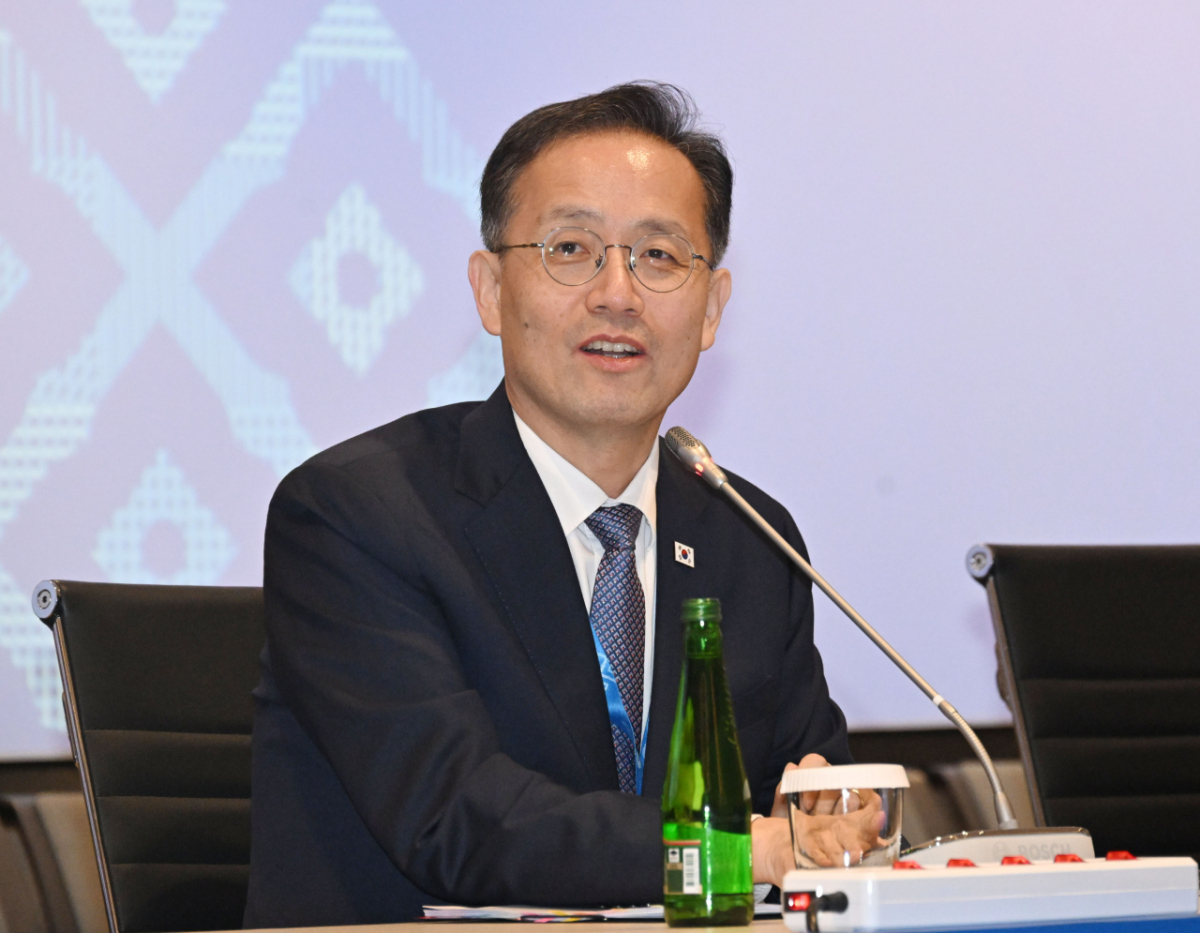
Lee Hyung-il, Deputy Prime Minister and Minister of the Ministry of Economy and Finance, forecast this year's growth rate at 3.4%–3.6%. The government will increase the number of annual economic forecasts from two to three.
Lee, who visited Bangkok, Thailand, to attend events such as the International Monetary Fund (IMF)·World Bank (IMF) Annual Meetings, met with the accompanying press corps locally on the 16th and said, "If no new external events occur during the remaining period that would have a significant impact, I think it is possible for this year's growth rate to reach the mid-3% range."
This is the first time the government has publicly raised its forecast for this year's growth rate to the mid-3% range. The official growth rate forecast presented by the Ministry of Economy and Finance so far has been 3.0%. Deputy Prime Minister Lee further explained that the "mid-3%" range he cited as this year's growth rate forecast refers to "3.4%, 3.5%, or 3.6%."
South Korea's growth rate forecasts have been revised upward consecutively. This is due to the prominent export-led growth driven by a boom in the semiconductor industry. The IMF raised its forecast for South Korea's growth rate this year from 2.6% to 3.3% during the current Annual Meetings period. The OECD (OECD) raised it from 2.6% to 3.7%.
Lee stated, "The first and second quarters grew at 1.8% and 0.6%, respectively, rising very sharply, and if things remain favorable through the third quarter, the growth rate will likely improve significantly," adding, "We believe it will exceed the IMF's forecast of 3.3%."
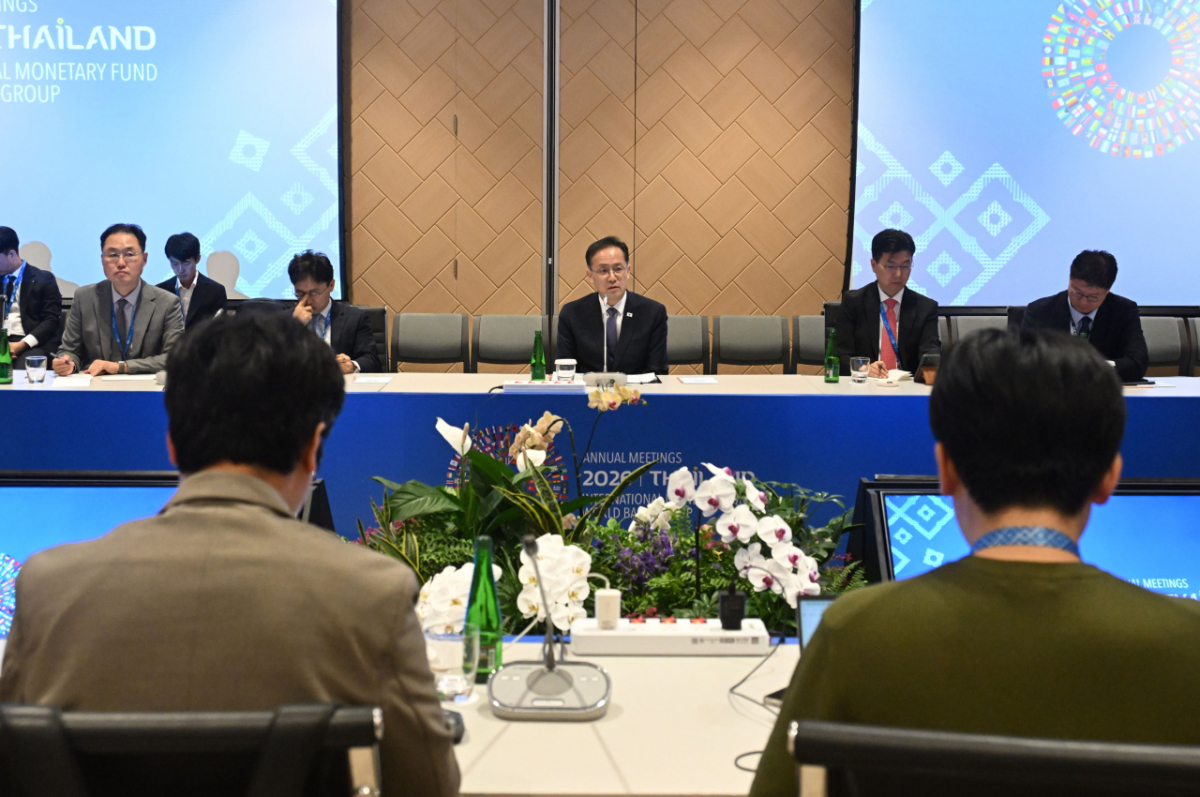
The government will also adjust the frequency of economic forecasts. Until now, growth rate forecasts were released when announcing the year-end Economic Growth Strategy and the second-half Economic Growth Strategy in June–July. Deputy Prime Minister Lee's assessment is that "starting next year, we should conduct forecasts more frequently."
Lee said, "Naturally, we must review next year's economy at year-end, and I think updating it twice rather than once would be a way to respond to the rapidly changing economy."
In particular, he noted, "If we increase the forecast cycle, we are concerned about how to handle the second-half Economic Growth Strategy," adding, "If our current thinking remains unchanged until year-end, an Economic Growth Strategy named 'second half' will be difficult to see next year."
Taken together, Lee's remarks indicate that the number of economic forecasts, currently twice a year, will increase to three. The second-half Economic Growth Strategy will not be released separately. Lee said, "Rather than undertaking another large-scale task (such as the second-half Economic Growth Strategy), it seems more realistic to provide response measures for areas requiring additional supplementation."
He placed emphasis on a 'rebound' regarding potential growth rate, which is the maximum growth rate achievable without causing inflation when all production factors are fully utilized. Deputy Prime Minister Lee stated, "I believe the potential growth rate can break away from its continuous downward trend and rebound," adding, "That time is approaching and, in a sense, imminent."

 in ECONOMY

