

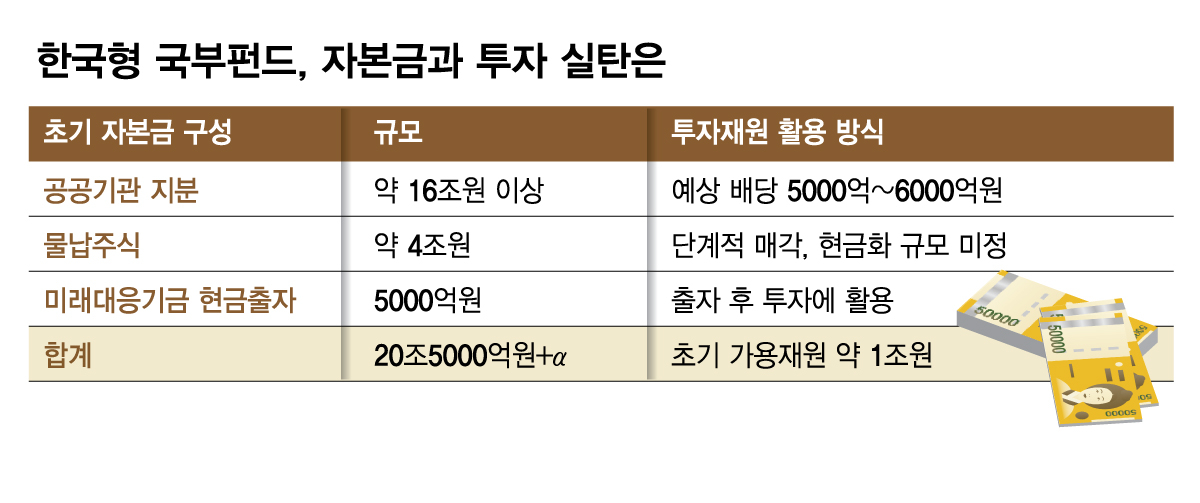
While the direction for the “Korean-style sovereign wealth fund” has shifted from establishing a separate corporation to creating a new account within the Korea Investment Corporation (KIC), there are still many challenges before its launch next year. The initial capital will exceed 20.5 trillion won, but most of it will be filled with public institution shares and in-kind tax payment stocks, while cash contributions from the Future Response Fund amount to only 500 billion won. It must secure resources for long-term investment in strategic industries and complete legal amendments and the establishment of a dedicated management system.
According to relevant government ministries on the 3rd, the initial capital of the Korean-style sovereign wealth fund is planned to consist of over approximately 16 trillion won in public institution shares held by the government, approximately 4 trillion won in in-kind tax payment stocks from inheritance and gift taxes, and a 500 billion won cash contribution from the Future Response Fund.
The Korean-style sovereign wealth fund is a national investment agency being promoted to make long-term investments of government assets in domestic and overseas strategic industries to enhance industrial competitiveness and accumulate investment returns as national wealth. The government presented a plan to establish an initial capital of 20 trillion won in its Economic Growth Strategy in January this year.
The problem is that the over-20-trillion-won capital cannot be immediately invested in strategic industries. Public institution shares are held to secure dividend income, and in-kind tax payment stocks must be cashed out through sales or other means. The initial available resources estimated by KIC amount to approximately 1 trillion won, combining a 500 billion won cash contribution and 500–600 billion won in dividends from state-owned banks.
There is also uncertainty in increasing investment resources through the sale of in-kind tax payment stocks. At the National Assembly audit of the Fiscal and Economic Planning Committee held on the 23rd of last month, it was pointed out that there are limits to cashing out because shares in NXC, the holding company of Nexon, a major in-kind tax payment stock, failed to sell four times.
KIC President Park Il-young also explained that in-kind tax payment stocks must be sold in stages, making it difficult to present specific amounts. He stated that if the scale of investment projects exceeds available resources, they will consult with the government on additional contributions or entrustments. This means that separate discussions on securing resources are needed to respond to large-scale investment demand.
Compared to the original concept, plans for establishing an independent institutional investor and expanding resources have also changed. The government considered a plan to establish a separate corporation apart from KIC, but shifted direction in its second-half Economic Growth Strategy last July to set up a strategic investment account within KIC. In the early stages of the concept, a plan to directly inject excess tax revenue into the sovereign wealth fund was also discussed. However, next year’s budget bill reflects a plan to receive a 500 billion won contribution from the Future Response Fund. Criticisms that the fund’s contribution scale is insufficient are already emerging.
The existing KIC foreign exchange reserve entrusted account and the new strategic investment account will be managed separately. This expands KIC’s investment function, which has managed entrusted assets from the government, the Bank of Korea, etc., overseas, to domestic and overseas strategic industries. The concept is to supply long-term patient capital without maturity or liquidation deadlines and attract co-investments from overseas sovereign wealth funds, among others.
Legislation has not yet been completed. Democratic Party of Korea lawmakers Kim Tae-nyeon and Oh Gi-hyung have each submitted bills to amend the Korea Investment Corporation Act, including the establishment of a strategic investment account. KIC has been operating a task force (TF) of about 20 people since last July, but plans to prepare specific operational measures such as organization, personnel, and investment criteria after legal amendments.
KIC aims for legal amendments within this year and the start of investments next year. However, follow-up procedures such as appointing a dedicated Chief Investment Officer (CIO) are needed even after legal amendments. Whether it will operate next year depends on the speed of legislation and organizational formation, while the actual investment scale will be determined by additional contributions and the cash-out of in-kind tax payment stocks.

 in ECONOMY
