

The fundamental cause of the fire service budget shortfall lies in the fact that, although fire service personnel have been converted to national civil servants, local governments must still bear the related expenses. This is because fire services are classified as local government affairs. It is pointed out that the basis for central government support will only be established once the distorted structure of fire services, which are national posts in name only—where the head of a Local Government holds the authority to appoint fire service personnel—is resolved.
Fire service personnel were converted to national civil servants in April 2020. This was intended to provide identical fire services in any region and strengthen the state's responsibility for disaster response during the Moon Jae-in administration.
However, complete conversion to national civil servants was not achieved, as decisions were made during this reform process to allow Local Governments to retain a significant portion of authority, including personnel management and command powers.
The Local Autonomy Act defines "regional fire prevention, surveillance, suppression, investigation, and rescue and emergency medical services" as Local Government affairs. Accordingly, the governors of metropolitan cities and provinces hold partial appointment authority over fire service personnel. Local fire headquarters also operate directly under the governors of metropolitan cities and provinces, exercising command and supervisory authority over fire activities during disasters. Thus, they possess both national and local civil servant characteristics simultaneously.
The problem arises here. The Local Finance Act explicitly states that Local Governments must bear the full cost required for local government affairs. This is why direct support from the central government is limited, despite their status as national civil servants.
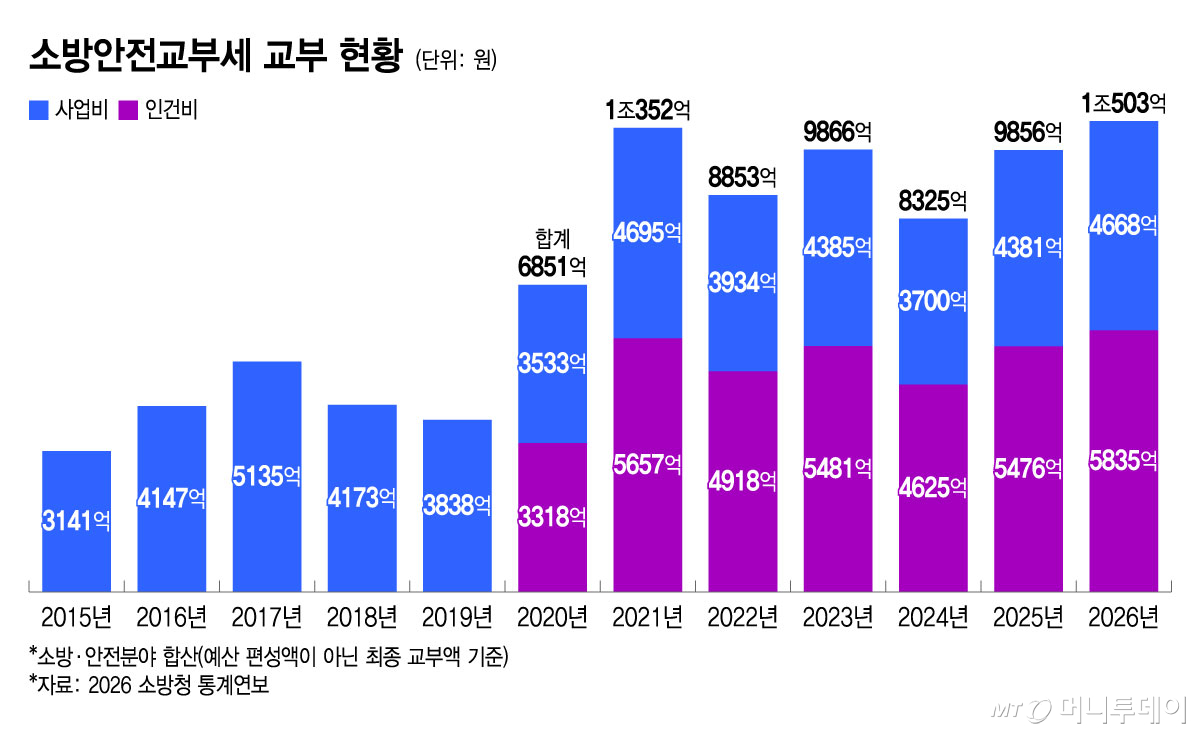
Instead, to increase the number of fire service personnel by 20,000 and support personnel costs during the conversion to national posts, the central government raised the Fire Safety Transfer Tax rate from 20% to 45%. According to a report titled "Has the Purpose of Converting Fire Service Personnel to National Civil Servants Been Achieved?" published in January by the National Assembly Research Service, the share of national funds in the total fire service budget was around 7% in 2019, but rose to 14.9% in 2021 following the conversion of fire service personnel to national civil servants in 2020.
However, this share subsequently decreased, falling to a level of 10.7% in 2025. Based on the 2026 budget proposal, out of the total fire service personnel costs of 6.555 trillion won, the portion supported by the Fire Safety Transfer Tax was 549.6 billion won, accounting for only 8.3%.
The share of national funds is likely to fall further. This is because personnel costs continue to increase, while the funding source for the Fire Safety Transfer Tax may decrease as consumption of combustible cigarettes declines. The Fire Safety Transfer Tax is funded by a certain percentage (45%) of the individual consumption tax on tobacco.
The issue is that local governments must bear most of the increasing fire service budget. Looking at the status of metropolitan city and provincial fire service budget allocations, based on final budgets, the figures were 4.0434 trillion won in 2015 and 5.0742 trillion won in 2018, surpassing 5 trillion won, followed by 6.6893 trillion won in 2021, 8.0951 trillion won in 2024, 8.4790 trillion won in 2025, and 8.5967 trillion won in 2026 (based on the budget proposal). This represents an increase of approximately two times compared to 2015.
Each time a major disaster occurs, past administrations have called for strengthening safety budgets. However, they have actually faced the limitation that fire services are local government affairs, making direct support difficult. To increase central government support, it is necessary to revise laws through consultation with the head of the Local Government, who holds personnel and fire command authority.
A government official said, "Because the Local Autonomy Act defines fire services as local government affairs, Local Governments must bear the financial burden under the Local Finance Act, and legal revision is needed to increase government support," while adding, "As a realistic alternative, there are methods such as increasing the Fire Safety Transfer Tax."

 in ECONOMY
