

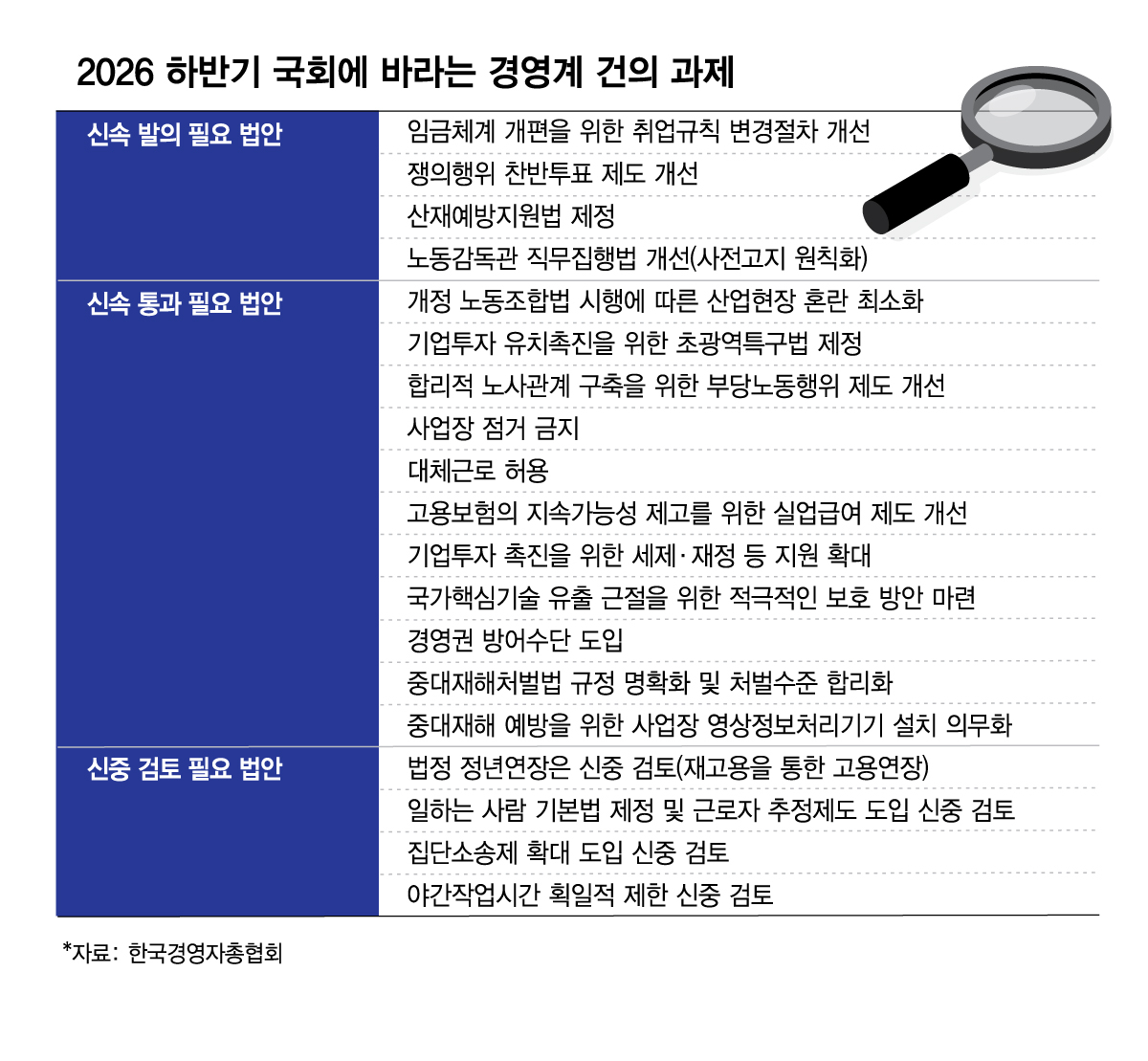
Behind the business community's appeal to the National Assembly to reflect the voices of management lies the desperation that, excluding semiconductors, most industries have been pushed into domestic and international crises. While the Korean economy is expected to post an unusually high growth rate in the late 3% range this year, it is a common assessment that if the effects of the "semiconductor super-boom" are stripped away, the majority of companies face a more difficult situation than usual. The business community urged that for domestic companies to continue growing, the National Assembly must step in to correct labor-biased policies and introduce systems that promote corporate innovation.
This is supported by the fact that a significant number of the 19th proposed tasks submitted by the Federation of Korean Industries (FKI) to the National Assembly are labor-related issues. The business community's consistent opinion is that the government's labor-biased policies, represented by the Yellow Envelope Act (amended Trade Union Act), which took effect in March last year, must be corrected now to reduce on-site confusion.
In fact, the FKI cited improvements to the Yellow Envelope Act as the top priority among "bills requiring swift passage." It specifically pointed out concerns that disputes could expand if, after negotiations begin on issues where the principal employer's status is recognized, subcontractor unions demand negotiations on matters exceeding the principal employer's scope of authority. It also criticized the contradiction that because labor commissions frequently evaluate a principal employer's compliance with industrial safety laws and safety assurance measures as "indicators of employer status," companies face greater legal risks the more diligently they comply with regulations.
The business community also expressed concerns about new labor policies being pushed by the government and the ruling party. A prime example is the statutory extension of retirement age. Currently, 10 bills to extend the retirement age from the current 60 have been introduced in the National Assembly, and Ministry of Employment and Labor Minister Kim Young-hoon recently stated that "bills on extending the retirement age must be processed within this year." While acknowledging the need to expand labor market participation for the elderly, the FKI predicted that a uniform extension of retirement age would △undermine companies' capacity for new hiring, worsening youth unemployment; △concentrate benefits among regular employees at large companies with unions; and △increase corporate labor cost burdens due to high seniority-based wages and employment rigidity.
The introduction of the "Basic Law for Working People" and the "Presumption of Employee Status System" is also analyzed to have significant negative impacts on industries. The Basic Law for Working People aims to include all individuals providing labor services for others, regardless of contract form, as subjects of legal protection. The Presumption of Employee Status System presumes that an individual is an employee if it is confirmed they provided labor services for others when a dispute over employee status arises, and recognizes them as such unless the employer can provide counter-evidence. An FKI official emphasized, "The Presumption of Employee Status System imposes a heavy management burden on companies and small businesses, raising significant concerns about employment contraction."
Instead, the business community requested that legislative efforts to promote corporate innovation be accelerated. A bill granting various special privileges for the establishment of ultra-regional strategic industrial special zones is mentioned first. Additionally, it is urgent to introduce a "Direct Tax Credit Refund System" that allows timely tax support for investments even when operating losses occur, and a "Domestic Production Promotion Tax System" that provides tax benefits when products are manufactured domestically and sold both at home and abroad.
Lee Dong-geun, Vice Chairman of the FKI, stated, "The business environment is changing rapidly," adding, "We ask the National Assembly to listen to the voices from the field that companies truly need." He advised, "Only by swiftly establishing protective measures to eradicate the outflow of core technologies, alongside expanding tax support for investment promotion, can companies build competitiveness."

 in INDUSTRY
