

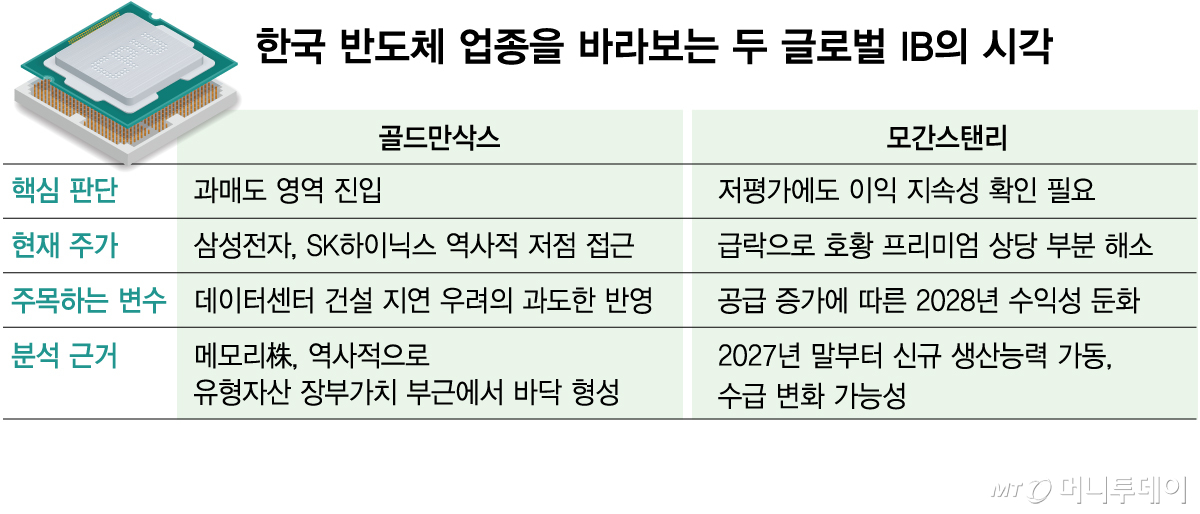
What separated Goldman Sachs' and Morgan Stanley's outlooks for Korean semiconductor stocks was their perspective on medium- to long-term supply and demand. Both global investment banks agreed that recent share price declines had been excessive. Goldman Sachs argued that data center regulations would shift the location of investment rather than dampen AI (artificial intelligence) investment demand, forecasting continued capacity expansion through 2028. In contrast, Morgan Stanley viewed data center regulations as a factor that could erode profitability when combined with increased memory supply.
Goldman Sachs determined that there is little reason for investment demand to decline if the scope of investors is expanded beyond major cloud companies to include AI developers, governments in various countries, and general enterprises. It forecast that total investment including all these entities would increase to approximately $1.3 trillion in 2027 and approximately $2 trillion in 2028. These figures represent year-on-year increases of approximately 60% and 42%, respectively.
Goldman Sachs analyzed that even under a conservative scenario with no additional growth in 2028, the price-to-earnings (PER) ratios of NVIDIA and Broadcom would be at levels of approximately 12x and 13x, respectively, making them attractive for investment. According to Daishin Securities, NVIDIA's current 12-month forward PER is 19.1x, which is below the five-year average of 35.2x. Broadcom's 12-month forward PER stands at 17.7x.
David Solomon, CEO of Goldman Sachs, also hinted at a similar perspective. In an interview with CNBC, CEO Solomon stated, "As long as computing demand exists, (if not built within the US) data centers will naturally move outside the United States." This implies that even if data center construction in the US is constrained, infrastructure investment can continue in other regions.
Goldman Sachs identified two key anxiety factors pressuring recent semiconductor share prices: funding methods to sustain large-scale AI investments and the possibility of securing data center infrastructure such as land and power. In a report on the 9th (local time), Goldman Sachs stated, "Along with concerns that AI data center construction in major regions like Texas will be delayed after the US midterm elections, the second issue has come to the forefront." The bank viewed these concerns as already being largely reflected in share prices.
Morgan Stanley, which considered the recent drop in share prices too rapid, also presented conditions under which investment appeal could revive. Morgan Stanley analyst Sean Kim stated, "If memory manufacturers make a credible commitment to slow down the pace of capacity expansion, investment appeal would improve significantly."
However, Morgan Stanley warned against increased medium- to long-term supply. It observed that once new production capacity is fully operational, supply may catch up with demand, potentially weakening memory makers' pricing power. Recent shipment forecasts and accelerated process transitions were cited as factors increasing the likelihood of higher supply than previously expected. The bank pointed out that even if Chinese companies do not export directly to the US, they can still impact global memory prices.
Based on this, Morgan Stanley lowered its forecast for SK hynix's average DRAM operating profit margin from 2029 to 2035 from the previous 60% to 32%. It also projected that Samsung Electronics' average DRAM operating profit margin over the same period would return to the historical average of approximately 39%. The background for the target price reduction was a shorter assumed duration for maintaining boom-time profitability.
Morgan Stanley expected an additional delay from 2028 to 2029 for US data center projects on a scale of approximately 5 gigawatts (GW). Reflecting this, the annual scale of new US data center operations is projected to decrease by 4% year-on-year in 2028 and increase by 38% in 2029. Analyst Kim analyzed, "Currently, unusually high profits are continuously driving manufacturers to expand supply."

 in STOCK
