

As manual therapy was converted to managed benefits starting last month, a "balloon effect" has emerged in the medical field where other non-covered treatments are increasing. With prices rising for extracorporeal shockwave therapy instead of manual therapy, and especially with a surge in utilization of the new non-covered kidney spray treatment, concerns about leakage in real-life insurance claims are becoming reality.
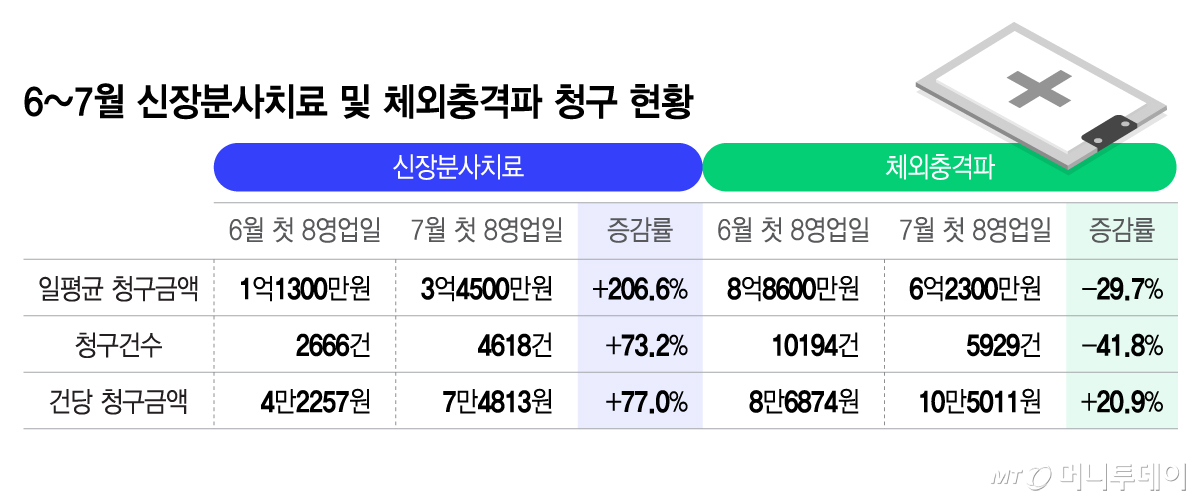
According to data from the property and casualty insurance industry on the 11th, an analysis of real-life insurance claims from seven insurers (Meritz, Samsung, Hyundai, KB, DB, Hanwha, and Heungkuk) revealed that during the first eight business days of July, immediately after the implementation of managed benefits, the average daily claim amount for kidney spray treatment reached 345 million won, more than triple the 113th million won recorded in the first eight business days of June. During the same period, the number of claims increased from 2,666 to 4,618 (a 73.2% rise), and the average claim amount per session rose from 42,257 won to 74,813 won (a 77.0% increase).
Kidney spray treatment is a therapy that sprays cooling spray to relieve muscle pain, differing from covered cold therapy. With manual therapy now limited to 43,850 won per session (95% co-payment rate) and capped at 15 sessions annually starting this month, the insurance industry analyzes that providers are replacing reduced revenue from manual therapy with non-covered kidney spray treatment.
In fact, at a hospital in the Seoul metropolitan area, a patient who received manual therapy for 160,000 won in June received kidney spray treatment for the same amount after the implementation of managed benefits. At another hospital, a patient who had paid 220,000 won for manual therapy received kidney spray treatment worth 150,000 won following the policy change.
Particularly, property and casualty insurers are concerned that, similar to past manual therapy cases, price differences for kidney spray treatment vary significantly among medical institutions. Non-covered prices at clinics range from a minimum of 0 won to a maximum of 500,000 won, with treatment times typically lasting only 1 to 5 minutes.
Another balloon effect from the manual therapy managed benefits was seen in price hikes for extracorporeal shockwave therapy. While the government imposed limits on the number of sessions for this treatment, it did not set separate price standards. As a result, although the total claim volume decreased, the average fee per session actually increased.
Based on data from seven property and casualty insurers, the average daily claim amount for extracorporeal shockwave therapy during the first eight business days of July was 623 million won, down 29.7% compared to the same period in June. The number of claims also dropped from 10,194 to 5,929 (a 41.8% decrease). However, the average claim amount per session rose from 86,874 won to 105,011 won (a 20.9% increase), indicating that providers are maintaining revenue by reducing session frequency while raising unit treatment prices.
In fact, price increases were confirmed in the medical field as well. Han (Rep.) changed a patient's previous combination of 150,000 won for manual therapy and 60,000 won for extracorporeal shockwave therapy to covered exercise therapy for manual treatment after the managed benefits implementation, while doubling the extracorporeal shockwave price from 120,000 won to 240,000 won. Another clinic was also found to have raised its extracorporeal shockwave unit price from around 50,000 won to 130,000 won starting this month for billing purposes.
An industry official stated, "It appears that clinics are trying to maintain reduced revenue from manual therapy by shifting to extracorporeal shockwave therapy." They added, "However, since there are limits on the number of sessions for extracorporeal shockwave treatment, they seem to be raising prices and moving toward new non-covered treatments like kidney spray treatment, so we are monitoring the situation closely."

 in FINANCE
