

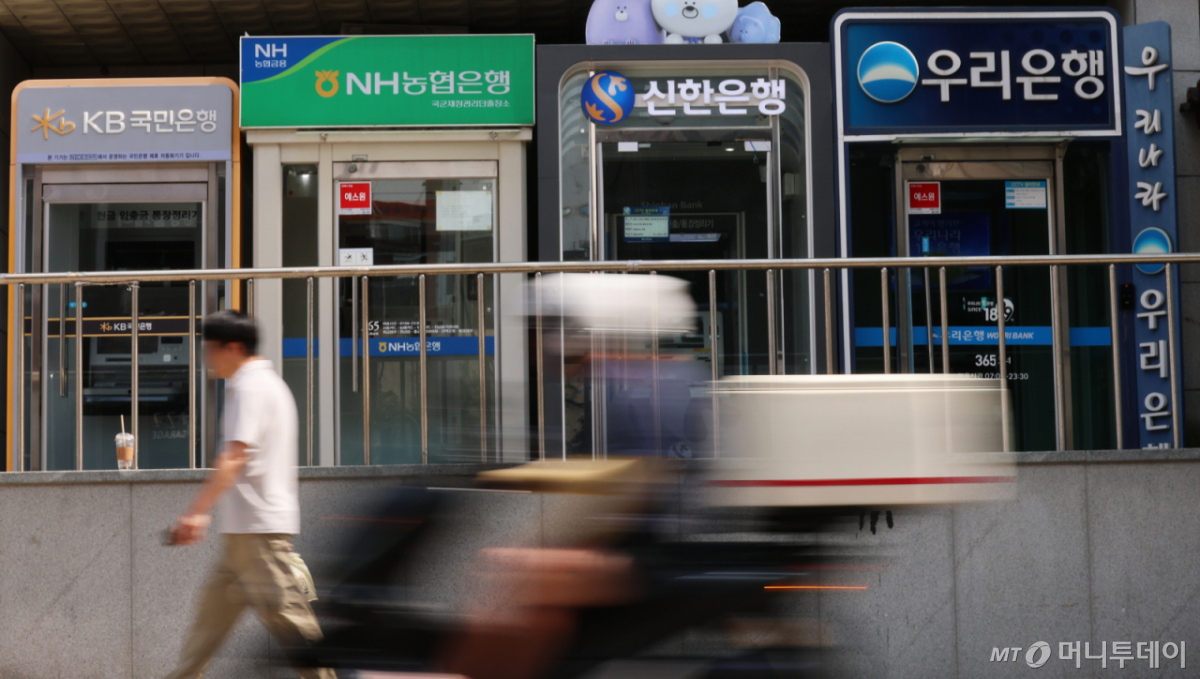
While the banking sector sold 60 trillion won worth of exchange-traded funds (ETFs) in the first half of the year alone, 20% were found to have target returns set below 5%. Critics argue that by setting target returns lower than deposit rates, banks encouraged short holding periods to boost fee income.
According to data submitted by the Financial Supervisory Service to the office of Chang-min Han, a member of the National Assembly's Political Affairs Committee from the Social Democratic Party, on the 2nd, products with target returns set below 5% among KB Kookmin, Hana, Woori, and NH NongHyup banks totaled 1.6041 trillion won as of end-June. These products accounted for an average of 20% of each bank's total entrusted assets.
By individual bank, Kookmin Bank had the highest share at 31%. Notably, 649.9 billion won was concentrated solely in the range above 3% but below 5%. This was followed by Woori Bank at 26% (542.3 billion won), NH NongHyup Bank at 19% (268.9 billion won), and Hana Bank at 2% (98.9 billion won).
While ETFs can be bought and sold through securities firms, banks also sell them in the form of specific monetary trusts. Since banks do not hold trading licenses, they conduct transactions this way. The products operate by setting a target return and automatically redeeming when that target is reached.
Among these, it has been pointed out that banks set target returns below 5% to boost fee income and induce frequent trading. For example, if an investor joins an ETF trust product with a 3% target return, the ETF is automatically sold each time the 3rd% threshold is reached. To join the same product again afterward, the investor must pay another trust fee. In reality, bank ETF trust holders tend to have short holding periods. According to the Financial Supervisory Service, the average holding period for bank ETF trusts is just 42 days, and from January 2025 to May 2026, the average number of contracts per customer was 5.5 times.
Banks have increased fee income through this practice. When customers join an ETF trust, banks collect a front-end load fee of 100BP (1BP=0.01 percentage points). Investors must also pay a trading fee once more when selling. Although the trading fee is not as high as the front-end load, it is set higher than securities firm transaction fees.
Sales of ETFs by the five major banks reached 59.3169 trillion won, already three times the scale sold last year (20.2047 trillion won). Trust fee income in the first half of the year totaled 1.0238 trillion won, a 129% increase compared to the same period last year. A significant portion appears to have come from ETF trust sales.
While target returns can be chosen by investors, due to the nature of trust products, they are often determined based on staff recommendations. This has raised concerns about whether proper guidance was provided. A financial industry official pointed out, "With deposit rates in the 4th% range, setting ETF returns as low as 2-3% itself encourages joining and redemption."
Following the issuance of a consumer alert, the Financial Supervisory Service launched an inspection into incomplete sales of ETF trusts at six institutions: Kookmin, Shinhan, Hana, Woori, NH NongHyup, and Standard Chartered Bank Korea. Key issues to be clarified through the inspection include whether there were circumstances of incomplete sales, such as inducing customers to set target returns excessively low or failing to properly explain fee structures. A Financial Supervisory Service official stated, "Data has emerged showing that a significant number of cases involved choices unfavorable to investors in ETF contracts," adding, "Whether fee structures were properly explained is the core focus of this inspection."

 in FINANCE
