

Local hub banks are demanding a revision of the current system that reflects the performance of regional Nonghyup Aggregates (unit cooperatives) in evaluations of NH NongHyup Bank. This follows controversies that erupted during the first treasury account selection for Gwangju Metropolitan City in Jeollanam-do last May, now spreading into nationwide calls for institutional reform.
According to financial sector sources on the 5th, six local hub banks—BNK Busan, BNK Gyeongnam, Jeonbuk Bank, Gwangju Bank, Jeju Bank, and iM Bank—have jointly submitted a proposal to the Ministry of the Interior and Safety to revise regulations governing treasury account designations for local governments, and are continuing to push for related institutional improvements.
The core issue is a request to explicitly codify in the regulations that regional Nonghyup Aggregate performance should not be factored into NH NongHyup Bank evaluations. Under current Ministry of the Interior and Safety regulations, treasury account evaluation criteria include "convenience for local residents" (18 points) and "other matters" (11 points) out of a total of 100 points. These items allow local governments to reflect regional Nonghyup Aggregate performance in NH NongHyup Bank evaluations at their discretion.
Local hub banks argue that since NongHyup Bank and regional Nonghyup Aggregates are legally separate entities, recognizing the branch network and local tax collection performance of regional Nonghyup Aggregates as part of NongHyup Bank's performance undermines fairness.
This controversy erupted prominently during the first treasury account selection for Gwangju Metropolitan City in Jeollanam-do last May. At that time, the Treasury Account Selection Review Committee decided to factor in the number of regional Nonghyup Aggregate branches and their local tax collection performance into the evaluation. As a result, NH NongHyup Bank was selected as the primary treasury account holder (1st treasury), while Gwangju Bank was designated as the secondary treasury account holder (2nd treasury). Previously, Gwangju Bank had held the primary treasury account for Gwangju City. Gwangju Bank has announced it will file a lawsuit over the unfairness of factoring in regional Nonghyup Aggregate performance and is currently seeking legal counsel.
In contrast, the NongHyup side countered that in rural counties, townships, and island areas, regional Nonghyup Aggregates jointly serve as financial infrastructure alongside NongHyup Bank. This means they effectively support residents' convenience by jointly handling local tax collection, public complaints, and on-site administrative support.
Notably, NongHyup Bank and regional Nonghyup Aggregates share a computer network system, allowing many financial services—including deposits, withdrawals, and transfers for NongHyup Bank accounts—to be processed at regional NongHyup Aggregate counters. During the pandemic and in recent cases of high fuel price subsidy distributions, they also jointly handled NongHyup Card-related tasks, making it reasonable to view them as a single financial service network.
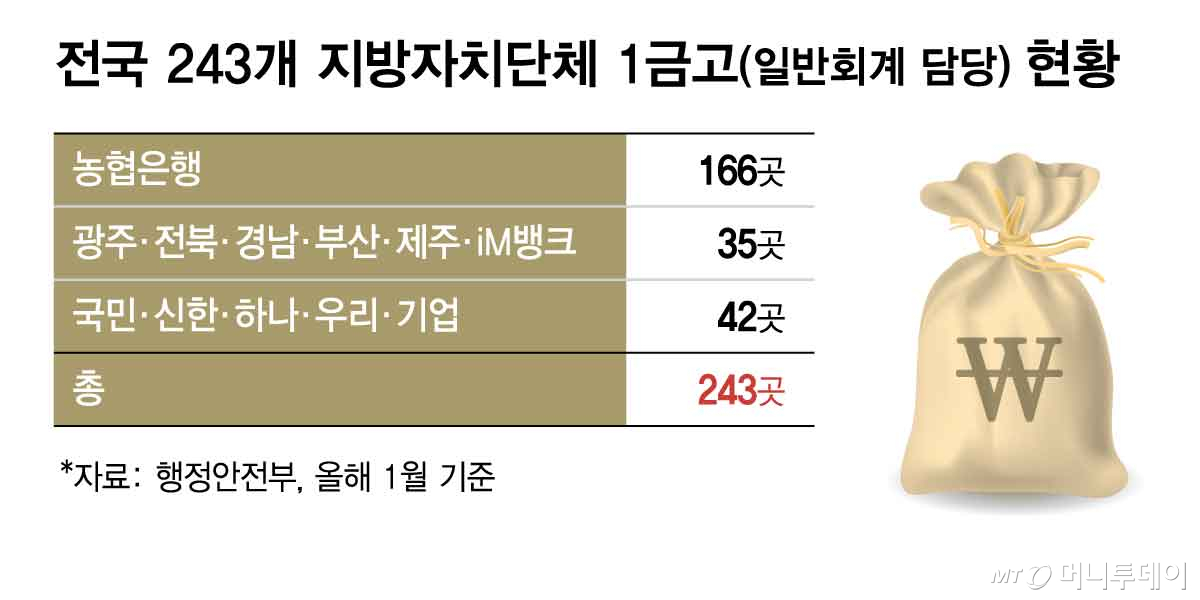
The fact that NH NongHyup Bank currently holds most local government treasury accounts nationwide is interpreted as reflecting the principle of "joint financial services by regional Nonghyup Aggregates and NongHyup Bank." Among 243 primary treasury accounts held by local governments nationwide, NH NongHyup Bank operates 166 (68%), while six local hub banks manage 35 (14%).
With some local government treasury accounts set for re-selection in the second half of this year, if the Ministry of the Interior and Safety clarifies the scope of recognizing regional Nonghyup Aggregate performance, significant changes are expected in future treasury account competition dynamics. Among the 243rd local governments nationwide, 69 have primary treasury contracts expiring at the end of this year; NH NongHyup Bank currently holds the primary treasury account for 38 of them.
In addition, local hub banks argue that the foreign credit rating institutional investor evaluation criterion (4 points) among treasury account selection evaluation items is structured to disadvantage local banks and requires improvement. They claim that while domestic credit rating institutional investors do not rate local banks lower than commercial banks, it is difficult for them to achieve similar ratings from foreign credit rating institutional investors as commercial banks.
A banking industry official stated, "From the perspective of local banks, with declining low-cost deposit inflows, there is a need for strategies to secure local government treasury accounts. However, even excluding regional Nonghyup Aggregates, it will not be easy due to NH NongHyup Bank's extensive branch network and relatively high interest rate competitiveness."

 in FINANCE
