

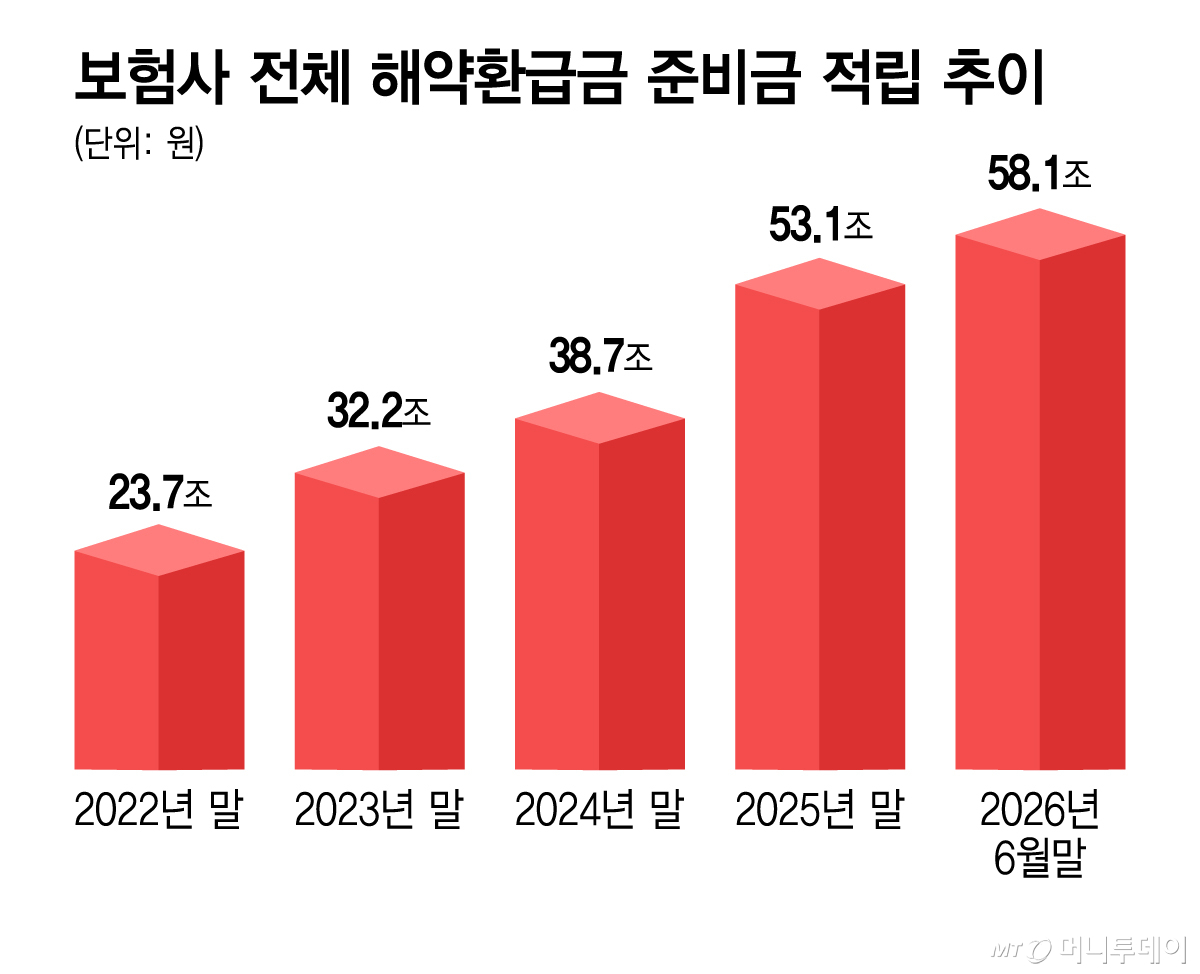
Surrender refund reserves (surrender reserves), which have swelled to 58 trillion won, are not only blocking insurance company dividends but also destabilizing capital ratios. Surrender reserves are expected to surpass retained earnings, requiring the difference to be deducted from the basic capital ratio. Financial authorities are reviewing fundamental improvement measures, such as lowering the conservative large-scale lapse assumption (80–100%) at the level of insurance company liquidation to around 30%.
According to financial authorities and the insurance industry on the 9th, the surrender reserve fund introduced in 2023 to protect policyholders is threatening not only its original purpose but also the basic capital ratios of insurance companies, raising concerns of a 'shock'.
Insurance companies are valuing insurance liabilities to be returned to policyholders at market prices under IFRS17 (new insurance accounting). However, when market-valued liabilities are smaller than surrender refund reserves calculated based on past cost standards, the difference must be accumulated as surrender reserves. This is a 'safety mechanism' established by financial authorities to ensure surrender payments can be made whenever policyholders terminate contracts en masse.
However, due to a combination of high interest rates, excessive new contract competition, and conservative large-scale lapse rate assumptions, surrender reserves have surged more than twofold from 23.7 trillion won just before the system's introduction to 58.1 trillion won as of the end of June.
Since surrender reserves represent liability amounts to be returned to policyholders, they are excluded from distributable profits. This is why major insurance companies such as Hanwha Life, Hyundai Marine & Fire Insurance, KB Insurance, and Shinhan Life have been unable to pay dividends despite earning tens of billions of won in profits annually.
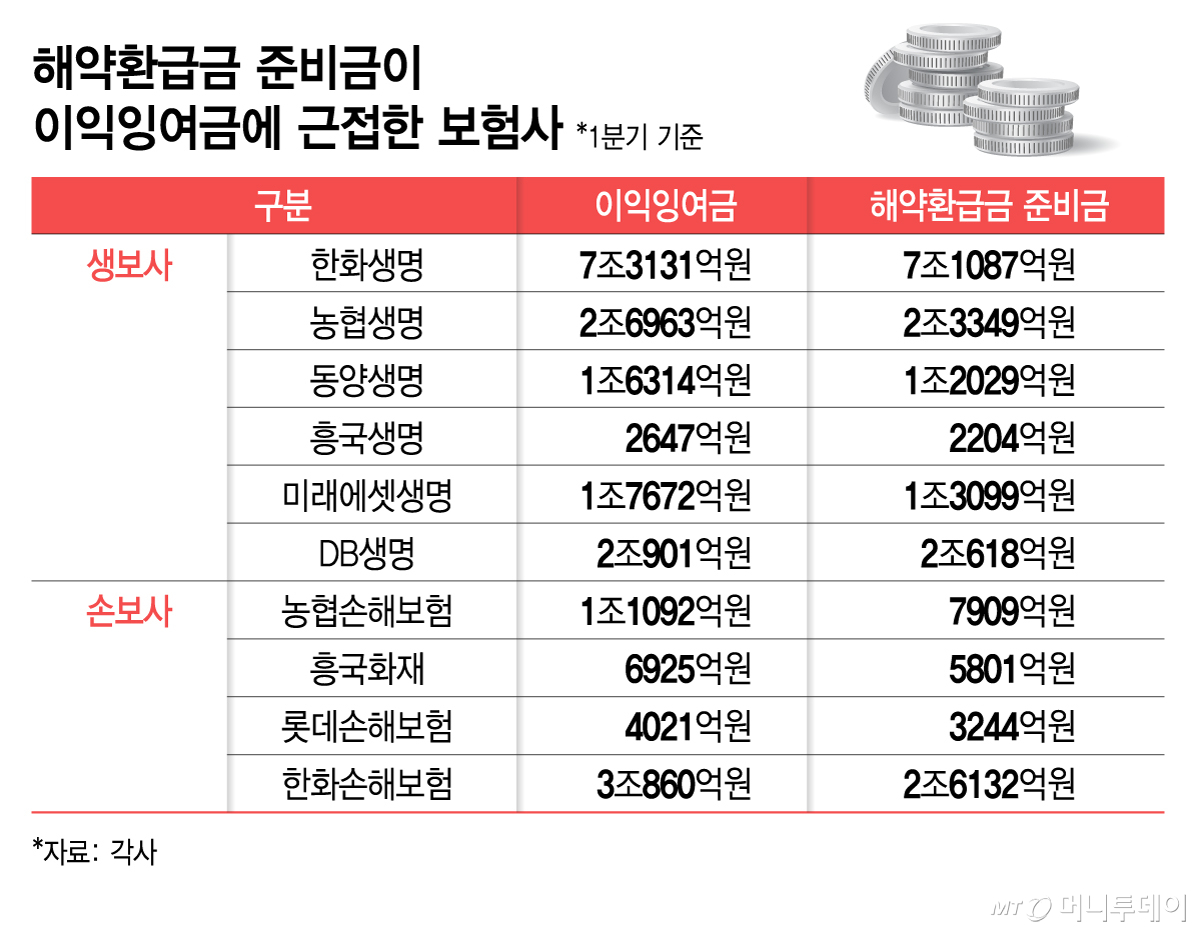
To make matters worse, surrender reserves now threaten to drag down basic capital ratios. At the current pace, insurance companies whose surrender reserves exceed retained earnings will emerge starting next year. The amount by which surrender reserves surpass retained earnings must be deducted from the basic capital ratio, which is the 'core' of insurance company soundness. This inevitably leads to a decline in insurance companies' capital ratios. Financial authorities will implement regulations on basic capital ratios at 50% gradually starting next year. Insurance companies failing to meet this threshold will face 'corrective measures for timely intervention'.
In fact, as of the end of June, Hanwha Life's surrender reserves stood at 7.1097 trillion won, already reaching 97.2% of its retained earnings of 7.3131 trillion won. Hanwha Life's basic capital K-ICS (solvency) ratio was 58%, nearing the regulatory threshold of 50%. Among life insurance companies, NH Life, Dongyang Life, Mirae Asset Life, and DB Life are at risk; among property and casualty insurers, NH Property & Casualty Insurance, Heungkuk Fire & Marine Insurance, Lotte Property & Casualty Insurance, and Hanwha Property & Casualty Insurance face potential capital ratio declines.
Financial authorities are also reviewing fundamental improvement measures. It is reported that a likely option involves revising the extreme assumption of "insurance company bankruptcy" used in calculating surrender reserves by lowering the large-scale lapse rate from the current 80–100% to 25% for protection-type contracts and 35% for savings-type contracts, reflecting reality. Another proposal under discussion is to treat surrender reserves as 'zero' for contracts that initially run at a deficit but later turn profitable (negative liabilities).
A financial authority official stated, "In line with the introduction of basic capital ratio regulations next year, we are reviewing fundamental improvement measures rather than temporary fixes to ensure the surrender reserve system operates in accordance with its original purpose."

 in FINANCE

