

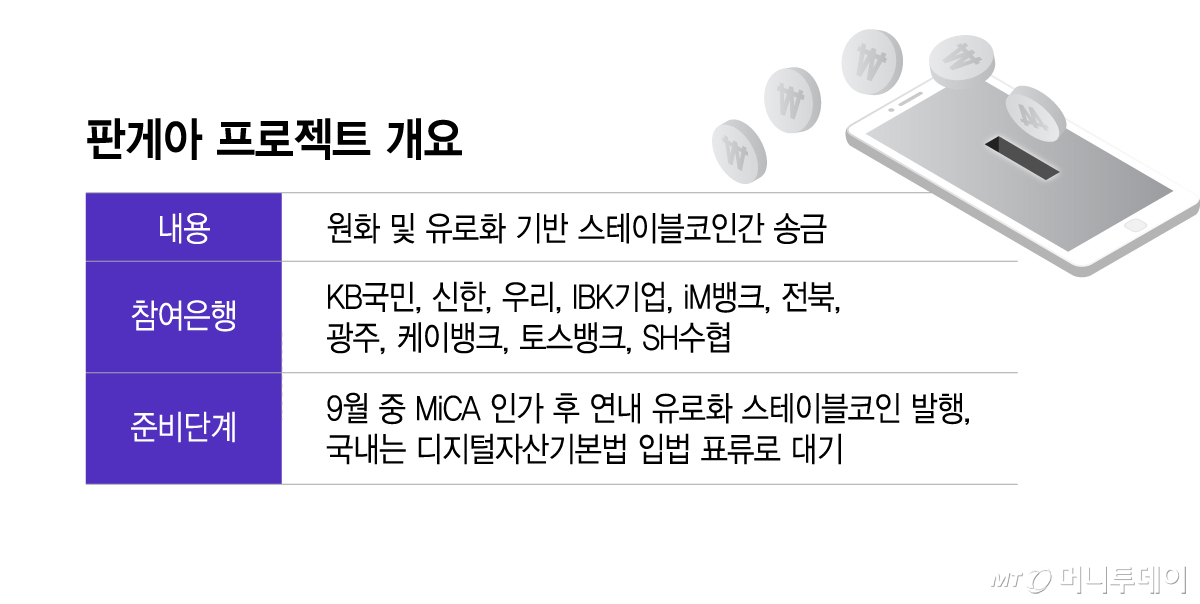
Ten domestic banks, including KB Kookmin, Shinhan, and Woori Bank, have launched practical discussions on a South Korea-EU stablecoin remittance project. This move aims to accelerate collaboration ahead of the planned launch this year of a euro-based stablecoin jointly issued by European banks. However, the actual commercialization hinges on the enactment of South Korea’s Digital Asset Basic Act.
According to financial sector sources on the 9th, Laurent Givral, Asia-Pacific (APAC) representative of KivaLis, visited South Korea and held discussions on the Pangaea project with domestic banks and blockchain infrastructure companies on the 3rd.
The Pangaea project is a proof-of-concept (PoC) initiative to establish a stablecoin remittance model involving 'Unica,' an alliance of Korean banks, and 'KivaLis,' a consortium of European banks. Cross-border remittances previously required multiple intermediaries, including the global SWIFT infrastructure, often taking several days. However, leveraging stablecoins is expected to streamline these complex procedures. Moreover, the Pangaea project holds significance as an attempt by South Korean financial institutions to move beyond the dollar-based stablecoin ecosystem dominated by Circle and Tether in the stablecoin industry.
Ten domestic banks are participating in this project: commercial banks such as Kookmin, Shinhan, Woori Bank, and iM Bank; internet banks including Kakaobank (Kakao) and Toss Bank; and regional banks like Gwangju Bank and Jeonbuk Bank. The practical meeting served to share industry status and development progress, with most attendees including KivaLis, SWIFT, Chainlink, and participating banks. As KivaLis executives visit South Korea to attend the upcoming Korea Blockchain Week (KBW) event later this month, they are also expected to hold meetings not only with domestic banks but also with relevant institutional investors such as the Bank of Korea.
While stablecoin collaboration among financial institutions worldwide is accelerating rapidly, the Pangaea project stands out as the largest initiative involving South Korean banks. The Open USD project, which aims to issue a dollar-pegged stablecoin (OUSD), involves some bank participation but is primarily led by the card industry. In contrast, the Pangaea project focuses on exchanging different types of stablecoins and has deep ties to the banking sector’s foreign exchange (FX) transactions.
With KivaLis planning to launch a euro-based stablecoin this year, it is expanding consultations with South Korea's financial sector. To issue a joint euro stablecoin, KivaLis has applied for an e-money token license under the EU’s Markets in Crypto-Assets (MiCA) framework, with results expected as early as this month.
The challenge lies in South Korea, where delays in enacting the Digital Asset Basic Act are slowing down stablecoin issuance itself. The Digital Asset Basic Act is a comprehensive bill covering regulatory oversight of all virtual assets, establishing consensus bodies among relevant institutional investors, and setting requirements for stablecoin issuance. Although legislation was initially discussed for the first half of the year, progress has stalled due to disagreements within both the opposition party and the ruling party regarding stablecoin issuance criteria and corporate governance structures of virtual asset exchanges.
As financial authorities have publicly committed to accelerating efforts in the second half of the year, the bill is expected to beed through a legislative initiative by lawmakers rather than government-led legislation. The financial sector emphasizes that without the Digital Asset Basic Act, building sophisticated remittance models is impossible, making its enactment an urgent priority. A financial industry official stated, "While currently in a pilot phase, many projects are already underway with actual issuance and commercialization in mind." They added concerns: "If domestic laws lag behind, South Korea may find itself excluded from the stablecoin issuance framework being established for other countries, despite laying the groundwork for cross-border transactions."

 in FINANCE
