

#. Recently, a prominent domestic law firm has held multiple business explanation sessions at local insurance agencies (GAs). This is to recruit GAs not only in the capital region but also in local areas as clients for consulting and litigation representation. As GAs have grown into super-large entities with annual sales reaching trillions of won, they have become a new market for law firms, alongside financial institutions such as banks and insurance companies.
#. Inka Financial Services, a KOSDAQ-listed company, conducts annual overseas travel promotions for its top-performing insurance agents. Top agents receive the highest level of treatment while traveling abroad on charter flights. A CEO of an insurance company has even invited representatives of GAs that primarily sell their products to join them on overseas trips. This demonstrates how much the status of GAs has risen.
With the number of agents affiliated with GAs surpassing 300,000, they have established themselves as "super-clients" to insurance companies. GAs with annual sales exceeding 1 trillion won are emerging one after another. As the status of GAs has risen dramatically, the dependency of insurance companies on these channels has become serious. Insurance companies pay tens of trillions of won in annual sales commissions to GAs but cannot refuse their unreasonable demands. The financial authorities have no sanction measures for illegal acts by super-large GAs and cannot impose severe penalties such as suspension of operations.
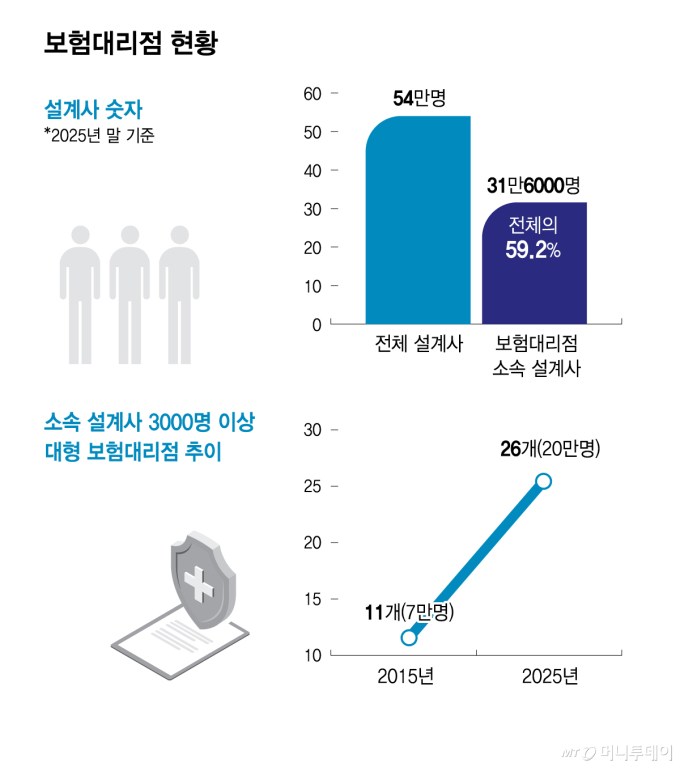
According to the insurance industry on the 22nd, as of the end of last year, there were 540,000 insurance agents, of which 310,000 belonged to GAs. More than half (59.2%) of the total are affiliated with GAs rather than insurance companies and handle products from multiple insurance companies, not just one specific insurer.
GAs are becoming super-large. The number of GAs with more than 3,000 affiliated agents increased by more than double from 11 in November 2015 to 26 at the end of last year. The number of agents belonging to these agencies also grew from 70,000 ten years ago to 200,000 last year. There are approximately 4,000 GAs in total, and more than half of them are large GAs with over 500 affiliated agents. Without GAs, the sale of insurance products would effectively come to a complete stop.
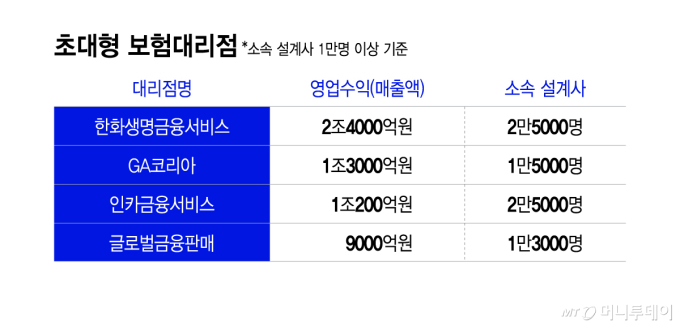
Super-large GAs with more than 10,000 affiliated agents include Hanwha Life Financial Services (25,000 agents), GA Korea (15,000 agents), Inka Financial Services (25,000 agents), and Global Financial Sales (13,000 agents). Given that exclusive agents for small and medium-sized insurance companies number at most 2,000 to 3,000, GAs already possess influence surpassing that of insurance companies. In fact, the annual sales of super-large GAs reach 1 trillion to 2 trillion won. Notably, Inka Financial Services saw its sales surge from 119.6 billion won in 2015 to nearly 1 trillion won (1.0218 trillion won) last year.
Despite GAs surpassing insurance companies in scale, the financial authorities have virtually no effective sanction measures. The Financial Supervisory Service determines sanctions against GAs based on the ratio of accident amounts to sales volume according to inspection and sanction regulations. If this ratio is less than 1%, a warning is issued; between 1% and less than 2%, operations are suspended for one month; and 2% or more results in a two-month suspension. Even if GAs commit serious illegal acts such as improper fund transfers or false contracts, their massive sales volume makes it impossible to impose severe penalties. In fact, a GA recently received a heavy penalty of 5.3 billion won in fines for false contracts but avoided suspension due to its large total sales volume.
More seriously, as the influence of GAs grows, the burden of recruitment commissions for insurance companies swells like a snowball. Insurance companies executed a total of 32 trillion won in recruitment commissions last year, recording an all-time high. Particularly, insurance companies with weak own channels have deepened their dependency on GA channels. They must unhesitatingly bear the high-level commissions demanded by GAs. Even major life insurance companies struggle to meet GA demands despite spending more than twice the scheduled business expenses. Some insurance companies have even paid sales commissions exceeding 30 times the monthly premium.
Unable to stand by any longer, the financial authorities applied a "1200% rule" to GAs starting in July, limiting them to no more than 12 times the monthly premium. However, loopholes were opened where economic benefits are provided indirectly, such as covering office interior costs instead of paying cash directly to agents or boosting sales through companies indirectly related to the GAs.
An insurance industry official stated, "They request travel subsidies under the guise of accompanying them on overseas trips or Jeju Island trips, or demand sponsorship by requiring attendance at GA annual award ceremonies, which is difficult to refuse." Another official lamented, "GAs even demand that we develop products with specific coverage they want. If we make them as requested, the loss ratio becomes serious, but we are stuck in a situation where we can neither do this nor that."
This is why there are calls for creating sanction standards at the level of insurance companies to match the changed status of GAs and finding fundamental measures to prevent excessive business expense execution. Insurance companies also diagnosed the situation, saying, "If we continue spending recruitment commissions like this, everyone will face mutual destruction," and "We have reached a point where we cannot stop on our own unless someone applies the brakes."
"If we leave insurance agencies (GAs) as they are, there will be no future for insurance. Changes at the level of reform are needed." (Financial authority official)
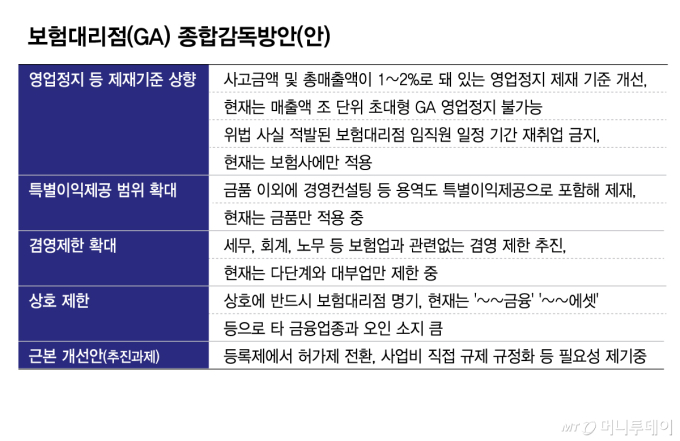
The financial authorities are preparing a comprehensive supervision plan for GAs at the "reform" level because they feel a crisis that if the GA problem is left unaddressed, the entire insurance industry could face mutual destruction. GAs are no longer simple channels outside of insurance companies; they now intervene in everything from product development to sales commissions (business expenses) of insurance companies. Yet, the regulatory level of the authorities remains stuck at 10 years ago, failing to secure even effective means to sanction super-large GAs. The insurance industry points out that for reform-level measures to emerge, there must be a fundamental shift to direct legal regulation and a licensing system for insurance business expenses (sales commissions).
According to the insurance industry on the 22nd, it is estimated that insurance companies executed approximately 32 trillion won in recruitment commissions last year. It is analyzed that most of these recruitment commissions went into the pockets of GAs, which account for 60% of channels. Particularly, since the introduction of new accounting standards (IFRS17), even if business expenses are incurred, costs are recognized over time until the insurance maturity date rather than at the point of execution, leading insurance companies to engage in bloody competition without brakes on business expense execution. They cannot refuse unreasonable demands from large GAs promising to sell more products.
The financial authorities deleted the regulation requiring "reasonable execution of business expenses within scheduled business expenses" from the Insurance Business Supervision Regulations in 2014. Since then, a vacuum has continued with no explicit direct regulation of business expenses codified in the Insurance Business Act. To prevent excessive business expense execution triggered by GAs, it is argued that the financial authorities must apply the brakes by reviving the clause previously deleted from the Insurance Business Act. It is pointed out that the window for insurance companies to reduce business expenses on their own has already passed.
The need to transition GAs to a licensing system is also raised. Currently, more than 4,000 GAs are scattered nationwide. Anyone can easily start operations simply by registering as a business and opening an office. It is possible to engage in other industries such as tax and labor services in addition to insurance. If sanctioned by the financial authorities, they can simply close down and put up a new signboard. Executives of sanctioned GAs are not subject to re-employment restrictions. Converting from a registration system to a licensing system would curb such disorderly situations to some extent.
The financial authorities recently announced plans to transition the purchased receivables collection industry, which buys overdue receivables for collection, from a registration system to a licensing system. Following President Lee Jae-myung's criticism of "cruel finance," the 911th collection agencies that proliferated were converted to a licensing system and reduced to around 30. The logic is to apply this to GAs as well. An insurance industry official stated, "By transitioning to a licensing system, we must require internal control levels commensurate with large GAs," adding, "This could also serve as a preliminary move to convert GAs into sales specialist companies in the future."

 in FINANCE


