

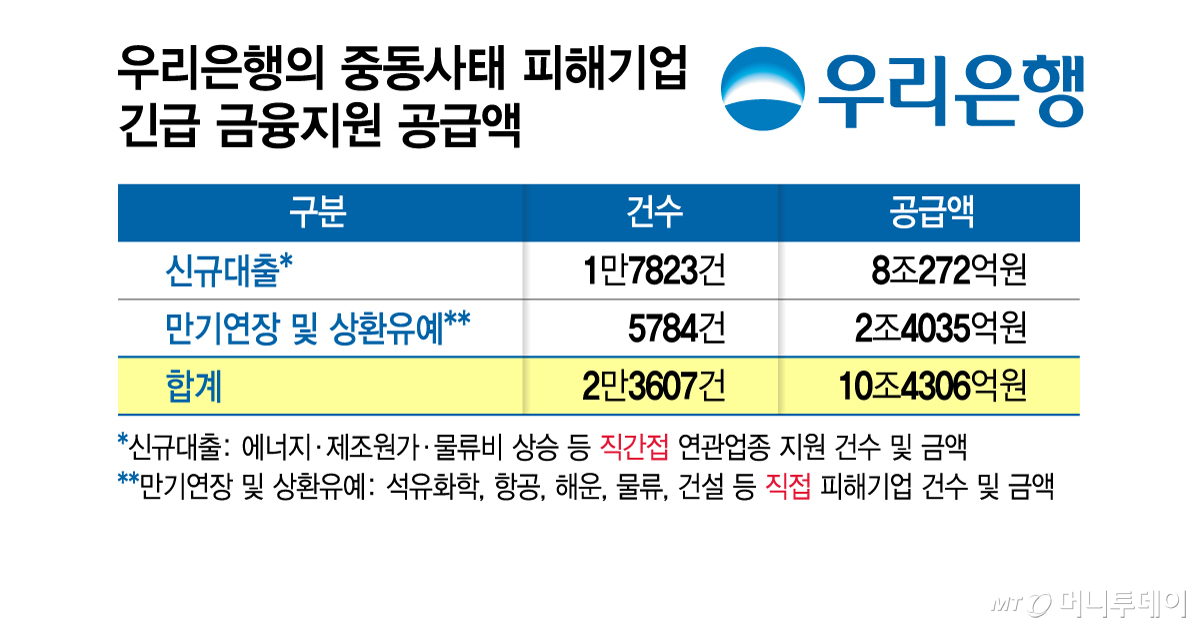
It has been revealed that Woori Bank has disbursed over 10 trillion won in emergency financial support to companies affected by the Middle East crisis, four months after the outbreak of war between the United States and Iran. Ninety-nine point nine percent of the support cases were concentrated on SMEs (small and medium-sized enterprises) and individual business owners. This is seen as an expansion of President Jung Jin-wan’s emphasized “productive finance,” which now extends beyond investments in advanced industries to providing liquidity that safeguards corporate production, exports, and supply chains amid geopolitical crises.
According to the financial sector on the 9th, Woori Bank provided new loans, maturity extensions, and repayment deferrals totaling 10.4306 trillion won across 23,607 cases to companies that suffered direct or indirect damage from the Middle East crisis between March 2 and the end of last month.
Of this total, new loans accounted for 8.0272 trillion won (17,823 cases), representing approximately 77 percent of all support. This indicates that the bank did not merely alleviate existing debt burdens but also responded to actual funding needs such as raw material purchases and logistics costs. Maturity extensions and repayment deferrals totaled 5,784 cases amounting to 2.4035 trillion won.
The scope of support was not limited to import-export companies directly trading with the Middle East. The coverage was expanded to include 36 specific industries affected by rising international oil prices, raw material costs, logistics disruptions, and shrinking consumer demand.
By industry, wholesale and commodity brokerage received the largest amount at 1.4151 trillion won (2,947 cases), reflecting the funding needs of distribution companies facing increased burdens on purchasing and operating capital due to rising raw material and product prices. Manufacturing of chemical substances and chemical products, which are directly exposed to fluctuations in international oil and raw material prices, followed with 1.3757 trillion won (1,108 cases). Construction projects by professional trades also received 913.7 billion won (2,508 cases). Support was also provided across machinery and equipment, food products, automobiles and parts, transportation and warehousing, and accommodation and restaurant sectors, covering production, distribution, logistics, and consumer services broadly.
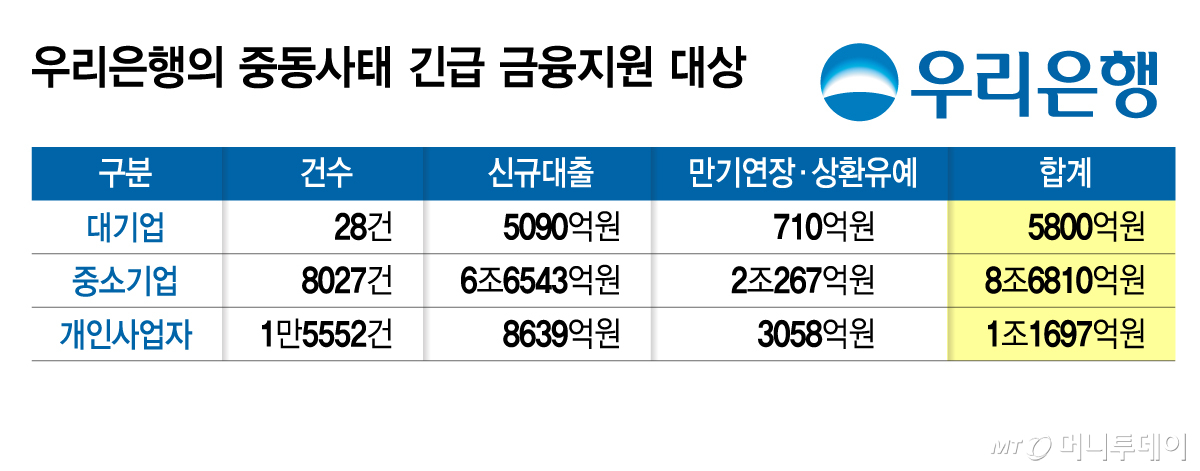
Out of the total 23,607 cases, 23,579 cases were allocated to SMEs (small and medium-sized enterprises) and individual business owners. On a case basis, this accounted for 99.9 percent, and on an amount basis, 94.4 percent, indicating that funding was primarily directed toward small and micro businesses relatively vulnerable to crises.
SMEs received a total of 8.681 trillion won, comprising 6.6543 trillion won in new loans and 2.027 trillion won in maturity extensions and repayment deferrals. Individual business owners received a total of 1.1697 trillion won, including 863.9 billion won in new loans and 305.8 billion won in maturity extensions and repayment deferrals. Support for large corporations amounted to 580 billion won. The bank focused on simultaneously providing new funding and alleviating repayment burdens on existing loans to prevent temporary liquidity shortages from escalating into production stoppages or management crises.
Woori Bank also took measures to manage the stability of trade transactions for companies doing business with the Middle East region. It closely monitored 164 cases involving export documentation shipments totaling 35.2 million dollars related to five Middle Eastern countries: the United Arab Emirates (UAE), Israel, Qatar, Kuwait, and Bahrain.
To ensure payment stability for import letters of credit opened prior to the outbreak of the Middle East crisis, Woori Bank changed the paying bank from its Dubai branch to its Hong Kong branch, managing 43 cases of import transactions totaling 3.1 million dollars. This move expanded the scope of support beyond merely providing loans to ensuring that actual corporate trade activities, including export documentation and letter of credit payments, proceeded without disruption.
This support is also significant in that it broadened the scope of productive finance emphasized by President Jung since taking office. It demonstrates that providing timely liquidity to enable companies to maintain production, exports, and employment amid global geopolitical crises is also a role of productive finance, alongside funding for advanced industries and future growth sectors.
A Woori Bank official stated, “In geopolitical crisis situations such as war, what companies truly need is not the announcement of support plans but funds disbursed on time.” The official added, “Moving forward, we will proactively identify companies in crisis and firmly support domestic industries and supply chains under the direction of productive finance.”

 in FINANCE

